Enterprise applications fail for the same reasons enterprise AI projects fail: the technology decisions get made before the strategic decisions, and the organizational complexity gets underestimated until it becomes a delivery problem.
A custom enterprise app built without a clear methodology for handling integrations, compliance, and long-term maintenance tends to become an expensive liability faster than it becomes a competitive asset.
This guide covers the full lifecycle of enterprise app development and deployment, from the early decisions that shape everything downstream to the post-launch support model that determines whether the investment holds its value over time.
What Separates Enterprise App Development From Standard App Development?
Enterprise app development requires a fundamentally different approach from building consumer or small business applications. While standard apps are often designed around a single user experience, enterprise applications must support complex business processes, multiple user groups, strict security requirements, and seamless integration with existing systems.
A successful enterprise mobile strategy focuses not only on building an app but on creating a scalable digital solution that improves workflows, connects business systems, and supports long-term organizational growth.
Enterprise Apps Are Built for Scale, Complexity, and Business Operations
Unlike consumer apps that typically serve individual users with similar needs, B2B mobile solutions are designed for organizations with hundreds or thousands of users across different departments, locations, and roles. Each user group may require different access levels, workflows, dashboards, and data permissions.
This complexity influences every stage of development, from user experience design and data architecture to authentication and role-based access control. A sales team, field employee, manager, and executive may all use the same corporate mobile app but require completely different features and levels of visibility.
Enterprise apps must also be built with scalability in mind. As organizations grow, their applications need to support increasing users, expanding data volumes, and evolving business requirements. This is why scalable enterprise apps are designed with flexible architectures that can adapt as business needs change.
Enterprise App Integration Is a Core Requirement, Not an Afterthought
Unlike standalone applications, enterprise apps rarely operate independently. They need to connect with existing business systems, including ERP platforms, CRM solutions, HR management systems, databases, cloud services, and third-party tools.
This makes enterprise app integration one of the most important considerations during development. Building integrations later often creates technical limitations, security risks, and costly redesigns.
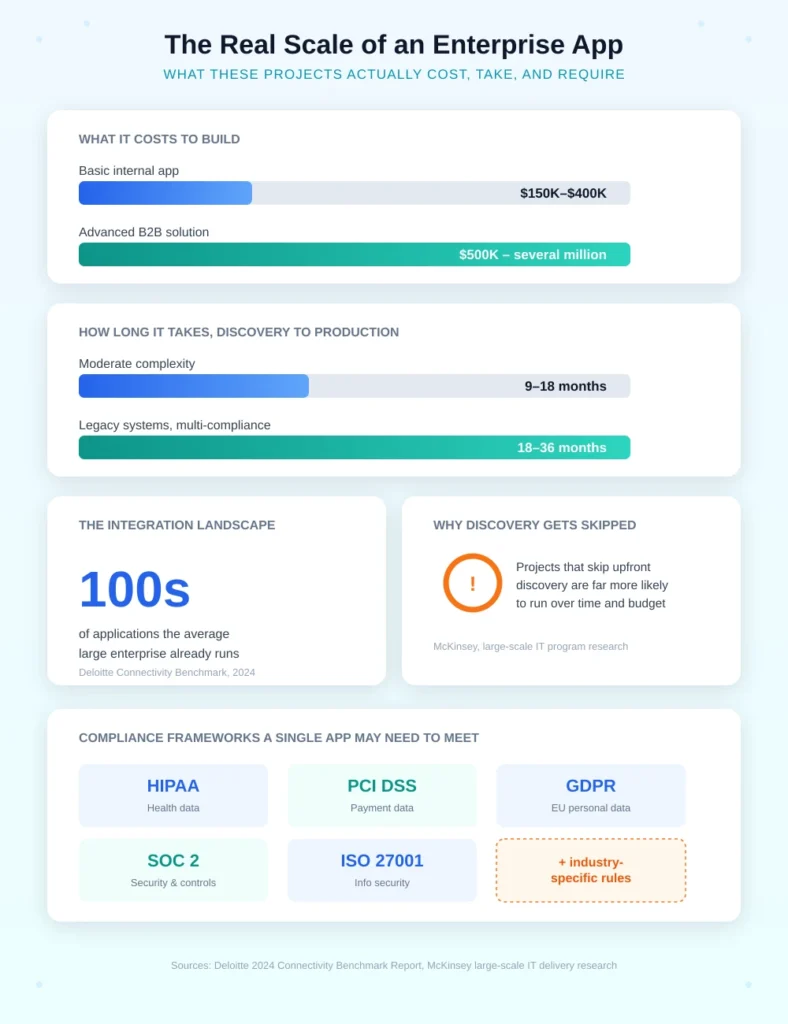
According to Deloitte 2024 Connectivity Benchmark Report, large enterprises operate hundreds of applications, making seamless connectivity a major challenge for digital transformation initiatives. Successful custom enterprise mobile software is therefore designed from the beginning to work within the organization’s existing technology ecosystem.
Security and Compliance Shape Enterprise App Architecture
Security is not simply an additional feature in enterprise applications. It is a core design requirement. Secure enterprise apps must protect sensitive business information while meeting industry regulations and internal security policies.
The security requirements for an application handling financial transactions differ from those for managing employee information or healthcare data. Depending on the industry and use case, enterprise apps may need to comply with standards such as SOC 2, HIPAA, GDPR, ISO 27001, or other regulatory frameworks.
These requirements influence decisions around authentication, data encryption, access controls, data storage, and monitoring from the earliest stages of development.
Enterprise Apps Require Long-Term Management and Evolution
Building an enterprise application is not the end of the process. Organizations need ongoing improvements, updates, security monitoring, and feature enhancements to ensure the application continues delivering value.
A structured enterprise app lifecycle management approach helps businesses manage every stage of the application journey from planning and development to deployment, maintenance, and future scaling.
The key difference between standard app development and enterprise app development is the focus. Standard apps are built to serve users; enterprise apps are built to support business operations. They must be secure, integrated, scalable, and adaptable enough to evolve alongside the organization.
What is a Proven Methodology for Enterprise App Development?
A methodology that works for enterprise app development is not a waterfall plan or an unconstrained agile process. It is a structured approach that combines upfront architectural rigor with iterative delivery, and that treats compliance, integration, and security as first-class concerns throughout rather than phases at the end.
Phase 1: Discovery and Requirements Definition
The discovery phase ensures the organization builds the right solution before investing in development. It includes mapping business workflows, gathering requirements from users and stakeholders, assessing existing systems and integration needs, and identifying compliance requirements. This phase uncovers hidden complexities early, helping define the right architecture, reduce costly changes later, and create a clear foundation for the enterprise app.
Phase 2: Architecture and Technical Design
The architecture phase defines how the application will operate at enterprise scale. It covers data architecture, integration strategy, security design, and deployment planning. Decisions around APIs, databases, authentication, encryption, and infrastructure determine whether the application can handle future growth, maintain performance, integrate with existing systems, and meet security requirements.
Phase 3: Iterative Development With Compliance Built In
Enterprise app development works best through structured sprints that deliver functional improvements while continuously validating security and compliance requirements. Instead of reviewing compliance at the end, teams assess data handling, access controls, encryption, and audit requirements throughout development. This approach reduces risks, prevents costly rework, and ensures the application remains aligned with business and regulatory standards.
Phase 4: Integration Testing and Enterprise QA
Enterprise testing goes beyond checking whether features work. It validates real-world performance, system integrations, security controls, and user workflows under realistic conditions. Testing includes API integration checks, load testing, vulnerability assessments, and user acceptance testing with actual business scenarios. Comprehensive QA helps reduce production issues, improve reliability, and lower long-term maintenance costs.
Phase 5: Deployment and Rollout Strategy
Enterprise app deployment requires careful planning beyond simply launching the application. A successful rollout includes user training, change management, performance monitoring, and phased adoption. Starting with a pilot group allows organizations to identify workflow issues, collect feedback, and resolve challenges before expanding the solution across the entire business.
How Do You Handle Enterprise App Integration With Existing Systems?
Enterprise app integration is where the complexity of the technical environment translates into real delivery risk. The most common reason enterprise app projects run over budget and over schedule is integration surprises discovered during development rather than during the technical environment assessment.
Mapping Integration Points Before Development Begins
Every system the enterprise app needs to connect to should be documented during discovery: what data flows in each direction, at what frequency, in what format, and through what mechanism. Systems with well-documented APIs are straightforward to integrate. Systems with legacy data formats, undocumented APIs, or no API at all require more creative approaches, sometimes including middleware layers or data transformation pipelines that add scope and timeline.
Middleware and Enterprise Integration Platforms
For enterprises with many systems to integrate, a middleware layer or enterprise integration platform provides a cleaner architecture than point-to-point connections between every system. Different app development platforms like MuleSoft, Azure Integration Services, and AWS EventBridge provide pre-built connectors for common enterprise systems and event-driven integration patterns that handle the asynchronous communication requirements that real-time integration with ERP and CRM systems typically demand.
Managing Data Consistency Across Systems
One of the more difficult integration problems in enterprise app development is maintaining data consistency when the same data exists in multiple systems. An employee record that exists in HRMS, the enterprise app, and the CRM platform needs consistent definitions and update propagation to prevent the data conflicts that erode user trust in any enterprise system. Defining the system of record for each data domain and designing integration flows that respect those boundaries is a design decision that needs to happen at the architecture phase.
The Hidden Scope of Enterprise App Projects
What Does Enterprise App Compliance Actually Require?
Enterprise app compliance is not a single checklist that applies to every application. The requirements depend on the industry, location, type of data being processed, and the security expectations of the organization using the application.
For businesses developing secure enterprise apps, compliance must be considered from the beginning of the development process to ensure the application is secure, scalable, and ready for enterprise adoption.
Understanding Industry-Specific Compliance Requirements
Different industries follow different compliance frameworks based on the type of information their applications handle.
- Healthcare applications managing sensitive patient information must comply with regulations such as HIPAA, which requires strong data protection measures, access controls, audit logging, and secure handling of protected health information.
- Financial applications processing payment information must meet PCI DSS requirements, including encryption, network security controls, vulnerability testing, and secure payment data management.
- Applications handling personal information of users in the European Union must follow GDPR requirements, including consent management, data access rights, and transparent data processing practices.
- Many enterprises also require SOC 2 Type II compliance before adopting third-party software, as it demonstrates that an application follows established standards for security, availability, confidentiality, and operational controls.
- For custom enterprise mobile software, these compliance requirements directly influence technical decisions around data storage, authentication, encryption, integrations, and user permissions.
Building Compliance Into the Enterprise App Development Process
Compliance should not be treated as a final review step before deployment. In successful enterprise mobile strategy planning, security and compliance requirements are built into the application architecture from the earliest stages.
For example, adding encryption after a database structure is finalized may require significant redesign. Similarly, implementing audit tracking after authentication systems are built may require major changes to the application architecture.
By incorporating compliance into planning, architecture, and development phases, organizations can avoid costly rework, reduce security risks, and create scalable enterprise apps that meet regulatory requirements from day one.
Creating Secure and Future-Ready Enterprise Applications
A strong compliance approach supports more than regulatory approval. It builds trust with employees, customers, and business partners. Through proper enterprise app lifecycle management, organizations can continuously monitor security, update compliance controls, and adapt to changing regulations.
The most successful enterprise applications are designed with compliance, security, and scalability as core foundations rather than additional features added after development. This approach enables businesses to build reliable corporate mobile apps that integrate securely with existing systems and support long-term growth.
What Is the Timeline for Enterprise App Development?
The timeline for enterprise app development varies significantly based on the application’s complexity, integration requirements, compliance needs, data readiness, and rollout strategy. Unlike standard applications, enterprise solutions often involve multiple systems, user groups, and business processes that require extensive planning and testing.
A moderately complex custom enterprise mobile software solution with several system integrations, role-based access control, and standard security requirements typically takes 9–18 months from discovery to production deployment.
More complex scalable enterprise apps involving legacy system integrations, multiple compliance frameworks, large user bases, and organization-wide adoption can take 18–36 months to fully develop and deploy.
The biggest factors affecting timelines are usually data readiness and integration complexity. Organizations with well-documented systems, clean data, and established APIs can move faster, while businesses managing outdated systems or fragmented data often require additional time for preparation and integration.
What Factors Influence the Cost of Enterprise App Development?
The cost of developing an enterprise application depends on the scope, technical complexity, and level of customization required. Unlike consumer apps, enterprise solutions often require advanced security, integrations, compliance controls, and ongoing management capabilities.
Basic internal applications with limited integrations and smaller user groups may cost around $150,000–$400,000. More advanced B2B mobile solutions with extensive integrations, compliance requirements, enterprise-level security, and large-scale deployment can range from $500,000 to several million dollars.
The primary cost drivers include:
- Enterprise app integration with existing ERP, CRM, HR, and legacy systems
- Data preparation and migration requirements
- Security and compliance implementation
- Custom features and workflow complexity
- User training and change management
- Long-term enterprise app lifecycle management
Investing in detailed discovery and planning early can significantly reduce unexpected costs. According to McKinsey research on large-scale technology programs, initiatives that prioritize thorough upfront discovery are significantly more likely to stay on schedule and within budget compared to projects that begin development without fully understanding requirements.
A well-planned enterprise mobile strategy helps organizations control costs, reduce development risks, and create secure enterprise apps that deliver long-term business value.
What Post-Development Support Does a Production Enterprise App Require?
The deployment date is not the end of the enterprise app lifecycle. It is the beginning of the operational phase, which for a well-built enterprise application typically runs for years. The support model for that operational phase needs to be defined before deployment, not after the first production incident.
Ongoing Maintenance and Performance Management
Enterprise apps require ongoing maintenance across several categories. Security patching keeps the application protected against newly discovered vulnerabilities. Dependency updates keep the underlying libraries and frameworks current. Performance monitoring identifies degradation before it affects user experience or business operations. And capacity management ensures the application scales as user populations and data volumes grow.
Feature Evolution and Version Management
Enterprise applications are not static. Business processes change, regulatory requirements evolve, and the organizational needs that shaped the original requirements will shift over time. A support model that includes a defined process for evaluating, prioritizing, and implementing feature changes, with appropriate version management and rollout planning, prevents the technical debt accumulation that eventually forces expensive rewrites.
The Total Cost of Ownership Perspective
Understanding enterprise app development as a total cost of ownership calculation rather than a single project budget produces better decisions throughout the lifecycle. An application built with thorough documentation, clean architecture, and comprehensive test coverage costs more to build and significantly less to maintain and evolve than one built to hit a deadline.
Building Enterprise Apps That Deliver Long-Term Value
Successful enterprise applications are built on strong foundations: scalable architecture, secure design, seamless integrations, and a development approach that considers long-term business needs. By treating compliance, security, and scalability as core requirements from the beginning, organizations can reduce risks and create applications that continue delivering value as they grow.
A structured enterprise app development methodology does not eliminate every challenge, but it ensures risks are identified early and managed effectively.
To build secure, scalable, and business-ready enterprise applications, Rocketeams helps organizations design, develop, and scale custom enterprise mobile solutions that align with their technology goals and long-term growth.
FAQs
What is your methodology for developing scalable and secure enterprise applications?
Our enterprise app development approach follows five phases: discovery, architecture, development, testing, and deployment. We build scalable enterprise apps with security, integrations, and compliance requirements embedded from the beginning.
How do you ensure enterprise applications meet industry compliance requirements?
We integrate compliance requirements into every stage of the enterprise app lifecycle management process. Our secure enterprise apps are designed with industry standards, security controls, and compliance checkpoints from the start.
What is the typical cost and timeline for developing a complex enterprise application?
Complex custom enterprise mobile software projects typically range from $500,000 to several million dollars and take 18–36 months. Timelines and costs depend on integrations, data readiness, and the complexity of the enterprise mobile strategy.
Can you share examples of successful enterprise app development projects?
We have delivered B2B mobile solutions that improved operational efficiency, automated workflows, and unified enterprise data. Our corporate mobile apps help organizations streamline processes and achieve measurable business transformation.
What support and maintenance services do you provide after launch?
Our ongoing support includes security updates, performance monitoring, system improvements, and feature enhancements. Through structured enterprise app integration and lifecycle management, we help businesses maintain reliable applications that evolve with their needs.