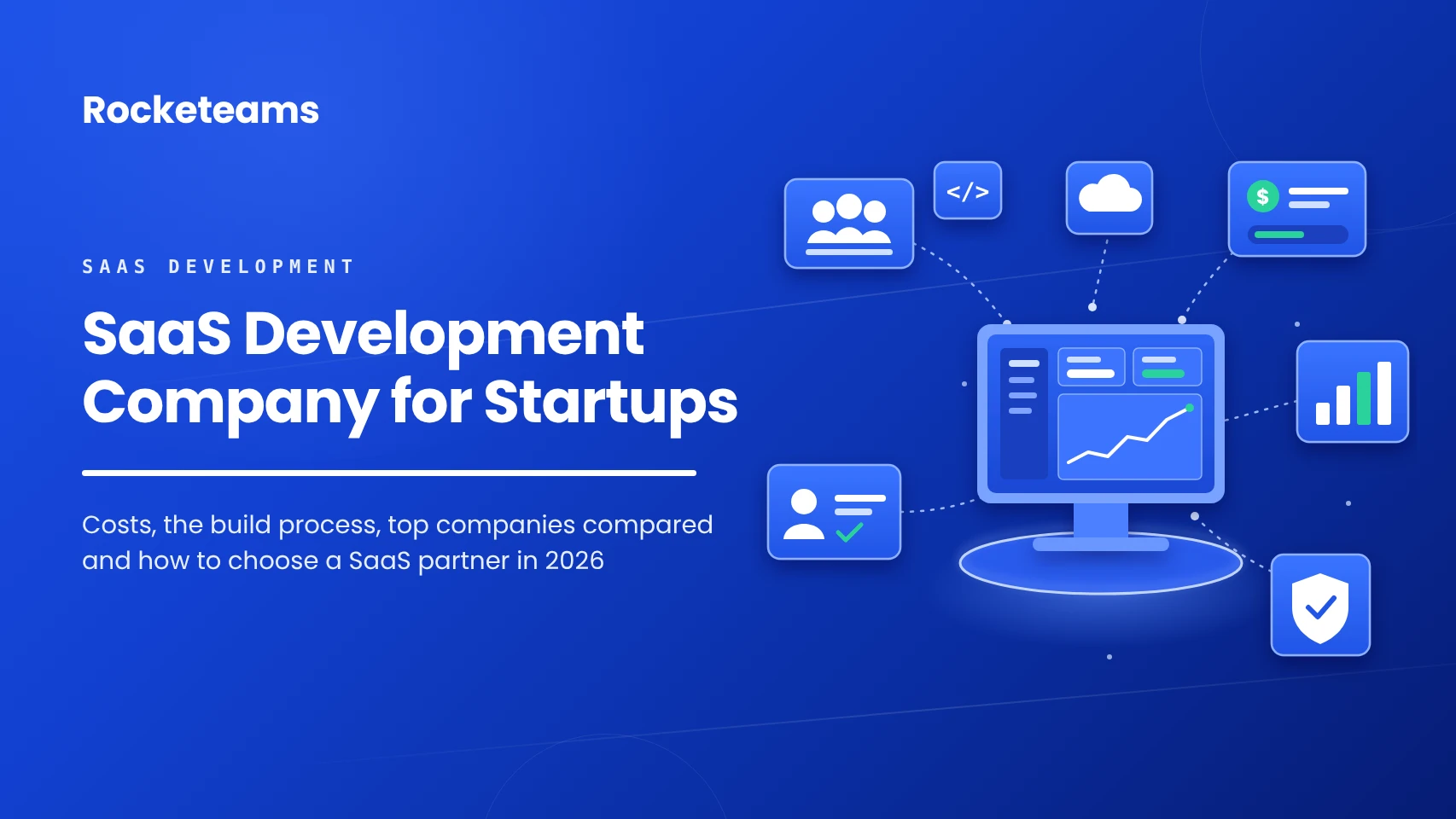
If you are a US founder with a SaaS idea and no engineering team yet, choosing a SaaS development company is probably the biggest call you will make before launch. A good partner gets a working product in front of paying users within a few months, while a poor fit can eat most of a seed round in rework. This guide covers what these firms actually do, what custom SaaS development costs in 2026, how the build process runs, and how the top SaaS development companies compare on price and minimums, so you can decide with real numbers rather than sales decks.
Quick Answer
In 2026, a SaaS MVP built for a US startup usually costs $20,000 to $60,000 with a managed offshore team and $80,000 to $260,000 with a US agency, and takes three to five months. The biggest cost drivers are team location, the number of integrations, and how much multi-tenant and security work the product needs on day one.
Rocketeams (managed)
$20k to $60k
SaaS MVP at $25 to $40/hr
US agency
$80k to $260k
SaaS MVP at $100 to $175/hr
Typical timeline
3 to 5 months
Discovery to launch
US developer salary
$135,980/yr
BLS median, May 2025
Estimates for a typical B2B SaaS MVP as of October 2026.
What Does a SaaS Development Company Do?
A SaaS development company designs, builds, tests and maintains cloud software that customers pay to use through a browser, a mobile app or an API. The difference from a general web agency is that the product has to serve many paying customers from one codebase, keep each customer’s data separate, bill them on a subscription, and stay online around the clock.
That changes how the work is done. SaaS developers spend a lot of their time on things a brochure website never needs: tenant isolation, role-based permissions, subscription billing, usage limits, audit logs, uptime monitoring and a release process that does not break things for existing customers. A team that has only built marketing sites or one-off internal tools will usually underestimate this part of the job, and that is where most budget overruns come from.
For a startup, the partner typically covers the full journey from an idea on a whiteboard to a launched product, then stays on to ship new features after launch. Some founders hand over the entire build, while others keep a technical cofounder in charge and bring in a team to do the heavy lifting.
Core SaaS Development Services Startups Actually Need
Most SaaS development services pages list the same dozen items. In practice, an early-stage startup needs a smaller set done well, and the rest can wait until there are paying customers. These are the SaaS application development services worth paying for in your first year:
- Product discovery: turning your idea into user stories, a feature list for the MVP, and a rough budget and timeline before any code is written.
- UX and UI design: clickable prototypes you can show to early customers and investors, plus a design system the developers can build from.
- Multi-tenant architecture: deciding how customer data is separated, how accounts and roles work, and which cloud setup (AWS, Google Cloud or Azure) fits your budget.
- Front-end and back-end development: the actual product, usually built with React or Next.js on the front end and Node.js, Python or .NET on the back end.
- Billing and subscriptions: plans, trials, invoices and dunning, normally through Stripe or a similar provider.
- Integrations: the CRMs, payment tools and data sources your customers already use, which are often what makes a B2B product sellable.
- QA and security: automated tests, access controls and the groundwork for SOC 2 if you plan to sell to mid-market or enterprise buyers.
- DevOps and maintenance: CI/CD pipelines, monitoring, backups and an agreed process for bug fixes after launch.
If a vendor’s proposal skips billing, multi-tenancy or QA, ask why. Those are the parts that are expensive to retrofit later.
Custom SaaS Development vs Off-the-Shelf and No-Code Tools
Not every startup needs custom SaaS development on day one. If you are still testing whether anyone will pay, a no-code prototype or a white-labeled tool can validate demand for a few thousand dollars. The trade-off shows up once real customers arrive, because no-code platforms tend to hit limits on data separation, performance, integrations and pricing control.
Custom SaaS development services make sense when the product itself is your competitive edge, when you need to own the code and IP for fundraising, or when your buyers will ask security and compliance questions that a third-party builder cannot answer. A common path for funded startups is to validate with a lean MVP, then rebuild the parts that matter on a custom stack once the first contracts are signed. Our guide to MVP development cost breaks down what that first version should include and what it should leave out.
How Much Does SaaS Development Cost in the USA in 2026?
Team location drives cost more than any feature on your list. According to the US Bureau of Labor Statistics, the median annual wage for software developers was $135,980 in May 2025, and employment is projected to grow 10% from 2025 to 2035, much faster than the average for all jobs. Add roughly 30% for benefits and payroll taxes, and a small in-house team of four engineers costs well over $700,000 a year before recruiter fees, equipment or a single line of shipped code.
That is why so many founders look at outsourcing SaaS development instead. The table below compares typical project budgets for a managed offshore team at $25 to $40 an hour against a US agency at $100 to $175 an hour.
| Product stage | What it includes | Typical hours | Rocketeams managed team ($25 to $40/hr) | US agency ($100 to $175/hr) | Timeline |
|---|---|---|---|---|---|
| SaaS MVP | Core workflow, sign-up and login, one pricing plan, admin panel | 800 to 1,500 | $20,000 to $60,000 | $80,000 to $260,000 | 3 to 5 months |
| Version 1 product | Multi-tenant accounts, roles, 3 to 5 integrations, analytics, Stripe billing | 2,000 to 3,500 | $50,000 to $140,000 | $200,000 to $610,000 | 6 to 9 months |
| Enterprise-ready platform | SSO, audit logs, SOC 2 groundwork, high-availability infrastructure | 4,000 to 7,000 | $100,000 to $280,000 | $400,000 to $1.2M | 9 to 15 months |
| Ongoing maintenance | Bug fixes, updates, monitoring, small features | Per year | About 15% to 20% of build cost | About 15% to 20% of build cost | Ongoing |
Hour ranges are estimates for a typical B2B SaaS product as of October 2026. Rates are rounded.
The hourly rate is only half the picture. A low quote from a freelancer can still cost more once you add your own management time, missed deadlines and rework. For a full comparison of rates by country and seniority, see our breakdown of app developer hourly rates.
The SaaS Product Development Process, Step by Step
The SaaS development process looks similar across most good partners, even if the names of the phases differ. Here is how a well-run SaaS development company takes a startup from idea to launch, and what you should expect to see at each step.
- Discovery (2 to 4 weeks). The team interviews you, maps user journeys and writes the MVP scope. You should leave this phase with a prioritized backlog, a technical plan and a budget range you can take to your board.
- UX and UI design (3 to 6 weeks). Designers build wireframes and a clickable prototype. Test it with five to ten target customers before development starts, because changes are cheap at this stage and expensive later.
- Architecture and setup (1 to 2 weeks). Engineers choose the stack, set up the cloud environment, decide how tenant data is separated and build the CI/CD pipeline so every change is tested before it ships.
- Sprint-based development (8 to 16 weeks for an MVP). Work runs in two-week sprints with a demo at the end of each one. You should be able to click through new features every two weeks, not wait months for a big reveal.
- QA and security testing (runs alongside development). Automated and manual tests cover core flows, permissions and billing. A short penetration test before launch is worth the cost if you handle customer data.
- Launch (1 to 2 weeks). The product goes live with monitoring, error tracking and a rollback plan in place. Early customers get onboarded while the team watches for issues.
- Iterate after launch. Real usage data replaces guesses. The team ships improvements based on what customers actually do, and the roadmap is reprioritized every month or so.
If you want to validate the riskiest technical idea before committing to the full build, a short proof of concept or MVP engagement can answer that question in a few weeks.
Top SaaS Development Companies for US Startups Compared
Public hourly rates and minimum project sizes tell you a lot about who a firm is built to serve. Several well-known names only take projects of $25,000 or $50,000 and up, which can rule them out for a pre-seed MVP. The table below compares rates and minimums listed on Clutch as of October 2026.
| Company | Hourly rate | Minimum project | Best fit | What is included |
|---|---|---|---|---|
| Rocketeams Most affordable | $25 to $40/hr | No minimum; start with one engineer | Seed and Series A startups building their first SaaS product | Top 1% vetted engineers, project lead, QA, sprint planning and payroll, 2-week risk-free trial |
| Itransition | $25 to $49/hr | $25,000+ | Mid-size and enterprise software projects | Full-cycle development and consulting |
| Appinventiv | $25 to $49/hr | $50,000+ | Funded companies with larger app budgets | Design, web and mobile development |
| ScienceSoft | $50 to $99/hr | $5,000+ | Companies needing compliance and security-heavy work | Consulting, development and testing |
| Intellias | $50 to $99/hr | $50,000+ | Larger product engineering programs | Product engineering and team augmentation |
| Typical US agency | $100 to $250/hr | Varies, often $50,000+ | Startups that need onshore teams for legal or contract reasons | Full team and project management |
Competitor rates and minimums from each firm’s Clutch profile as of October 2026. Rocketeams rates reflect a blended managed-team rate.
For startups building B2B products specifically, our SaaS and B2B development team works with the integrations, permissions and billing models that business buyers expect.
How to Choose the Best SaaS Development Company
The right partner for your startup is the one whose team has shipped products like yours, at a price that leaves you runway to find product-market fit. Ratings and award badges help with a shortlist, but the questions below are what separate a reliable partner from an expensive lesson.
- Have they shipped multi-tenant SaaS before? Ask to see a live product, not a mockup, and ask how they handled tenant data, roles and billing.
- Who owns the code and IP? Your contract should assign all code, designs and documentation to your company from the first commit. Investors will check this during due diligence.
- Who will actually work on your product? Meet the engineers, not just the sales team, and ask how they handle turnover if someone leaves mid-project.
- How much time-zone overlap will you get? Four or more hours of overlap with US working hours makes daily standups and quick decisions possible.
- How is pricing structured? Fixed price suits a tightly defined scope, while time and materials works better when you expect to learn and change direction. Many startups mix the two.
- What do security and QA look like? Ask about automated test coverage, code reviews and how they would prepare you for a SOC 2 audit later.
- Can you start small? A paid trial or a single engineer for a few weeks lets you judge output and communication before signing a large contract.
A partner that answers these clearly, and puts the answers in the contract, is usually a safer bet than a bigger brand that will not let you meet the team. If you are still weighing whether to hire or outsource, our software development outsourcing guide and our guide on how to hire software engineers in the USA walk through both routes in more detail.
Should You Work With an AI SaaS Development Company?
Most SaaS products launched in 2026 include some AI, whether that is a chat assistant, document summaries, smart search or automated data entry. You do not need a specialist AI SaaS development company for that, but you do need a team that knows how to call model APIs safely, control costs per request, and keep customer data out of places it should not go.
The practical test is simple. Ask the vendor how they would cap your monthly AI spend, how they would evaluate whether the AI feature is actually accurate, and what happens to customer data that passes through a third-party model. A team that answers those three questions well can usually build the rest.
Why US Startups Choose Rocketeams
Rocketeams builds SaaS products for US startups through fully managed offshore engineering teams. Our engineers are top 1% vetted, AI-matched to your stack, and managed by us from sprint planning through payroll, so you get one point of contact and predictable monthly costs instead of a pile of freelancer invoices.
A managed team costs $25 to $40 an hour with project management and QA included, which is roughly a third of US rates. You can start with a single developer or hand over the full build, and every engagement starts with a 2-week risk-free trial. Founders who want a team for the whole journey, from discovery to launch and beyond, can see how it works on our product development page.
Conclusion
Building a SaaS product in 2026 does not have to mean spending a year hiring or handing most of your seed round to an onshore agency. Start with a tight MVP scope, insist on owning your code from day one, and compare partners on fully loaded cost rather than the hourly rate on the first page of a proposal. Look for a team that has shipped multi-tenant products, gives you real overlap with US hours and lets you start with a small paid trial. If you would like a quote for your own roadmap, our team can scope your product and show you what a SaaS development company with managed offshore engineers would cost in practice. Book a consultation and we will price it against your scope.
FAQs
What Is a SaaS Development Company?
It is a firm that designs, builds and maintains cloud software that customers subscribe to and use through a browser, app or API. Beyond coding, it handles multi-tenant architecture, subscription billing, security and the ongoing releases a live product needs.
What Is a SaaS Developer?
A SaaS developer is a software engineer who builds subscription software that runs in the cloud. Day to day, that means working on features plus the parts specific to SaaS, such as account and role management, billing, data separation between customers and uptime monitoring.
Does SaaS Need Coding?
A simple prototype can be built with no-code tools, but almost every SaaS product with paying customers runs on custom code. Coding gives you control over performance, integrations, security and pricing, and it lets you own the IP that investors look at.
Is ChatGPT a SaaS?
Yes. ChatGPT is delivered over the internet, runs on the provider’s servers and is sold through monthly subscription plans, which are the defining traits of software as a service. Its API is also sold on a usage basis to other software companies.
Is Netflix a SaaS?
Not in the usual sense. Netflix is a subscription streaming service that delivers content rather than software you use to get work done, so it is normally grouped with media subscriptions rather than SaaS.
Will AI Replace SaaS?
AI is changing what SaaS products do rather than replacing them. Most new SaaS tools now ship with AI features built in, and AI products themselves are usually sold as SaaS subscriptions, so the delivery model is still very much alive.
What SaaS Is in High Demand?
In 2026, demand is strong for vertical SaaS built for one industry, such as fintech, healthtech, real estate and logistics, as well as AI-assisted workflow tools, compliance software and B2B products that plug into existing CRMs and payment systems.
Which Type of SaaS Is Best for a Startup?
Vertical B2B SaaS is often the safest bet for a new startup because the buyers are easier to find, the problems are specific and contracts tend to be larger. Horizontal tools for everyone face heavier competition and higher marketing costs.
How Much Does It Cost to Build a SaaS MVP?
A SaaS MVP usually costs $20,000 to $60,000 with a managed offshore team and $80,000 to $260,000 with a US agency, depending on features, integrations and how much security work is needed at launch.