The numbers behind mobile apps in 2026 are hard to ignore. Global users are projected to spend 5.5 trillion hours in apps by the end of this year. Combined app revenue across Google Play and the Apple App Store surpassed $935 billion in 2025, a 52% increase from 2023.
And the average U.S. smartphone user now interacts with around 18 different apps per day, logging 75 to 200 app sessions daily, according to RealityMine’s July 2025 privacy-first consumer tracking data.
What those numbers do not show is the structural shift underneath them. The mobile app market is maturing. Download growth is stabilizing. Retention rates remain challenging, with 30-day retention dropping to 2 to 6% across most app categories. And user expectations for performance, personalization, and privacy have risen faster than most development teams have adapted.
The top mobile app development trends in 2026 reflect that maturity. They are less about new features and more about how apps are built, how AI is embedded at the architecture level, how cross-platform tooling has changed the cost equation, and what security and privacy compliance now requires. This guide covers all of it.
What is the State of the Mobile App Market in 2026?
Before exploring the latest mobile app development trends, it’s important to understand the market forces shaping them. The mobile ecosystem in 2026 is defined less by rapid expansion and more by competition, user attention, and product quality.
A Market Focused on Depth, Not Volume
The global app ecosystem has reached a maturity stage. The combined number of active apps across the Apple App Store and Google Play has stabilized at roughly 4.1 million apps.
- Google Play hosts around 2.87 million apps
- Apple’s App Store has approximately 1.96 million apps
New app releases are slowing, partly due to stricter platform policies. For example, Google introduced tighter quality standards in 2024 that reduced low-quality listings while continuing to increase revenue through subscriptions and in-app purchases. Building a custom mobile app in the USA involves multiple cost factors, including design, development, features, and maintenance.
As a result, the biggest challenge in 2026 is no longer publishing an app, it’s getting users to discover and keep using it. Apps that succeed today typically share three characteristics:
- Strong product–market fit
- High early engagement
- Retention systems that keep users active beyond day 30
The Mobile Attention Bottleneck
Another defining feature of the market is the concentration of user attention. RealityMine’s 2025 consumer behavior data shows that while the average U.S. smartphone user interacts with around 18 apps per day, the majority of screen time is concentrated in just a handful of platforms.
Nearly half of total mobile usage occurs within six apps:
- TikTok
- Safari
- YouTube
- Google Chrome
For new apps, this creates a clear challenge: they must compete for the limited remaining share of user attention. As a result, successful apps focus less on maximizing downloads and more on delivering consistent value to a specific user group. Apps designed to solve a recurring, focused problem tend to outperform broad platforms with generic use cases.
The Rise of the AI App Economy
AI-powered apps are one of the fastest-growing segments of the mobile ecosystem. According to Business of Apps data, generative AI applications grew from 100 million downloads in 2022 to 3.6 billion downloads in 2025.
Adoption has been rapid. For example, the ChatGPT mobile app doubled its U.S. user penetration from 9% to 20% between January and July 2025, while time spent on the app increased ninefold.
AI consultancy helps businesses identify, implement, and scale AI solutions while ensuring transparency and accountability through explainable AI practices.

Top 5 Mobile App Development Trends in 2026
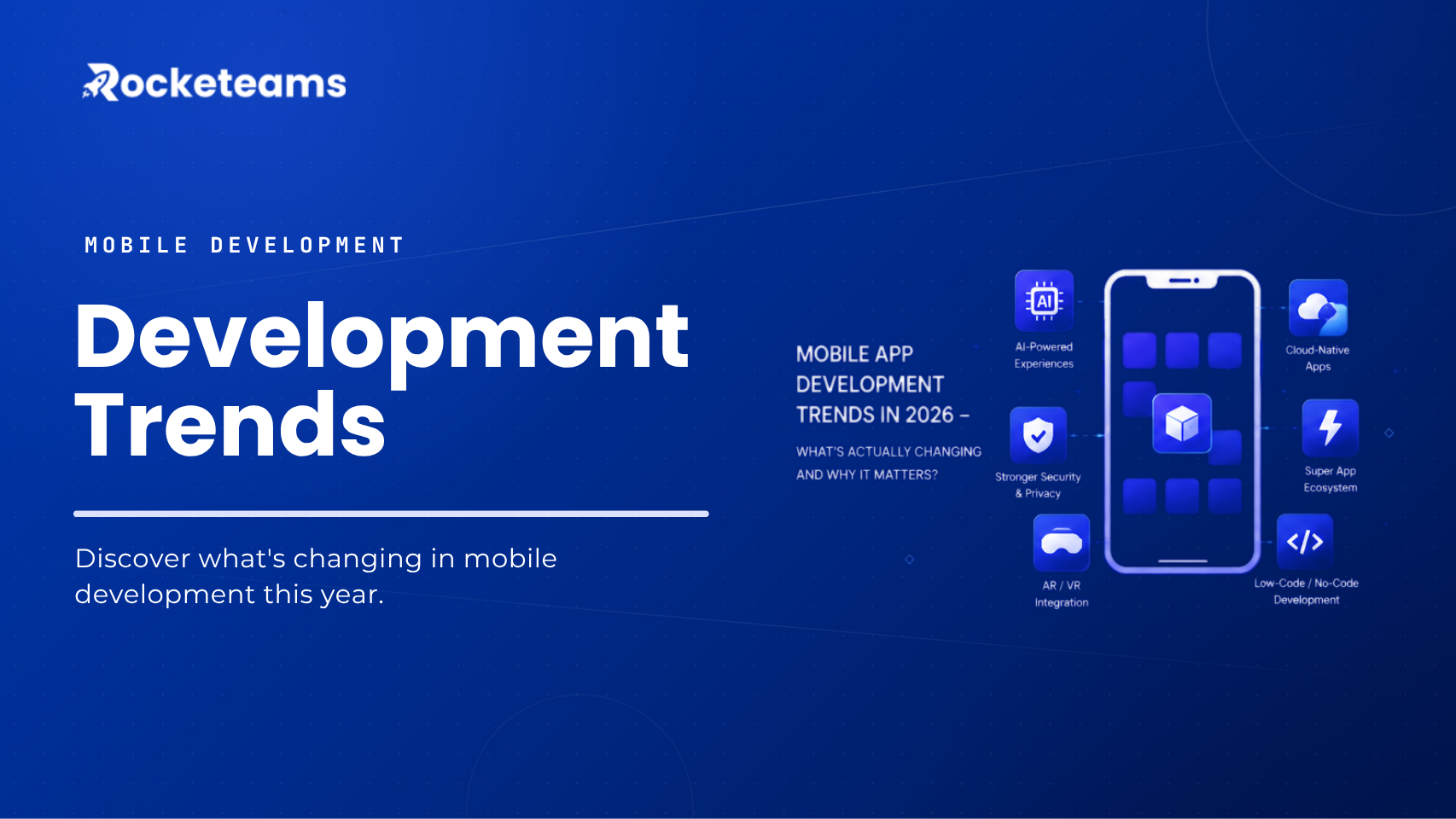
The mobile ecosystem is evolving quickly, and the top mobile app development trends in 2026 reflect how both technology and user expectations are changing. These trends are already visible in leading products and are expected to shape mobile development strategies for the next several years.
1. AI-Native Architecture Is Becoming the Standard
One of the most significant shifts in mobile development is the transition from adding AI features to building AI-native applications.
According to CMARIX development statistics, 63% of mobile developers now integrate AI features, and 70% of mobile apps use AI to enhance user experience. Gartner also predicts that 40% of enterprise applications will include task-specific AI agents by the end of 2026, compared to less than 5% in 2025. In practice, AI-native architecture allows apps to continuously learn from user behavior, personalize content and recommendations in real time, and predict user needs before explicit interaction.
Platforms like Spotify and Netflix pioneered these models, but modern APIs and pre-trained models now make AI-driven experiences accessible to development teams of all sizes.
2. Low-Code and No-Code Are Expanding Beyond Internal Tools
Low-code development is rapidly moving from simple prototypes to production-grade application development. Forrester reports that 87% of enterprise developers already use low-code platforms in their workflow. The market growth reflects this shift. The global low-code market is expected to expand from $37.39 billion in 2025 to $264.40 billion by 2032.
Modern platforms like Retool and Lovable now allow teams to validate product ideas faster, build internal tools quickly, and launch new features without full engineering cycles. For many companies, low-code platforms are becoming part of the product development stack rather than just a prototyping tool.
3. Edge Computing and Offline-First Apps Are Gaining Momentum
Performance and reliability are becoming core competitive factors in mobile apps. This is driving the adoption of edge computing and offline-first architecture, where data processing occurs directly on the device rather than relying entirely on cloud servers.
Processing data locally offers several advantages, like faster response times, improved privacy, and continued functionality with limited connectivity.
This architecture is particularly valuable in sectors like healthcare, finance, and education. For example, wearable health apps can process sensor data directly on the device, enabling real-time monitoring without transmitting raw patient data to the cloud.
Similarly, the mobile learning market, projected to reach $58.5 billion by 2029, increasingly relies on offline-capable apps that allow users to continue learning even without stable internet access.
4. 5G is Enabling Real-Time Mobile Experiences
The continued rollout of 5G networks is expanding what mobile applications can deliver in real time. Higher bandwidth and lower latency are enabling new types of experiences, including AR and VR interactions, high-definition video streaming, real-time multiplayer gaming, and remote collaboration tools.
Enterprise applications are also benefiting. Examples include AR-assisted equipment inspections, telemedicine platforms with real-time diagnostic video, and field-service tools that stream data instantly.
The global AR/VR market is expected to exceed $220 billion by 2026, with mobile devices playing a major role in that growth. However, development teams still need to design for network variability, ensuring apps perform smoothly across LTE, Wi-Fi, and 5G environments.
Mobile App vs Web App – The Development Decision in 2026
The mobile app vs web app debate has become clearer as user behavior continues to shift toward native experiences. According to 2025 usage data stats, 90% of mobile screen time now occurs in apps rather than mobile browsers.
Mobile apps also deliver significant performance advantages because they can store data directly on the device. Compared to mobile websites, apps typically load 2 to 3 times faster, provide smoother user experiences, and generate higher engagement and retention.
E-commerce data highlights the business impact as well. App users spend an average of $95 per order, compared to $73 on mobile web, and overall conversion rates tend to be higher. Choosing between resource augmentation and staff augmentation depends on your project needs, scalability goals, and level of control required.
Web apps still serve important roles, particularly for SEO-driven discovery or content-heavy platforms. However, for transactional products, subscription services, and high-engagement experiences, native or cross-platform mobile apps consistently deliver stronger results.

What These Mobile App Development Trends Mean for Product Teams?
Taken together, the mobile app development trends of 2026 point toward a clear direction. Successful apps are increasingly built around AI-native architecture, high-performance, offline-capable engineering, and security and privacy built into the foundation.
The market environment reinforces this shift. Global users are expected to spend 5.5 trillion hours in mobile apps this year, while total app revenue is projected to exceed $1 trillion by 2026.
As competition intensifies, the gap between high-performing apps and those that fail to retain users is widening. For product teams, this makes mobile development both a technology decision and a talent decision. Building AI-powered, cross-platform, and security-first apps requires engineers with specialized skills in machine learning integration, frameworks like Flutter or React Native, and modern mobile security practices.
The trends shaping mobile app development in 2026 are accessible to companies of all sizes, but realizing their full potential depends on having the right technical expertise behind the product.
Conclusion
The mobile app development trends in 2026 show a clear shift toward smarter, faster, and more personalized digital experiences. AI-native architecture, cross-platform frameworks, edge computing, and 5G connectivity are redefining how modern apps are built and scaled. For product teams, success now depends not only on technology choices but also on access to the right technical expertise.
Companies that align their architecture, tooling, and talent with these trends will be better positioned to compete in an increasingly crowded app ecosystem. Rocketeams help businesses access pre-vetted global developers who can integrate quickly and build production-ready mobile applications.
FAQs
How many apps are downloaded each day?
Around 390 million apps are downloaded daily worldwide, based on the 142.2 billion downloads recorded in 2025. Most downloads occur on Google Play, which accounts for roughly 73% of global app installs.
How many mobile apps exist today?
As of 2026, there are roughly 4.8 million apps across the Apple App Store and Google Play. However, only a fraction of them receive consistent user engagement each month.
How many new apps are created every day?
Between 3,000 and 4,000 new apps are published daily across both app stores. Many of these fail to gain traction and become inactive within their first year.
What software is trending for interactive app development?
Popular development tools include Flutter and React Native for cross-platform apps, along with AI frameworks like OpenAI APIs, Core ML, and ML Kit for building intelligent mobile experiences.
Which companies prefer mobile apps over web apps?
Industries with frequent user interaction, such as retail, fintech, and healthcare, typically prefer mobile apps. Businesses focused on SEO-driven discovery or desktop workflows often rely more on web apps.