Two things have made nearshore staff augmentation a mainstream strategy rather than a niche option: the normalization of distributed teams and the widening gap between local technical talent supply and demand.
Eurostat reports that 62.8% of EU enterprises attempting to hire ICT specialists found the roles difficult to fill. In the U.S., the tech unemployment rate remains near historic lows, and the BLS projects a shortfall of 1.2 million software engineers by 2026, according to 180 Engineering Insights.
Nearshore staff augmentation addresses that gap directly. By sourcing technical talent from geographically close markets with significant workday overlap, companies can access pre-vetted engineers, integrate them into active sprints, and start delivering in weeks rather than months, at a cost structure that is 40 to 60% lower than comparable local hiring, according to verified 2025 payroll data from Howdy.
This guide explains exactly how the model works, why time zone alignment matters more than many teams anticipate, what nearshore team augmentation actually costs by role and region in 2026, and how to evaluate a nearshore staff augmentation service that will perform in production.
What is Nearshore Staff Augmentation?
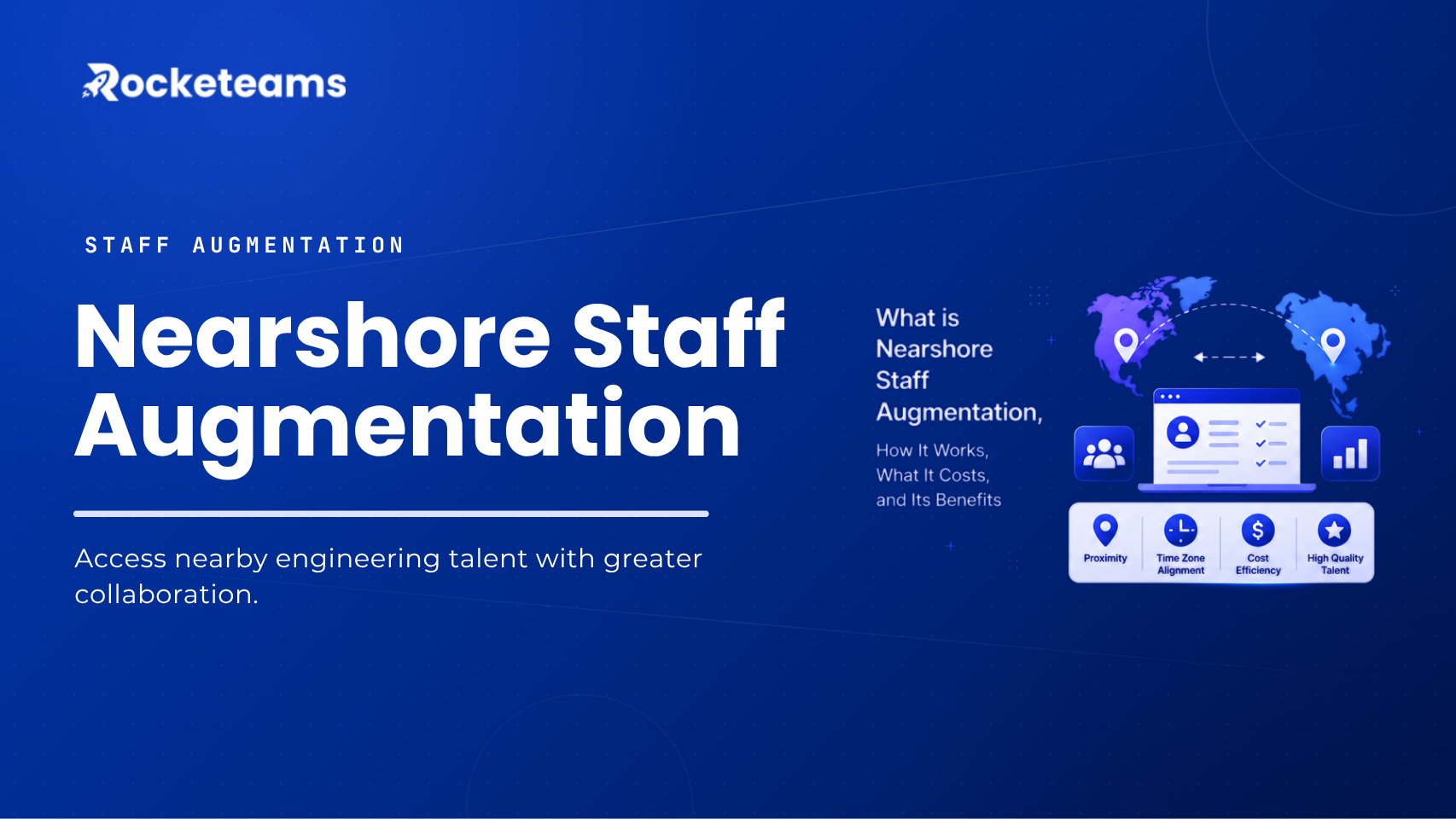
Nearshore staff augmentation is a hiring model where companies extend their internal teams by bringing in skilled professionals from nearby countries that share similar time zones. These external specialists work as part of the client’s team, using the same tools, workflows, and reporting structures. Outcome-based staff augmentation focuses on delivering specific results rather than just providing talent, aligning teams with clear goals and performance metrics.
Unlike traditional outsourcing, where a vendor manages the project and deliverables, nearshore team augmentation allows businesses to retain full control over project management while gaining access to specialized talent. This model combines the flexibility of external hiring with the collaboration benefits of working within closely aligned time zones.
What Nearshore Means in Practice?
In nearshore IT staff augmentation, the external team is typically located within two to four hours of the client’s time zone. This proximity enables real-time communication, smoother collaboration, and faster decision-making compared to offshore models.
For example:
- U.S. companies often rely on nearshore talent from Latin America, including Mexico, Colombia, Argentina, Brazil, and Chile.
- Western European companies commonly work with professionals from Central and Eastern Europe such as Poland, Romania, Hungary, and the Czech Republic.
Because these regions operate within similar working hours, nearshore teams can participate in daily stand-ups, sprint planning, and code reviews without the delays common in offshore collaborations.
Nearshore vs Offshore vs Onshore
To fully understand nearshore staff augmentation explained, it helps to compare it with the two other common hiring models:
| Dimension | Onshore | Offshore | Nearshore |
|---|---|---|---|
| Cost vs. Local Hiring | Highest — full local salary, benefits, and overhead | Lowest sticker price, but coordination overhead adds hidden cost | 40–60% lower than onshore, minimal hidden overhead |
| Time Zone Overlap | Full — same time zone | Minimal to none — often 8–12 hour gap | 2–4 hours of working-day overlap |
| Collaboration Style | Real-time, in-person possible | Mostly asynchronous — slower feedback loops | Real-time stand-ups, sprint planning, code reviews |
| Talent Pool Access | Limited to local market | Very large, global | Large regional pools — LatAm for U.S., CEE for Western Europe |
| Project Control | Full | Often vendor-managed, less direct control | Full — staff augmentation model, you manage directly |
| Best For | Roles needing constant in-person presence or strict local-only requirements | Well-scoped, non-urgent work that can tolerate delayed feedback | Scaling engineering teams fast while keeping real-time collaboration and control |
Benefits of Nearshore Staff Augmentation for Startups and SMBs
For startups and small-to-medium businesses, hiring full-time technical talent can be slow, expensive, and risky. Nearshore staff augmentation offers a more flexible way to scale development teams without the overhead of traditional hiring.
By working with nearshore staff augmentation services, companies gain access to specialized talent while maintaining control over their projects and workflows. Nearshore staff augmentation services allow companies to increase productivity, maintain agility, and access global expertise while controlling costs.
Some of the benefits are:
Faster Access to Talent
Hiring locally for specialized roles can take months. Nearshore IT staff augmentation allows businesses to bring experienced developers, engineers, and specialists into projects within weeks, keeping development timelines on track.
Greater Flexibility
Projects rarely require the same level of resources throughout their lifecycle. Nearshore team augmentation allows companies to scale teams up or down depending on project needs, without long-term employment commitments.
Cost Efficiency
With nearshore IT staffing, businesses only pay for the skills and time they need. There are no expenses related to full-time salaries, office infrastructure, benefits, or recruitment overhead.
Access to Specialized Skills
Emerging technologies such as AI, blockchain, cybersecurity, and cloud infrastructure require niche expertise. Nearshore software staff augmentation provides access to experienced professionals who already possess these capabilities.
Improved Project Continuity
When internal teams face skill gaps or resource shortages, development timelines can stall. Augmented professionals help bridge these gaps, keeping projects moving forward and reducing delivery risks.
What Problems Make Nearshore Team Augmentation the Right Choice?
Nearshore IT staffing becomes particularly valuable when organizations face specific operational challenges while scaling technical teams. While not every situation requires it, staff augmentation nearshore consistently solves three major problems for growing technology teams.
1. Shortage of Specialized Technical Talent
Many companies struggle to find experienced professionals in areas such as AI, machine learning, cybersecurity, cloud engineering, and data science. Local talent pools often cannot keep up with the growing demand for these skills.
Nearshore regions have significantly expanded their technology ecosystems over the past decade. Latin America, Eastern Europe, and emerging markets now produce thousands of skilled engineers annually. By leveraging nearshore IT staff augmentation, companies gain access to these specialized talent pools without competing in oversaturated local hiring markets.
2. Rising Cost of Local Hiring
Hiring full-time engineers locally involves much more than salary. Organizations must also account for payroll taxes, benefits, equipment, office space, and HR administration.
Nearshore software staff augmentation allows companies to access highly skilled developers at significantly lower costs while avoiding the administrative complexity of international hiring. The service provider manages payroll, compliance, and HR operations, allowing businesses to focus purely on project execution.
3. Collaboration Challenges with Offshore Teams
Offshore outsourcing often introduces large time zone differences that limit real-time communication. This can slow down development cycles, delay feedback loops, and create friction in agile workflows.
Because nearshore teams operate within similar time zones, daily stand-ups, sprint planning, and real-time code reviews can happen during normal working hours. This makes nearshore team augmentation far more compatible with Agile development environments.
How Much Does Nearshore Staff Augmentation Cost?
Cost is often the first consideration when evaluating nearshore staff augmentation services. While rates vary depending on region, role, and seniority, nearshore hiring typically provides significant savings compared to local hiring. Choosing between resource augmentation and staff augmentation depends on your project needs, scalability goals, and level of control required.
1. Typical Nearshore Development Rates
These rates can vary depending on the country, technology stack, and level of expertise required. But in major nearshore markets, software development rates generally fall within the following ranges:
| Seniority Level | Typical Hourly Rate |
|---|---|
| Junior Developer | $25 – $45 / hour |
| Mid-Level Developer | $45 – $65 / hour |
| Senior Developer | $65 – $90 / hour |
Most nearshore staff augmentation providers add a 15–25% margin on top of the developer’s base rate to cover compliance, HR management, and administrative overhead.
2. Regional Cost Differences
Different nearshore regions offer varying cost structures:
- Latin America is the primary nearshore destination for U.S. companies, with competitive rates and strong English proficiency.
- Eastern Europe is a popular nearshore region for Western European companies due to its highly skilled engineering workforce.
- Emerging regions such as North Africa and South Asia are also gaining attention because of strong technical education and favorable cost structures.
3. Factors That Influence Pricing
Most nearshore staff augmentation services charge a margin of roughly 15–25% above the developer’s base rate to cover compliance, HR management, and administrative overhead. The final cost of nearshore IT staff augmentation depends on several variables, including:
- Seniority and specialization of the developer
- Technology stack and project complexity
- Engagement model (hourly, monthly, or dedicated team)
- Provider service margin and operational support
How to Evaluate and Run a Nearshore Staff Augmentation Engagement
Choosing the right provider and managing the engagement effectively are critical to getting the most value from nearshore IT staff augmentation. AI staffing augmentation is reshaping technical hiring in 2026 by combining human expertise with AI-driven talent sourcing and evaluation.
1. Evaluate the Provider’s Vetting Process
The quality of talent depends heavily on the provider’s screening process. A strong vetting process ensures that only highly qualified candidates are presented to clients. A reliable nearshore staff augmentation service should conduct structured evaluations that include:
- Technical skill assessments
- Communication and collaboration evaluation
- Domain-specific expertise testing
- Live coding or system design exercises
2. Look for Trial Engagement Options
Many high-quality nearshore staff augmentation services offer trial periods or pilot engagements. These allow companies to evaluate both technical performance and cultural alignment before committing to a long-term collaboration. Trial engagements reduce hiring risk and provide confidence in the provider’s talent quality.
3. Prepare for Effective Onboarding
Even highly skilled professionals need the right context to contribute quickly. Proper onboarding allows nearshore developers to begin contributing within their first sprint. Companies should ensure the following are ready before onboarding augmented staff:
- Access to development tools and repositories.
- Clear project documentation.
- Defined sprint objectives.
- A dedicated internal point of contact
4. Establish Governance and Communication Structures
Successful nearshore team augmentation requires clear operational processes. These governance practices ensure smooth collaboration between internal teams and augmented professionals. Organizations should implement:
- Daily stand-ups and sprint reviews
- Regular performance reporting
- Code review cycles during time zone overlap
- Defined escalation and feedback processes
5. Protect Intellectual Property and Data
Cross-border collaboration requires strong legal and security protections. These safeguards protect proprietary code and sensitive business information. Companies should ensure that nearshore IT staffing providers implement:
- NDAs and IP assignment agreements
- Role-based access controls
- Secure development environments
- Compliance with relevant data regulations
The Case for Nearshore Staff Augmentation in 2026
Over the past few years, nearshore staff augmentation has evolved from a simple cost-saving tactic into a strategic approach for scaling engineering teams.
Companies increasingly rely on nearshore software staff augmentation because it combines three critical advantages:
- Time zone alignment for real-time collaboration.
- Access to large global talent pools.
- Significant cost savings compared to local hiring
With faster onboarding, pre-vetted professionals, and stronger Agile compatibility, nearshore IT staff augmentation enables organizations to expand technical capacity quickly without sacrificing collaboration or quality.
For many growing technology teams, the question today is no longer whether nearshore staff augmentation services work but which provider can deliver the right talent, governance, and long-term partnership needed for successful distributed development.
Proven Best Practices for Building a High-Performing Nearshore Team
Understanding the value of nearshore staff augmentation company is only the first step. Successful companies treat it as a structured operational model, not just a hiring shortcut. Clear planning, strong communication, and disciplined project management ensure that nearshore IT staff augmentation delivers long-term value.
1. Start with Clear Pre-Engagement Planning
Before engaging a provider, define exactly what you need. Identify skill gaps, project timelines, budget limits, and the number of developers required. Decide whether the need is temporary or long-term.
A simple build vs. augment framework can help: build internally for long-term core capabilities, and use nearshore team augmentation for specialized or short-term expertise. Clear planning reduces hiring mistakes and accelerates onboarding.
2. Choose the Right Nearshore Partner
The success of nearshore staff augmentation services depends heavily on the partner you choose. Evaluate vendors based on technical vetting processes, communication responsiveness, relevant project experience, and their ability to scale teams quickly.
Review portfolios, conduct technical interviews with proposed developers, and confirm that the provider follows recognized security standards such as ISO 27001 or SOC 2. Trial engagements are also valuable for testing collaboration before committing long term.
3. Implement Structured Onboarding
Effective onboarding determines how quickly nearshore developers become productive. Provide access to development tools, documentation, repositories, and project guidelines before the first day.
Assign a mentor or internal point of contact and begin with smaller tasks before moving to full sprint responsibilities. A structured onboarding process allows nearshore software staff augmentation teams to integrate within weeks instead of months.
4. Establish Strong Communication and Collaboration
Successful distributed teams rely on structured communication. Use collaboration tools such as Slack, Microsoft Teams, Jira, and GitHub to maintain transparency across tasks and workflows.
Maintain a predictable meeting cadence including daily stand-ups, sprint reviews, and retrospectives. When teams share two to four hours of time zone overlap, these real-time interactions help nearshore IT teams collaborate almost as seamlessly as in-house teams.
5. Define Clear Goals and Performance Metrics
For nearshore IT staffing to deliver measurable results, teams must understand what success looks like. Define project goals and convert them into sprint-level deliverables.
Track metrics such as development velocity, code quality, bug resolution time, and time-to-market improvements. Regular performance reviews and feedback sessions ensure continuous improvement and keep teams aligned with business outcomes.
Conclusion
Nearshore staff augmentation has become a powerful strategy for companies that need to scale technical teams quickly without sacrificing collaboration or control. By combining global talent access with time zone alignment, organizations can accelerate development, reduce hiring costs, and maintain agile workflows.
The key to success lies in choosing the right partner and implementing strong governance, communication, and onboarding practices. Providers like Rocketeams specialize in delivering pre-vetted nearshore developers who integrate smoothly into client teams, helping companies scale engineering capacity efficiently while maintaining high standards of performance and reliability.
FAQs
What is nearshore staff augmentation?
Nearshore staff augmentation is a hiring model where companies add developers from nearby countries into their teams while maintaining direct management. These professionals work within your tools, workflows, and sprints while the provider handles employment logistics.
What is a nearshore employee?
A nearshore employee is a developer or specialist located in a nearby country who works as part of your internal team. They collaborate in real time, attend stand-ups, and report to your managers while being employed through the provider.
What does nearshore mean?
Nearshore refers to hiring talent from countries in similar time zones, typically within two to four hours of your location. This proximity allows real-time collaboration while still benefiting from international talent pools.
How much does a nearshore team cost?
Nearshore developer rates typically range from $30 to $90 per hour, depending on experience and location. Even with provider margins, companies usually save 40–60% compared to local hiring.
What is nearshore recruitment?
Nearshore recruitment involves sourcing, vetting, and placing technical professionals from nearby regions into client teams. Providers manage the hiring and compliance process while clients manage the developer’s day-to-day work.