AI has moved from experimentation to execution. For enterprise teams, the question is no longer whether to adopt AI, but how to do it in a way that aligns with business goals, governance standards, and long-term scalability.
This is where partner selection becomes critical. Many organizations find themselves choosing between AI consulting services and AI agencies without a clear understanding of how each contributes to enterprise AI strategy.
This article breaks down that distinction and provides a structured way to evaluate the right fit based on your organization’s needs, maturity, and growth objectives.
What’s the Difference Between AI Consulting Services and AI Agencies?
Before evaluating options, it helps to clarify how these two categories differ in practice.
How do AI consulting services typically operate?
AI consulting services are structured around business transformation rather than execution alone. They focus on aligning AI initiatives with enterprise goals, ensuring that investments translate into measurable outcomes. Consultants typically work with leadership teams, not just technical stakeholders. Their role is to shape decision-making, not just deliver outputs.
What defines an enterprise AI consulting engagement?
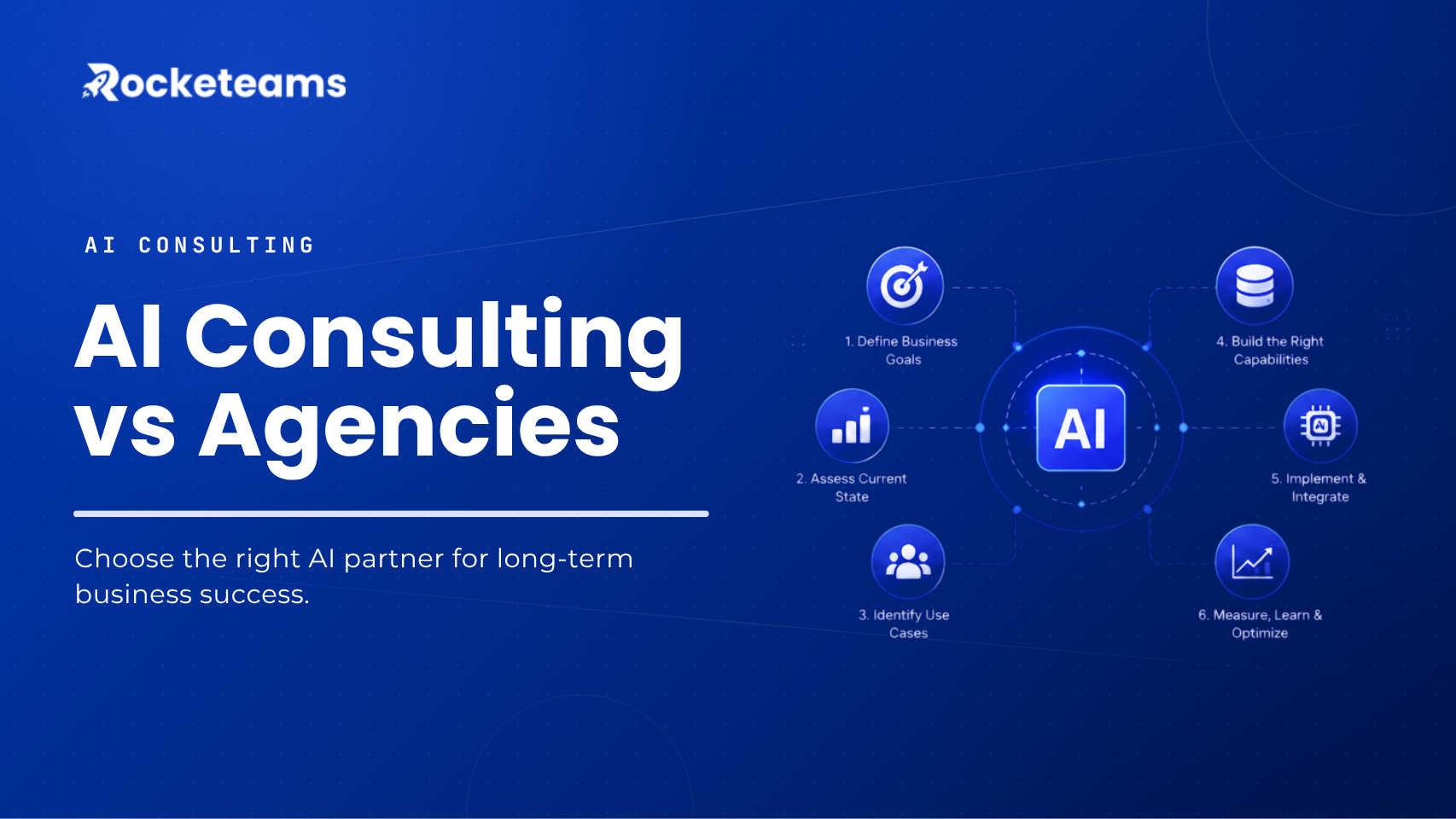
At a high level, consulting engagements focus on:
- Strategic assessment of current capabilities
- Identification of high-impact AI use cases
- Development of an AI technology roadmap
- Governance, compliance, and risk frameworks
- Long-term scalability and integration
How do AI agencies differ in their approach?
AI agencies tend to operate with a project-first mindset. Their focus is on building and deploying specific solutions, often within defined timelines. They are execution-oriented and typically engage after a problem has already been defined.
Where do AI agencies add the most value?
AI agencies are often well-suited for:
- Rapid prototyping and MVP development
- Generative AI applications such as chatbots or content tools
- Campaign-driven AI use cases
- Front-end AI integrations
AI Consulting Services vs. AI Agencies: At a Glance
Dimension | AI Consulting Services | AI Agencies |
| Primary focus | Business strategy and transformation | Execution and delivery |
| Engagement level | Leadership and cross-functional teams | Technical and project teams |
| Typical starting point | Problem discovery and prioritization | Defined requirements and scope |
| Timeframe orientation | Long-term (6 to 18+ months) | Short to medium-term (weeks to months) |
| Output type | Roadmaps, frameworks, governance models | Working prototypes, deployed solutions |
| Decision-making role | Shapes what to build and why | Determines how to build it |
| Best used when | Direction is unclear or fragmented | Direction is clear, execution is needed |
| Risk profile managed | Strategic and organizational risk | Technical and delivery risk |
Why does this distinction matter for enterprise decision-makers?
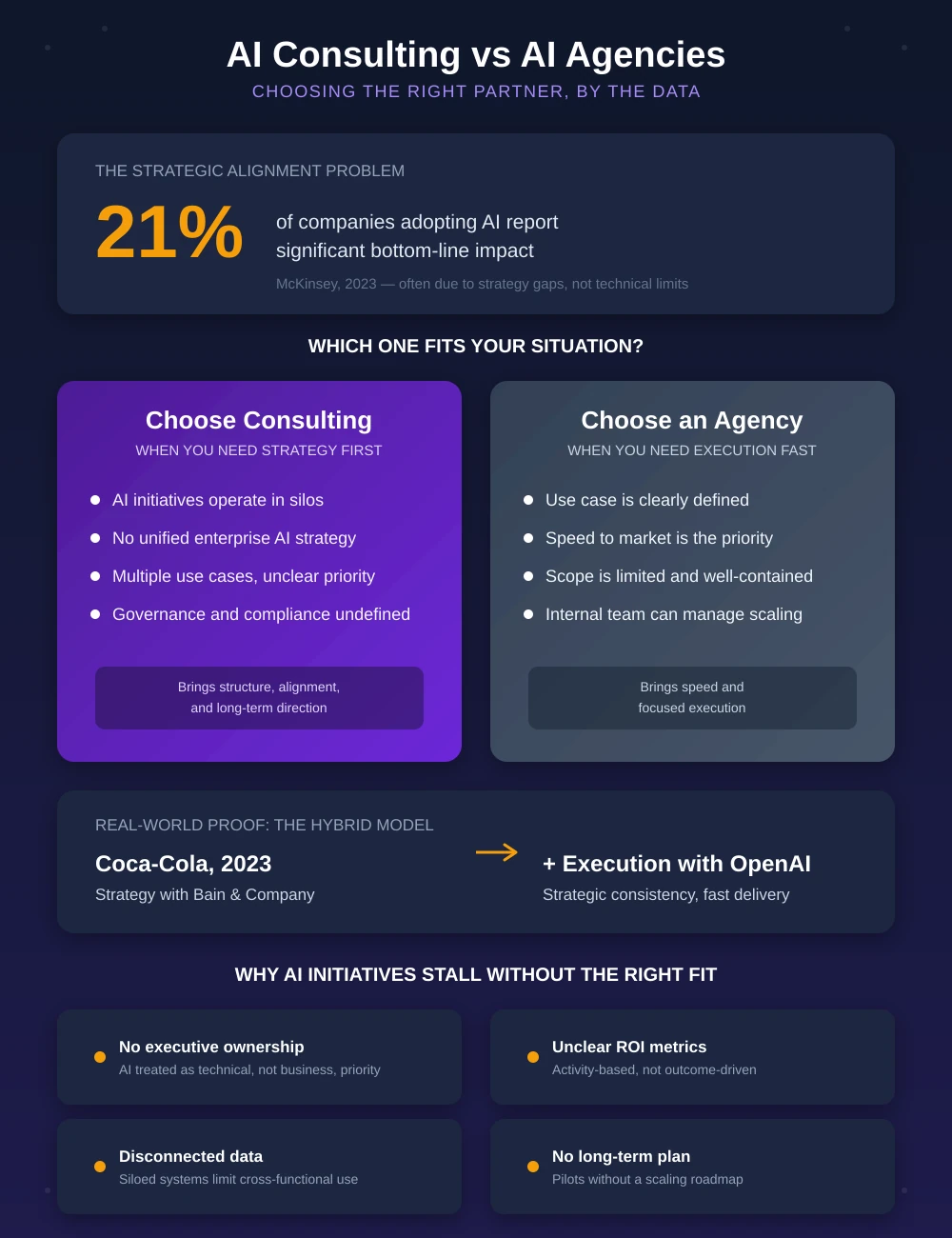
The difference is not just about the services offered, but about the level at which each partner operates. A 2023 report by McKinsey found that only 21% of companies adopting AI report significant bottom-line impact, often due to a lack of strategic alignment rather than technical limitations.
How does partner type impact long-term outcomes?
Choosing the wrong type of partner can lead to:
- Fragmented AI initiatives without a cohesive strategy
- Redundant investments across departments
- Poor alignment between AI outputs and business KPIs
AI Consulting Services VS AI Agencies – Quick Stats Comparison
What core challenges do enterprises face when selecting an AI partner?
Most organizations underestimate what AI transformation actually involves. The decision is often framed as selecting the right vendor or technology, but the real complexity sits within the organization itself. Systems, processes, data structures, and decision-making models all need to evolve alongside AI adoption.
This is why partner selection becomes less about capability alone and more about fit. The right partner needs to address structural challenges, not just deliver technical outputs.
1. Why is aligning AI with business strategy so difficult?
AI initiatives rarely fail because the models do not work. They fail because they are disconnected from how the business creates value.
In many enterprises, AI starts as a localized effort. A marketing team experiments with personalization, operations tests automation, or customer service introduces a chatbot. These efforts may show early promise, but they remain isolated.
Without centralized direction, these initiatives do not compound into meaningful impact.
What causes misalignment between AI and business goals?
Several patterns show up consistently across organizations:
- Lack of executive ownership: AI is often treated as a technical initiative rather than a business priority. Without leadership accountability, initiatives lack direction and struggle to secure long-term investment.
- Unclear ROI metrics: Teams experiment with AI without defining what success looks like. Metrics remain activity-based rather than outcome-driven, making it difficult to justify scaling efforts.
- Disconnected data infrastructure: Business units operate on separate systems, limiting the ability to build cross-functional AI use cases that drive meaningful value.
- Short-term experimentation without long-term planning: Many organizations invest in pilots without a roadmap for integration, scaling, or governance.
This is where AI business consulting plays a critical role. It introduces structure by linking AI initiatives directly to business priorities, ensuring that every use case contributes to measurable outcomes such as revenue growth, cost efficiency, or improved customer experience.
2. How do data readiness and infrastructure limitations affect success?
Even the most promising AI use cases depend on the quality and accessibility of underlying data. When data foundations are weak, outcomes become inconsistent and difficult to scale.
Organizations often assume that having large volumes of data is sufficient. In practice, usability matters more than volume.
What are the most common data-related bottlenecks?
Several issues tend to surface during implementation:
- Siloed data across systems: Data is spread across departments and platforms, limiting visibility and reducing the effectiveness of AI models that rely on unified datasets.
- Inconsistent data quality: Duplicate records, missing fields, and outdated information lead to unreliable outputs and erode trust in AI systems.
- Lack of real-time data access: Many enterprise systems are not designed for real-time processing, which restricts the ability to build responsive AI applications.
- Governance and compliance gaps: Without clear data ownership and policies, organizations face risks related to privacy, security, and regulatory compliance.
These challenges directly impact the performance of custom AI solutions. Models trained on fragmented or unreliable data cannot deliver consistent business value. More importantly, they become difficult to maintain and scale over time.
Addressing data readiness is not a preliminary step. It is a continuous requirement that influences every stage of AI adoption.
3. Why is scaling AI beyond pilot projects such a challenge?
Many enterprises are able to demonstrate value in controlled environments. Pilot projects often receive focused attention, dedicated resources, and a limited scope. The challenge begins when organizations attempt to extend these solutions across the business.
This transition requires more than replication. It requires standardization, integration, and operational alignment.
What prevents AI from moving beyond proof-of-concept?
Several barriers tend to limit scalability:
- Lack of standardized deployment frameworks: Without consistent processes for development, testing, and deployment, each AI initiative becomes a standalone effort, increasing complexity and cost.
- Limited internal AI expertise: Organizations may rely heavily on external partners during pilots, but lack the in-house capabilities needed to maintain and expand solutions.
- Resistance to process changes: AI often requires adjustments to workflows and decision-making. Teams may hesitate to adopt new systems if the impact on their roles is unclear.
- Integration challenges with legacy systems: Many enterprise environments include outdated infrastructure that is not designed to support modern AI applications, making integration time-consuming and resource-intensive.
Common Enterprise AI Challenges and Which Partner Addresses Them
Challenge | Best Addressed By | Why |
| No unified AI strategy across departments | AI Consulting Services | Consultants align initiatives to business goals and build cohesive direction |
| Low ROI from AI pilots | AI Consulting Services | Consulting reframes success metrics and links outputs to business KPIs |
| Siloed or poor quality data infrastructure | AI Consulting Services | Data governance and readiness planning is a consulting-led exercise |
| Need to build a generative AI chatbot fast | AI Agency | Agencies deliver defined, execution-ready solutions within tight timelines |
| Scaling a proven AI use case across teams | Hybrid Model | Requires both strategic governance and execution capacity simultaneously |
| Legacy system integration for AI deployment | Hybrid Model | Architecture decisions need consulting oversight; build needs agency execution |
| MVP for a customer-facing AI feature | AI Agency | Clear scope, speed priority, and front-end integration are agency strengths |
| AI governance and compliance framework | AI Consulting Services | Governance design requires strategic and regulatory expertise, not just build |
How can businesses choose the right AI implementation partner?
Selecting the right AI implementation partner is less about comparing vendor capabilities and more about understanding what your organization actually needs at its current stage. Many enterprises approach this decision reactively, often after an internal push for AI adoption. A more effective approach is to evaluate partners through a structured lens that connects business objectives, internal readiness, and long-term scalability.
A clear evaluation framework helps avoid fragmented investments and ensures that the chosen partner can support both immediate priorities and future growth.
Establishing internal clarity before partner selection
Before engaging with external partners, organizations need a grounded view of their own capabilities and constraints. Without this, even the most capable partner will struggle to deliver meaningful outcomes.
At this stage, the focus should be on defining a few key areas:
- Current AI maturity level: Whether the organization is in early experimentation, running pilots, or scaling existing solutions significantly influences the type of partner required.
- Core business problems to solve: AI should not be approached as a broad initiative. A clear problem definition helps narrow down use cases that can deliver measurable value.
- Data and infrastructure readiness: Understanding the state of data systems, accessibility, and governance frameworks is critical in determining feasibility.
- Internal capabilities and resource gaps: Identifying where internal teams fall short helps clarify whether the need is strategic guidance, execution support, or both.
This level of clarity shapes the entire decision-making process. It determines whether the organization requires high-level AI business consulting or a more execution-focused partner.
Prioritizing AI consulting services for strategic alignment
AI consulting services are typically the right fit for organizations that are still building direction around their AI efforts. This is especially relevant in early to mid stages of AI adoption, where multiple initiatives may exist but lack cohesion.
In practice, the need for consulting becomes evident when:
- AI initiatives operate in silos without a unified direction
- Leadership requires a clearly defined enterprise AI strategy
- Multiple use cases are being explored without clear prioritization
- Governance, compliance, and risk management are not yet structured
In these scenarios, consulting-led engagement brings structure to what is often a fragmented landscape. Consultants help define an enterprise AI strategy, prioritize use cases based on business impact, and build an AI technology roadmap that aligns with long-term goals.
More importantly, they ensure that AI initiatives are tied to measurable outcomes. This shifts the focus from experimentation to sustainable AI-driven business growth.
Engaging AI agencies for focused execution
AI agencies are better suited for organizations that already have strategic clarity and need support with execution. Their strength lies in delivering defined outcomes within specific timelines.
This model works well when:
- The use case is clearly defined with established requirements
- Speed to market is a priority
- The scope of work is limited and well-contained
- Internal teams are capable of managing integration and scaling
In these cases, agencies can accelerate development and deployment without the need for extensive strategic input. They are particularly effective for building custom AI solutions, such as generative AI applications, automation tools, or customer-facing features.
The key advantage here is efficiency. Agencies focus on delivering results within a defined scope, making them a practical choice for execution-heavy projects.
Adopting a hybrid model for balanced outcomes
For many enterprises, the most effective approach is not choosing between consulting and agencies, but combining both in a structured way.
A hybrid model allows organizations to benefit from strategic alignment while maintaining execution speed. In practice, this typically involves:
- Consultants defining the overall AI transformation strategy and roadmap
- Agencies executing specific initiatives within that framework
This separation of roles ensures that execution remains aligned with broader business objectives, reducing the risk of disconnected or redundant efforts.
A relevant example is Coca-Cola’s approach in 2023. The company worked with Bain & Company to shape its AI strategy while collaborating with OpenAI to develop generative AI applications. This combination allowed Coca-Cola to maintain strategic consistency while moving quickly on execution.
Choosing Your Engagement Model: A Decision Reference
Scenario | Recommended Model | Indicators |
| Early-stage AI adoption with no clear strategy | AI Consulting Services | Multiple siloed pilots, no unified roadmap, unclear ROI metrics |
| Well-defined use case with technical requirements ready | AI Agency | Scope documented, data available, internal team can manage post-launch |
| Scaling proven pilots across the enterprise | Hybrid Model | Strategy exists but execution capacity and governance both needed |
| Regulated industry with compliance requirements | AI Consulting Services | Governance frameworks and compliance alignment must precede build |
| Fast-to-market generative AI or automation feature | AI Agency | Speed priority, contained scope, clear deliverable |
| Enterprise-wide AI transformation program | Hybrid Model | Complex, multi-phase initiative requiring both direction and delivery |
| Post-pilot with unclear next steps | AI Consulting Services | Success was local, scaling path undefined, leadership alignment missing |
What strategies ensure successful AI transformation?
AI transformation succeeds when initiatives are structured, governed, and aligned with business outcomes. Organizations that treat AI as a coordinated effort across strategy, systems, and people are more likely to move beyond experimentation and achieve scalable impact.
Building an enterprise AI strategy
A strong enterprise AI strategy connects AI initiatives directly to business goals such as revenue growth, efficiency, or customer experience. Starting with business priorities rather than technology ensures that efforts remain relevant and measurable.
An effective AI technology roadmap includes prioritized use cases, clear data and integration requirements, defined talent plans, governance frameworks, and phased timelines. This structure ensures AI investments remain focused, scalable, and aligned with long-term objectives.
The role of AI solution architecture in long-term success
AI solution architecture determines how systems integrate, scale, and adapt over time. Without a strong architectural foundation, even high-performing models struggle to deliver consistent value in real-world environments.
Successful architecture supports integration with existing systems, scalability across business units, strong security and data privacy, and flexibility to evolve with new AI capabilities. These elements are essential for sustaining AI-driven business growth.
Driving adoption across teams and functions
AI transformation depends on adoption, not just implementation. Organizations that embed AI into workflows and decision-making processes are more likely to realize its full value.
Adoption improves when business stakeholders are involved early, supported with training, aligned through incentives, and given clear communication about impact. Addressing these factors ensures AI becomes part of everyday operations.
Measuring ROI from AI initiatives
Clear measurement frameworks are essential for scaling AI initiatives and justifying investment. Without defined metrics, organizations struggle to evaluate success and prioritize efforts.
Relevant metrics include revenue impact, cost savings, operational efficiency, customer experience improvements, and faster decision-making.
Conclusion
Choosing between AI consulting services and AI agencies is not about selecting a better option, but about selecting the right fit for your current stage and objectives.
Consulting services bring structure, alignment, and long-term direction. AI agencies bring speed and execution. The most effective organizations understand how to use both, depending on the problem they are solving.
As AI becomes more embedded in core business operations, partner selection will increasingly influence not just project outcomes, but overall competitive positioning.
The goal is not to adopt AI faster. It is to adopt it in a way that consistently delivers value.
FAQs
What specific business challenges can your AI consulting services help us address and solve?
AI consulting services address challenges such as unclear AI strategy, low ROI from pilots, data fragmentation, and difficulty scaling AI across business units.
What is the typical engagement process for your AI consulting services, from initial assessment to implementation?
It usually starts with a capability assessment, followed by use case prioritization, roadmap creation, and support through implementation and scaling phases.
Can you provide case studies demonstrating the ROI achieved by clients through your AI consulting engagements?
Yes, many engagements show measurable ROI through cost reduction, process automation, and revenue growth, often within 6 to 18 months, depending on scope.
How do your AI consulting services ensure ethical considerations and data privacy are maintained throughout AI solution development?
They incorporate governance frameworks, compliance checks, and data protection standards aligned with regulations like GDPR and enterprise policies.
What is the estimated timeline and cost for a comprehensive AI consulting engagement tailored to our enterprise needs?
Timelines typically range from 3 to 9 months for strategy and initial implementation, with costs varying based on scope, complexity, and organizational scale.