For most of the last decade, mobile apps have followed the same basic contract: the user taps, the app responds. Even the smartest apps, the ones with recommendation engines and push notifications, still wait for a cue before doing anything. That contract is starting to break down.
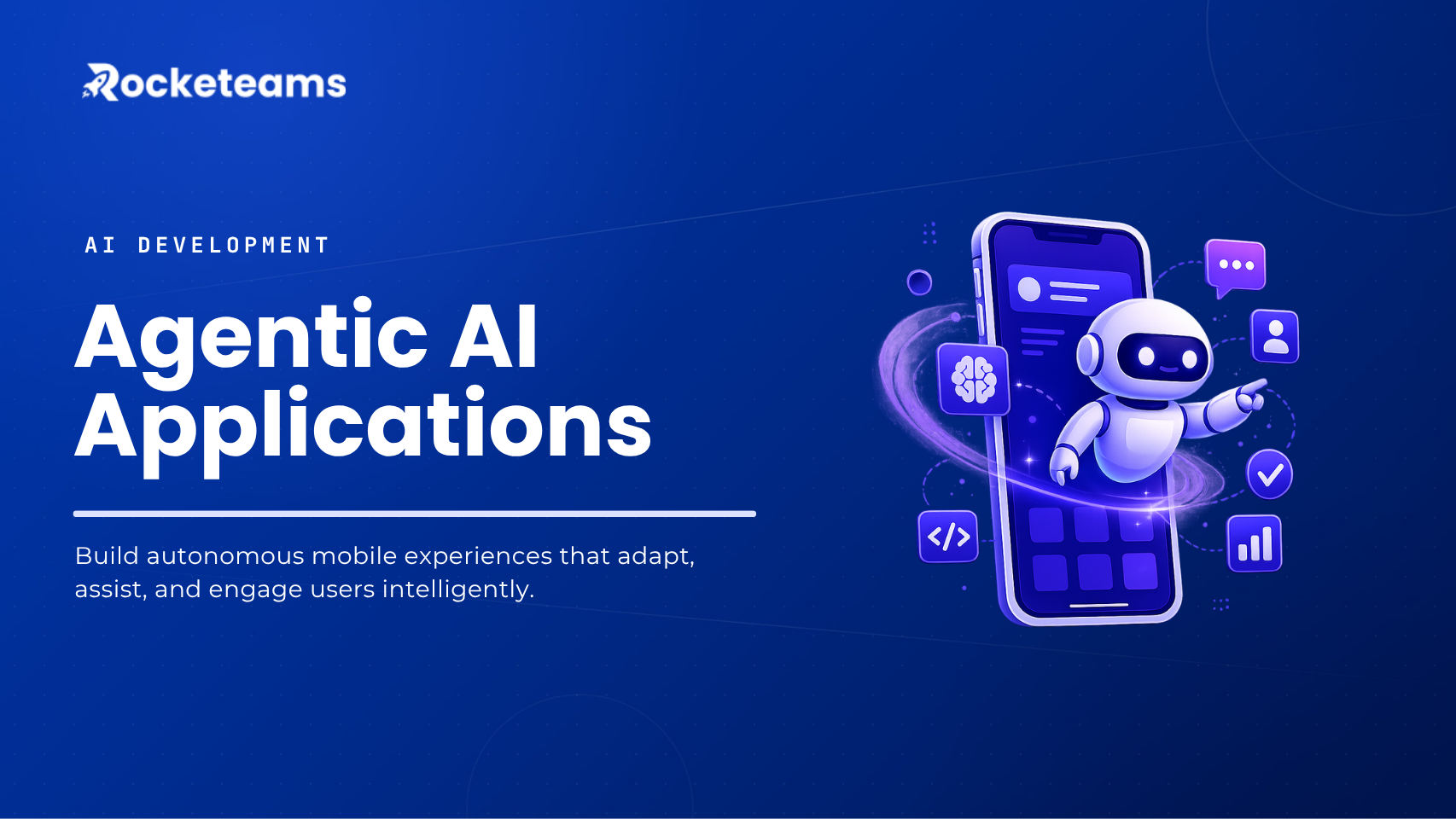
A new generation of mobile applications can observe context, make a judgment call, and take action without a person tapping anything first. Banking apps that move money to avoid an overdraft. Travel apps that rebook a flight before the user even knows it’s been cancelled. This is agentic AI, and it’s changing what mobile experience actually means for enterprise product teams.
What is Agentic AI for Mobile Apps?
Agentic AI refers to AI systems built around autonomous agents: software that can set sub-goals, make decisions within defined boundaries, and execute multi-step tasks with minimal human prompting. In a mobile context, this means the app itself can act as a participant in a workflow rather than just a window into one.
Think of the difference between a calculator and an assistant. A calculator waits for input and gives you exactly what you asked for. An assistant notices you’re running low on something, checks your calendar, and orders it before you remember to ask. Agentic AI mobile apps behave more like assistants.
Gartner’s research puts a number on how fast this is moving: by 2028, 33% of enterprise software applications will include agentic AI, up from less than 1% in 2024, driving over $450 billion in revenue. That’s not a niche feature set. That’s a structural shift in how enterprise software gets built.
How Does It Differ From Generative AI and Predictive AI in Mobile Apps?
To avoid confusion, teams should separate three terms that vendors often use interchangeably in pitch decks, because each solves a different problem.
Predictive AI looks at historical data and forecasts an outcome. It’s the model behind “customers who bought this also bought that,” or churn scoring on a subscription app. It’s useful, but it stops at the prediction. Someone still has to act on it.
Generative AI creates new content: text, images, code, summaries. A generative AI feature in a mobile app might draft a reply to a customer message or summarize a long document. It’s reactive by design. You prompt it, it generates something, and the loop ends there.
Agentic AI sits on top of both, but adds something neither has on its own: the ability to plan a sequence of steps toward a goal and carry them out, often touching multiple systems along the way. A predictive model might flag that a customer is likely to churn. A generative model might draft a retention email. An agentic system could do both, then actually decide whether to send the email, adjust an offer based on the customer’s account history, and log the outcome, all without a human reviewing each step.
The distinction matters for B2B buyers because it changes what you’re actually evaluating. You’re not just asking “Is the output accurate?” You’re asking, “Can this system be trusted to act on its own judgment, and how do we audit that judgment afterward?”
Why Are Traditional AI-Powered Mobile Apps Hitting a Ceiling?
Most enterprise mobile apps already have AI in them somewhere. Recommendation widgets, chatbots, fraud scoring. So why does it feel like progress has stalled? The answer has less to do with model quality and more to do with architecture. Traditional AI features were built to inform a decision, not make one.
Static Personalization vs. Real-Time Adaptation
Personalization in most mobile apps today is still largely rule-based, even when it’s powered by machine learning. A user gets segmented into a cohort, and that cohort gets a set of pre-defined experiences. The segmentation might update weekly or daily, but it rarely updates at the moment.
The gap shows up constantly in practice. A fitness app might know a user typically works out at 6 a.m., but if that user’s sleep tracker shows four hours of rest the night before, a static system has no mechanism to adjust the workout recommendation in real time. The data exists. The system just isn’t built to act on it without a batch job running overnight.
Agentic systems close that gap by treating personalization as a continuous decision rather than a periodic update. The agent reassesses context each time it’s relevant, not on a fixed schedule.
The Cost of Constant Human Intervention
The second ceiling is operational. Many smart features still require a human in the loop for anything beyond a narrow, pre-approved action. A support chatbot can answer FAQs, but the moment a request gets complicated, it hands off to a person. A fraud detection model can flag a transaction, but a human analyst still has to review and approve the response.
This isn’t a failure of the AI so much as a deliberate design choice from an earlier era of caution. The problem is that it doesn’t scale. Every escalation point is a queue, and every queue adds latency and headcount. Industry analysis on this points to a consistent pattern: standard AI tools are good at surfacing information but stop short of acting on it, prediction-based models often can’t keep pace with fast-moving business conditions, and generative tools tend to lack the deeper context needed to carry out a full enterprise workflow on their own.
That gap between insight and action is exactly where agentic AI is positioned to operate, provided the guardrails are designed well from the start.
How Does Agentic AI Actually Improve Mobile UX?
The theoretical case for agentic AI is straightforward enough. The practical question for product and engineering leaders is what it actually changes about the day-to-day experience of using an app, and what it takes to build that experience responsibly.
Autonomous Mobile Agents That Act, Not Just Respond
The clearest UX shift is that agents can complete tasks end to end instead of just surfacing options. Banking apps are a good proving ground for this. An agentic banking app doesn’t just alert a user that a bill is due. It can check the account balance, confirm the payment won’t trigger an overdraft, and execute the payment, all within parameters the user has explicitly authorized in advance.
Travel is another category where this plays out well. When a flight gets cancelled, a traditional app pushes a notification and leaves the user to sort it out. An agentic travel app searches alternative flights, applies loyalty status and fare rules, rebooks automatically, and notifies the user of what it did instead of asking what to do.
The user experience improvement isn’t really about flashier interfaces. It’s about removing steps. By removing screens users would otherwise tap through, teams engineer away friction -and that’s a fundamentally different kind of UX work than optimizing button placement or animation timing.
On-Device AI Processing for Speed and Privacy
A lot of agentic functionality depends on processing happening close to the user, not in a distant data center. On-device AI processing matters for two reasons that tend to get conflated but are actually separate problems.
The first is latency. An agent that needs to react to a sensor reading or a location change in real time can’t afford a round trip to the cloud for every decision. Apple’s on-device Neural Engine and Google’s Gemini Nano, both shipping in flagship phones since 2024 and expanding further through 2025 and 2026, exist specifically to let inference happen locally for exactly this reason.
The second is privacy and data governance. Enterprise buyers, particularly in healthcare and financial services, are increasingly wary of sending sensitive data to third-party cloud inference endpoints. Processing health metrics or transaction data on-device, rather than streaming it to a server, reduces the attack surface and simplifies compliance conversations considerably. This is one of the more underrated drivers of agentic AI adoption in regulated industries: it’s not just about smarter features, it’s about keeping sensitive data where it already lives.
Agentic Workflows Across Common App Categories
The shape of agentic functionality looks different depending on the category, but a few patterns repeat across enterprise mobile products. Mobile app development can also drive ROI.
E-commerce, agents handle real-time personalization that goes beyond static recommendation widgets, adjusting product suggestions and even pricing based on live signals like browsing behavior, time of day, and current inventory levels.
Healthcare apps, agents monitor connected device data such as glucose readings or heart rate variability and can flag anomalies or adjust medication reminders without a clinician manually reviewing every data point.
Logistics and field service apps, agents reroute deliveries or technician assignments in response to traffic, weather, or schedule changes, something that used to require a dispatcher to manually monitor a dashboard.
Customer support is worth calling out separately because it’s often where enterprises see the fastest return. An agentic support layer doesn’t just answer scripted questions. It can pull a user’s order history, check shipment status across a carrier’s API, and issue a refund within pre-set thresholds, reasoning through the specific situation rather than matching it to a canned response. The cases that fall outside those thresholds still escalate to a person, but the volume of escalations drops significantly when the agent can actually resolve routine requests instead of just routing them.
What ties these examples together isn’t the industry. It’s that each workflow involves multiple steps, each step depends on changing real-world conditions, and the cost of waiting for human review at every step outweighs the risk of letting a well-bounded agent handle it. The categories where agentic AI is gaining traction fastest tend to share one more trait: a clear, measurable definition of what a good outcome looks like, which makes it easier to set the boundaries an agent operates within.
What Should You Consider Before Building Agentic AI Into Your App?
None of this is a reason to skip the planning stage. If teams rush agentic systems into production, they introduce real risk, and the considerations below determine whether most enterprise projects succeed or stall.
Data Privacy and Ethical Guardrails
An agent that can act on a user’s behalf needs access to more data than a passive feature does, and often needs that access continuously rather than on a single request basis. That raises the stakes on every privacy decision a product team makes.
Regulatory frameworks like GDPR in the EU and HIPAA in U.S. healthcare weren’t written with autonomous agents in mind, which means compliance teams are often interpreting older rules for a newer kind of system. The safest approach is to scope agent permissions narrowly and explicitly. Designers should not give an agent that handles bill payments unrestricted access to a user’s full transaction history unless they specifically require and disclose that access.
Explainability is the other piece that’s easy to underbuild. If an agent moves money between accounts or adjusts a medication reminder, the user needs a clear, accessible answer to “why did it do that?” This is harder on a small mobile screen than it is in an enterprise dashboard, and it’s worth treating as a core design requirement rather than an afterthought bolted on after launch.
There’s also a practical governance question that doesn’t get enough attention in early planning: who reviews an agent’s decisions after the fact, and how often. Even a well-scoped agent will occasionally make a call that looks wrong in hindsight, and the teams that handle this well tend to build a lightweight audit trail from day one, logging what the agent observed and why it acted, rather than retrofitting that visibility after a user complaint forces the issue.
Cost, Timeline, and Technical Readiness
Budget and timeline expectations for agentic AI projects vary widely depending on scope, but a few patterns hold across most enterprise engagements. Teams can often scope, build, and test a narrow, single-workflow agent—such as automated rebooking for a travel app—in a few months. A broader agentic layer that spans multiple workflows and integrates with several backend systems is a longer undertaking, frequently six months to a year, and the cost scales accordingly with the number of systems the agent needs to touch.
Technical readiness is often the bigger constraint than budget. Agentic AI depends on having clean, accessible APIs across the systems an agent needs to coordinate. A team with a tangled legacy backend will spend more time on integration work than on the AI itself. It’s worth conducting an honest technical audit before committing to a timeline, because the agent is only as capable as the systems it can actually reach.
Gartner’s own research is a useful gut check here. The same forecast cited earlier predicts agentic AI in a third of enterprise software and warns that teams will cancel many projects launched today before they reach production scale, largely due to cost overruns, unclear ROI, or missing risk controls from the start. The lesson isn’t to avoid agentic AI. It’s to scope a pilot with a clearly measurable outcome before expanding into broader, higher-stakes workflows.
Conclusion
Agentic AI in mobile apps isn’t a feature update. This shift allows an app to act without asking first. That shift creates real value, fewer steps for users, faster resolution of routine tasks, experiences that adapt to context instead of waiting for input, but it also raises the bar on governance, transparency, and technical groundwork.
The enterprises getting this right aren’t the ones moving fastest. They’re the ones being precise about where autonomy actually helps, building permission boundaries before they build features, and treating explainability as a requirement rather than a nice-to-have.
Developers built mobile apps around the assumption that users always make the first move. That assumption is no longer a given, and the teams that plan for that now will have a real head start over the ones who treat it as someone else’s problem to solve later.
FAQs
How can integrating Agentic AI enhance the user experience and functionality of our mobile applications?
It shifts the app from reactive to proactive, letting it complete multi-step tasks like rebooking, payments, or personalized recommendations without requiring the user to manually walk through each step.
What are the typical use cases and benefits of applying Agentic AI in custom mobile app development?
Common use cases span e-commerce personalization, healthcare monitoring, banking automation, and logistics rerouting. This approach reduces friction and speeds up task completion across these workflows.
What is the estimated timeline and cost for incorporating Agentic AI features into an existing or new mobile app?
A narrow, single-workflow agent can often launch in a few months. Broader agentic layers spanning multiple systems typically take six months to a year, with cost scaling based on backend integration complexity.
How do you ensure data privacy and ethical considerations when developing Agentic AI for mobile applications?
By scoping agent permissions narrowly, processing sensitive data on-device where possible, and building clear explainability into the interface so users understand why an agent took a given action.
Can you provide examples of mobile apps that have successfully leveraged Agentic AI to achieve business goals?
Banking apps using autonomous bill payment within user-set limits, travel apps that auto-rebook cancelled flights, and healthcare apps that monitor connected devices and flag anomalies are among the clearer production examples today.