Most enterprise AI projects do not fail because the technology is wrong. They fail because the strategy that should have come before the technology was never built. Teams approve budgets, pick vendors, and start building before anyone has answered the questions that actually determine whether an AI initiative will hold up in production: What business problem are we solving? Is our data ready? Who owns the outcome?
A custom AI roadmap for enterprises is the document that answers those questions before they become expensive surprises. This guide covers exactly how to build one, from the first readiness assessment through to scaling AI across the enterprise, with the specific steps that separate organizations that see measurable returns from the ones still running the same pilot two years later.
Why Do Most Enterprise AI Initiatives Fail to Deliver ROI?
Understanding the failure modes before building a roadmap is more useful than any template. The patterns are consistent across industries and company sizes, which means they are also consistently preventable.
The Strategic Clarity Problem
McKinsey’s 2024 State of AI report found that 78% of organizations now use AI in at least one business function, up significantly from prior years. Yet a separate Gartner analysis found that the majority of AI pilots fail to reach production scale. The gap between adoption and value is almost always a strategy problem, not a technology problem.
The most common root cause is that enterprises start with a capability rather than a problem. A leadership team hears about large language models and asks what the company can do with them. That framing is backwards. The right starting point is identifying a specific business process that is slow, expensive, error-prone, or constrained by human capacity, and then asking whether AI is the right tool to address it.
Data Readiness Is Almost Always Overestimated
IBM’s 2024 Cost of a Data Breach report put the average enterprise data breach at $4.88 million, a figure that reflects how central data has become to enterprise operations. AI makes that centrality even more acute.
An AI system is only as good as the data feeding it, and enterprises consistently overestimate how ready their data actually is. Siloed databases, inconsistent field definitions, and incomplete historical records are the norm, not the exception, in organizations that have not specifically invested in data infrastructure.
Discovering data quality problems after AI development has started is one of the most expensive outcomes a roadmap can produce. Discovering them before is simply a prerequisite for doing the work properly.
What Does an Enterprise AI Roadmap Actually Include?
An enterprise AI roadmap is far more than a list of AI projects or a high-level vision document. It is a strategic framework that connects business goals with execution, ensuring every AI initiative delivers measurable value. While many organizations use the term “roadmap” loosely, an effective enterprise AI roadmap is built on three essential layers.
- Strategic Layer: This defines the business outcomes AI is expected to achieve, such as increasing revenue, reducing operational costs, improving customer experience, or streamlining workflows. Every AI initiative should support a clear business objective; if it doesn’t, it shouldn’t be part of the roadmap.
- Execution Layer: This translates strategy into action through prioritized use cases, implementation phases, timelines, budgets, resource allocation, and ownership. It establishes the sequence of initiatives, ensuring the organization builds the right capabilities at the right time rather than pursuing disconnected AI projects.
- Governance Layer: This provides the rules and oversight needed to deploy AI responsibly. It covers data governance, model management, compliance, security, risk management, and decision-making processes, ensuring AI initiatives remain scalable, secure, and aligned with regulatory and organizational requirements.
When these three layers work together, the roadmap becomes a practical guide for enterprise-wide AI adoption. Without strategy, AI lacks direction. Without execution, it never moves beyond planning. Without governance, organizations expose themselves to unnecessary risk. A comprehensive enterprise AI roadmap brings all three together to help businesses scale AI confidently and sustainably.
How Do You Assess Your Organization’s AI Readiness?
| Readiness Area | What to Evaluate | Common Gap |
|---|---|---|
| Data Infrastructure | What data exists, where it lives, how clean and accessible it is to the systems that need it | Siloed databases, inconsistent field definitions, incomplete historical records |
| Internal Talent | Data engineering, ML engineering, AI-aware product management, change management capacity | Skill gaps that carry real budget and timeline implications once acknowledged honestly |
| System Architecture | Existing ERP/CRM/HRMS systems, available APIs, and data flows between platforms | Integration costing more than model development because nobody scoped it upfront |
AI readiness assessment is the phase most enterprises rush through or skip entirely in their eagerness to start building. It is also the phase that determines more about eventual success than any subsequent step.
Evaluating Data Infrastructure
The assessment starts with data. Specifically: what data exists, where it lives, how clean it is, and how accessible it is to the systems that would need to use it. This means cataloging data sources across business units, identifying gaps between what AI use cases would require and what is currently available, and estimating the effort needed to close those gaps. For many enterprises, this phase reveals that a data infrastructure investment needs to happen before any AI development can begin. That is not a failure; it is the roadmap working as intended.
Assessing Internal Capabilities and Talent
AI readiness also depends on what skills the organization already has and what it needs to acquire or hire. A realistic talent assessment covers data engineering capability, ML engineering experience, product management familiarity with AI development cycles, and the change management capacity to bring operational teams along through a workflow change. The honest version of this assessment is harder than most organizations expect, because it requires acknowledging gaps that carry budget and timeline implications.
Understanding Existing System Architecture
Every AI initiative will eventually need to integrate with existing enterprise systems: ERP platforms, CRM systems, HRMS tools, cloud infrastructure. Understanding the current architecture, the APIs that exist, the systems that lack them, and the data flows between platforms is essential before designing an AI integration strategy. Enterprises that skip this step regularly discover that integration costs more than model development, because they did not know what they were integrating against until they were already building.
How Do You Identify and Prioritize High-Impact AI Use Cases?
Identifying the right AI use cases is one of the most important steps in building a successful enterprise AI roadmap. The objective isn’t to implement AI everywhere, it’s to focus on initiatives that deliver measurable business value while being realistic to execute. This is where an AI readiness assessment meets business strategy.
Creating a Framework to Evaluate AI Opportunities
The most effective approach is to evaluate each potential AI initiative across two key dimensions: business impact and implementation feasibility.
- Business impact measures the value an AI solution can create by considering factors such as revenue growth, cost savings, operational efficiency, customer experience improvements, and strategic importance.
- Implementation feasibility evaluates whether the organization has the necessary data, technology, infrastructure, integration capabilities, and internal expertise to successfully deploy the solution.
The highest-priority initiatives are those that score strongly in both categories. High-impact but low-feasibility projects should remain on the roadmap for later phases, once foundational capabilities are in place. Low-impact initiatives, regardless of how easy they are to implement, should not consume enterprise resources.
Enterprise AI Use Cases That Deliver Measurable Business Impact
While AI opportunities vary by industry, several enterprise use cases consistently deliver strong returns across organizations:
| Use Case | Business Impact |
|---|---|
| Customer Service Automation | Reduces support costs while improving response times and resolution rates |
| Predictive Analytics | Enhances demand forecasting, inventory management, and supply chain planning |
| Intelligent Document Processing | Automates manual workflows in finance, legal, HR, and compliance — less time, fewer errors |
| Predictive Maintenance | Helps manufacturing and logistics minimize equipment failures and unplanned downtime |
These initiatives typically generate measurable ROI quickly, making them ideal candidates for the first phase of an enterprise AI implementation strategy.
Using Business Data and Industry Trends to Guide Priorities
Industry research reinforces this approach. According to McKinsey’s 2024 Global AI Survey, organizations most frequently report revenue gains from AI in marketing and sales, supply chain management, and product development, while the greatest cost savings are consistently achieved in operations and customer service. These findings provide valuable guidance when determining which business functions should be prioritized within an enterprise AI roadmap.
Rather than pursuing the latest AI trends in 2026, enterprises achieve the best results by focusing on use cases that align with strategic business objectives, leverage available data, and can be scaled successfully over time.
Integrating Generative AI into an Enterprise AI Strategy
Generative AI has become one of the most discussed areas of enterprise AI, but successful adoption requires the same strategic evaluation as any other AI initiative. Organizations should identify where Gen AI can create measurable value, such as automating knowledge work, improving customer interactions, accelerating content creation, assisting employees with internal knowledge search, and enhancing software development workflows.
Rather than implementing Gen AI across the organization without a clear objective, enterprises should prioritize use cases based on business impact, data readiness, security requirements, and integration complexity. A well-defined AI roadmap ensures Gen AI initiatives are aligned with business goals and supported by the necessary governance and infrastructure.
What Are the Critical Steps in Building an Enterprise AI Roadmap?
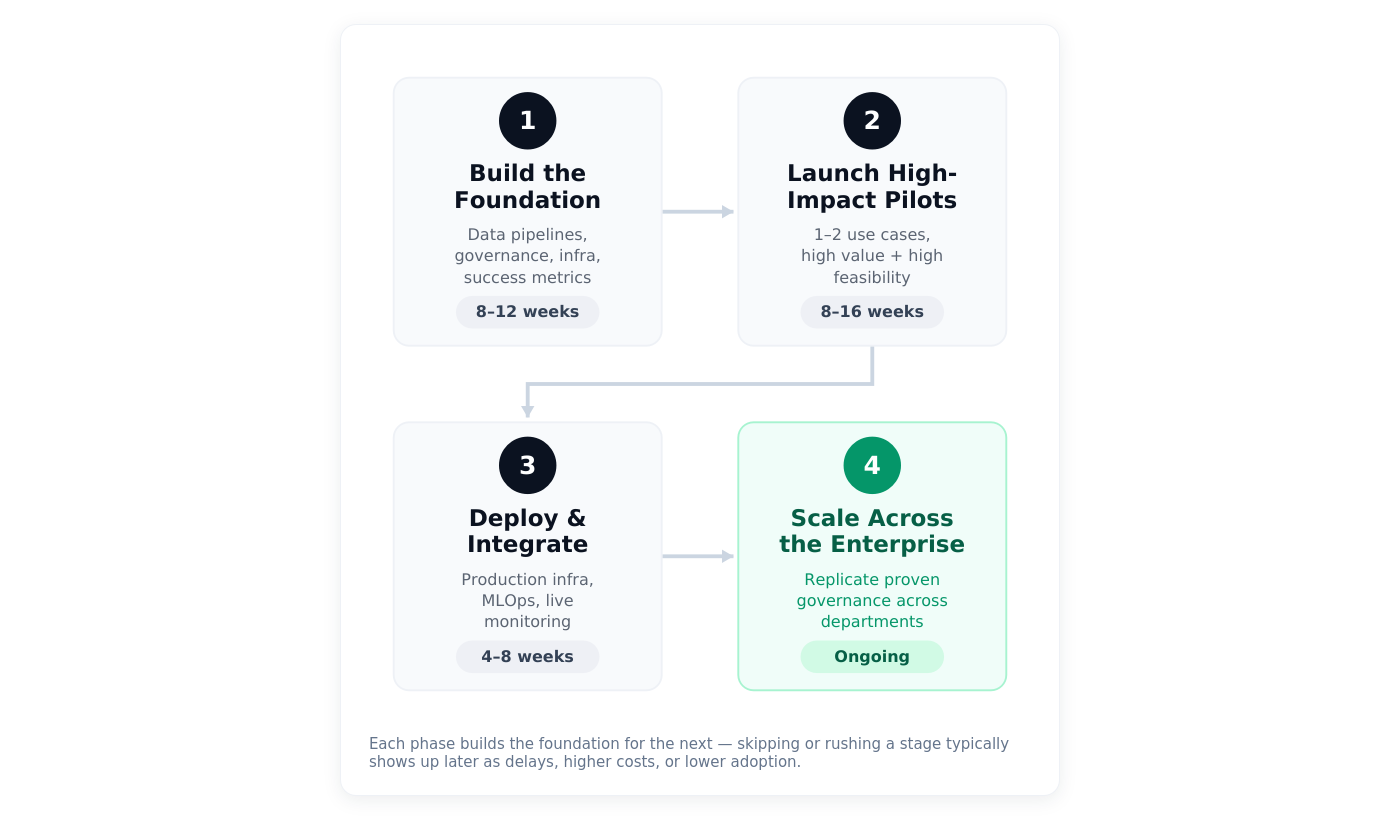
Once you’ve completed an AI readiness assessment and prioritized high-value use cases, the next step is turning strategy into execution. A successful enterprise AI roadmap follows a structured sequence where each phase builds the foundation for the next. Skipping or rushing any stage often leads to delays, higher costs, and lower adoption.
Phase 1: Build the AI Foundation
Every successful enterprise AI journey begins with a strong foundation. Before developing AI models, organizations need reliable data pipelines, high-quality datasets, scalable infrastructure, and clear governance policies.
This phase typically includes:
- Establishing data collection and integration processes
- Improving data quality and accessibility
- Defining AI governance, security, and compliance standards
- Preparing cloud or on-premises AI infrastructure
- Setting success metrics and KPIs
Although this stage doesn’t produce immediate AI applications, it significantly reduces implementation risks and creates the infrastructure needed for long-term AI success.
Phase 2: Launch High-Impact AI Pilots
Rather than deploying AI across the organization immediately, enterprises should validate their roadmap through carefully selected pilot projects.
Choose one or two high-priority use cases that combine strong business value with high implementation feasibility. The objective is to confirm that the AI solution works effectively with your organization’s data, integrates with existing systems, and delivers measurable business outcomes.
Well-executed pilots also provide valuable insights into technical challenges, user adoption, governance requirements, and return on investment in helping leadership make informed decisions before expanding AI initiatives.
Phase 3: Deploy and Integrate AI into Business Operations
Once pilot projects demonstrate measurable success, the focus shifts to production deployment. At this stage, AI moves from experimentation to becoming part of day-to-day business operations.
Successful deployment requires:
- Integration with enterprise applications and workflows
- Scalable and secure infrastructure
- Automated deployment and testing (MLOps)
- Continuous monitoring of model performance
- Ongoing measurement of business KPIs alongside technical metrics
The goal isn’t simply to launch an AI model, it’s to ensure the solution remains reliable, accurate, secure, and valuable over time.
Phase 4: Scale AI Across the Enterprise
After proving value in one business area, organizations can begin scaling AI across departments, functions, and use cases. Effective AI scaling isn’t about deploying more models. It’s about replicating proven processes, governance, and best practices throughout the enterprise.
By leveraging lessons learned from early deployments, organizations can:
- Accelerate implementation of new AI initiatives
- Reduce deployment costs and technical risk
- Standardize governance and operational processes
- Improve collaboration across business and technical teams
- Build reusable AI capabilities that support long-term innovation
Organizations that successfully scale AI treat each deployment as an opportunity to strengthen their enterprise AI capabilities. Every implementation improves data quality, refines governance, enhances integration practices, and builds internal expertise making future AI projects faster, more efficient, and more impactful.
A well-structured enterprise AI roadmap isn’t just a deployment plan; it’s a long-term strategy for building the people, processes, and technology needed to drive sustainable AI adoption across the organization.
What Does an AI Governance Roadmap Need to Include?
An AI governance roadmap ensures that enterprise AI remains secure, ethical, compliant, and accountable as adoption scales across the organization. Rather than being treated as a final compliance step, governance should be embedded into every phase of the enterprise AI roadmap to reduce risk, build stakeholder trust, and support long-term AI success.
Integrating The Core Components of an AI Governance Roadmap
A comprehensive AI governance framework should address four key areas:
| Governance Pillar | What It Covers |
|---|---|
| Model Explainability | Transparent, understandable decisions — clear explanations for employees, customers, and regulators |
| Bias & Fairness | Ongoing processes to identify, monitor, and mitigate bias as data and conditions evolve |
| Data Privacy & Security | Compliance with GDPR, HIPAA, and industry standards for collecting, storing, and using data |
| Human Oversight | Clear rules for when AI operates autonomously vs. when human review is required |
Integrating Governance into the Enterprise AI Roadmap
Effective AI governance is not a standalone initiative it should be integrated into the broader AI implementation strategy. Governance checkpoints should be built into every major stage of the AI lifecycle, from use case selection and solution design to pilot validation, production deployment, and ongoing model monitoring.
Embedding governance throughout the enterprise AI journey enables organizations to detect issues such as model drift, compliance risks, security vulnerabilities, and performance degradation before they impact business operations. It also ensures AI systems continue to align with evolving regulations, organizational policies, and stakeholder expectations.
By making governance a continuous operational practice rather than a one-time compliance exercise, enterprises can scale AI responsibly while maintaining trust, transparency, and long-term business value.
What Timeline Does an Enterprise AI Roadmap Require?
Bar length is proportional to phase duration (using the upper end of each range). Phase 4 is shown as continuous since enterprise scaling is an ongoing process, not a fixed window.
The timeline for building and implementing an enterprise AI roadmap depends on your organization’s AI maturity, data quality, infrastructure, and the complexity of the selected use cases. Rather than being a one-time project, AI adoption is a phased journey that moves from planning to enterprise-wide deployment.
Phase 1: Roadmap Development (8–12 Weeks)
The first stage focuses on planning and strategy. During this period, organizations conduct an AI readiness assessment, identify business opportunities, prioritize high-impact use cases, assess data and infrastructure gaps, and establish an AI governance framework. The outcome is a clear, actionable roadmap aligned with business objectives.
Phase 2: Pilot Development (8–16 Weeks)
Once the roadmap is approved, organizations typically launch one or two pilot projects. These pilots validate whether the chosen AI solution performs effectively using the organization’s real-world data and existing systems while delivering measurable business outcomes.
Phase 3: Production Deployment (4–8 Weeks)
After a successful pilot, the AI solution is integrated into live business operations. This stage involves deploying production-ready infrastructure, integrating with enterprise applications, implementing monitoring systems, and ensuring the solution can operate reliably at scale.
Phase 4: Enterprise Scaling (Ongoing)
Scaling AI is an ongoing process rather than a fixed project phase. Organizations expand successful AI solutions across departments and business functions while continuously improving governance, infrastructure, and operational capabilities. Businesses with mature data environments and experienced AI teams typically progress through these phases faster than organizations that are still building foundational capabilities.
What Investment Does an Enterprise AI Roadmap Require?
The investment required for an enterprise AI roadmap varies considerably because every organization starts from a different level of AI readiness. Factors such as data maturity, infrastructure, existing technology, and project scope all influence the overall cost.
| Internal Investments | External Investments |
|---|---|
| Preparing and governing enterprise data | Cloud computing platforms |
| Building scalable AI infrastructure | AI software licenses |
| Implementing MLOps capabilities | Specialist AI consulting services |
| Training employees on AI-powered workflows | Custom AI development |
Across both categories, data readiness remains the single biggest driver of overall cost and timeline — clean, governed data moves projects from planning to deployment far faster than fragmented data does.
Internal Investments
The largest internal investments typically include preparing and governing enterprise data, building scalable AI infrastructure, implementing MLOps capabilities, integrating AI into existing systems, and training employees to adopt AI-powered workflows. Organizations often underestimate the resources needed for change management, even though user adoption plays a significant role in AI success.
External Investments
Many enterprises also invest in cloud computing platforms, AI software licenses, specialist AI consulting services, and custom AI development to accelerate implementation or address technical skill gaps. These costs vary depending on the technologies selected and the complexity of the deployment.
The Biggest Cost Driver is Data Readiness
Among all investment factors, data readiness has the greatest impact on both project costs and implementation timelines. Organizations with clean, well-structured, and governed data can move from planning to deployment much more efficiently.
In contrast, businesses with fragmented or poor-quality data often need significant preparation before AI solutions can deliver reliable results. Rather than viewing AI as a one-time technology expense, enterprises should treat it as a long-term strategic investment.
Building strong data foundations, governance frameworks, and scalable infrastructure early enables organizations to reduce future implementation costs, accelerate AI adoption, and maximize long-term return on investment.
How Does an AI Roadmap Help Prioritize Initiatives and Allocate Resources?
One of the biggest challenges enterprises face is deciding which AI initiatives to pursue first. Every department has ideas for using AI, but budgets, technical resources, and skilled talent are limited. Without a clear decision-making framework, organizations often invest in projects based on urgency or executive preference rather than long-term business value.
An enterprise AI roadmap solves this problem by providing a structured approach to evaluating, prioritizing, and funding AI initiatives.
Why Do Enterprises Need a Structured Prioritization Framework?
A successful AI roadmap ensures every proposed initiative is assessed against the same set of criteria. Instead of asking “Can we build this?”, organizations ask “Should we build this?”
Each use case is evaluated based on factors such as:
- Expected business impact
- Alignment with strategic objectives
- Technical feasibility
- Data availability and quality
- Expected return on investment (ROI)
This process helps identify quick wins while also planning for larger, more complex AI initiatives that require additional preparation. Projects with the greatest business value and the highest chance of success are prioritized first, while lower-value initiatives are postponed or removed from the roadmap altogether.
Allocating Budget, Talent, and Technology Effectively
Prioritizing initiatives is only part of the process. An AI roadmap also helps organizations determine where to invest their budget, people, and technology resources.
Because every initiative is ranked according to its value and implementation readiness, leadership can confidently allocate resources to projects that are most likely to achieve measurable business outcomes. It also makes the trade-offs clear.
If a new AI project is proposed, decision-makers can evaluate whether it offers greater value than initiatives already planned before shifting budgets or teams. This structured approach replaces reactive decision-making with strategic planning, ensuring limited resources are invested where they will have the greatest impact.
Keeping AI Investments Aligned with Long-Term Business Goals
Many AI initiatives require upfront investment in areas such as data infrastructure, system integration, and governance before measurable results begin to appear. Without a clear roadmap, these foundational investments are often viewed as costs rather than enablers of future business value.
An enterprise AI roadmap connects every stage of implementation to a long-term business objective. It helps stakeholders understand how early investments support later outcomes, making it easier to maintain funding, manage expectations, and keep AI projects moving forward.
Building for Long-Term AI Success
An enterprise AI roadmap is not a one-time document, it is a living strategy that evolves as technology advances, business priorities change, and organizations gain new insights from AI deployments. Successful AI adoption requires ongoing investment in data infrastructure, governance, talent, and continuous improvement.
Enterprises that approach AI as a long-term capability rather than a short-term project are better positioned to achieve sustainable results. A structured roadmap provides the foundation for scaling AI responsibly, aligning initiatives with business goals, and turning AI investments into measurable outcomes.
To accelerate your enterprise AI journey, Rocketeams helps organizations build scalable AI strategies, implement effective roadmaps, and transform AI opportunities into real business value.
FAQs
What are the critical steps in developing an AI roadmap for large enterprises?
A successful AI implementation steps plan starts with an AI readiness assessment, prioritizes high-impact use cases, and follows a phased rollout with governance from day one.
How does your AI roadmap align with our business strategy and digital transformation?
Our AI integration strategy aligns every initiative with business goals, creating a long-term AI strategy that strengthens your digital transformation instead of competing with it.
Can you share examples of successful enterprise AI roadmaps?
Our enterprise AI journey has helped organizations deliver measurable ROI through phased deployments, proving the value of structured AI adoption phases over large-scale rollouts.
What is the typical timeline and investment for an enterprise AI roadmap?
An AI readiness assessment and AI infrastructure planning typically take 8–12 weeks, with costs depending on data maturity and organizational complexity.
How does an AI roadmap help prioritize initiatives and allocate resources?
An effective AI governance roadmap ranks initiatives by business impact and feasibility, making Scaling AI more strategic while maximizing ROI and resource efficiency.