The outsourcing decision has shifted. For most of the 2010s, companies chose offshore partners primarily for one reason: cost. India, the Philippines, Vietnam, and Eastern Europe offered strong technical talent at a fraction of Western rates, and for many companies, that math worked fine.
What’s changed is the nature of the work. Agile development, real-time product iteration, and increasingly complex coordination needs have made the “cheapest option” calculus less reliable.
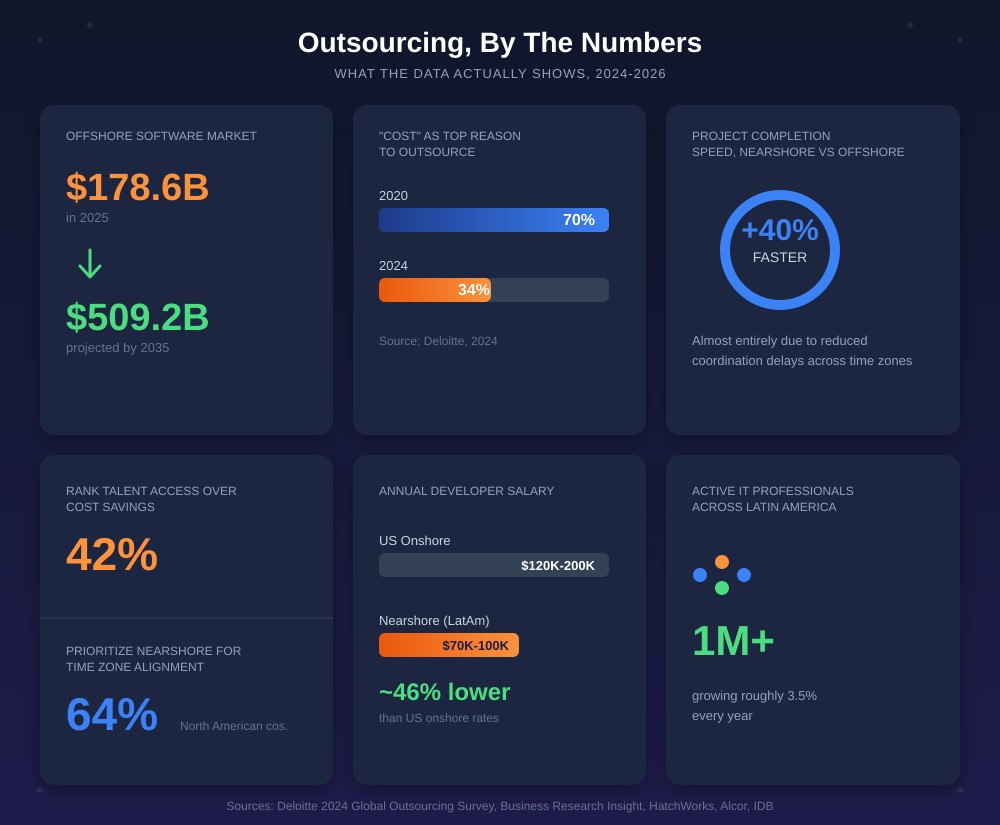
According to Deloitte’s 2024 Global Outsourcing Survey, cost concerns dropped from 70% to 34% as the primary outsourcing driver over four years. Meanwhile, 42% of companies now rank talent access over cost savings, and 64% of North American companies say they now prioritize nearshore locations when time zone alignment matters for project success.
This shift has put the nearshore vs offshore debate front and center for engineering and operations leaders. This guide breaks down what the difference between nearshore and offshore outsourcing actually means, where each model delivers, and how to make a clearer decision for your context.
What is Offshore Outsourcing, and When Does It Work?
Offshore outsourcing has the longest track record in the industry, and for good reason. The model has produced some of the world’s most well-known software products. WhatsApp famously used Eastern European engineers for early development, keeping costs low while the product scaled.
Offshore outsourcing means working with teams located in a country that is geographically distant from your own, typically in a different region with a significant time zone gap. For a US-based company, offshore destinations commonly include India, the Philippines, Ukraine, Vietnam, and Poland.
The global offshore software development market reached $178.6 billion in 2025, according to Business Research Insight, and is forecast to grow to $509.2 Billion by 2035. The appeal is primarily economic. Senior developers in India, Vietnam, or the Philippines typically earn a fraction of equivalent salaries in the US or Western Europe.
For companies with well-defined project scopes and mature internal processes, offshore teams can deliver significant cost reductions, with savings of up to 40% compared to local hiring, according to research published by World Business Outlook.

Where Offshore Works Best?
Offshore outsourcing fits well when the work is clearly defined, doesn’t require constant real-time coordination, and benefits from a large talent pool across multiple specializations.
Large-scale backend development, quality assurance, data engineering, and infrastructure work are strong candidates, as are long-term dedicated teams that have built deep context in your codebase over time.
The model also works for companies that have invested in solid asynchronous communication practices. Documentation-first cultures, structured sprint reporting, and clear specification handoff processes reduce the coordination friction that time zone differences create. Offshore works best for teams that have already solved the problem of working well in distributed, async environments.
Key Offshore Hubs by Region
India remains the most preferred offshore destination globally. Eastern Europe, particularly Poland and Ukraine, has grown quickly as a hub for technically strong engineering teams with a stronger time zone overlap for European clients. Vietnam and the Philippines continue to expand, particularly for large-scale software delivery and customer operations. According to a 2025 Doyle Group report, 76% of IT leaders currently use offshore teams, with a growing number now blending them with nearshore models to improve delivery speed.
What Is Nearshore Outsourcing, and Why Is It Growing So Fast?
Nearshore outsourcing is the model that’s gained the most ground in recent years, and the reasons are more practical than they might first appear.
Defining Nearshore
Nearshore outsourcing means working with teams in nearby countries, typically within one to three hours of your time zone. For US-based companies, the primary nearshore region is Latin America: Mexico, Colombia, Argentina, Brazil, and Chile are the most active hubs. For European companies, Eastern European countries and parts of North Africa serve a similar function. The time zone proximity is the defining characteristic.
The Inter-American Development Bank projects that nearshore outsourcing will contribute an additional $78 billion to Latin American and Caribbean export industries post-2025. That growth reflects rising demand, not just regional capacity building. Over 1 million IT professionals are active across Latin America, with the talent pool growing at roughly 3.5% annually, according to Alcor data.
What’s Driving Nearshore Growth
The shift toward nearshore outsourcing reflects a broader rethinking of what outsourcing is actually for. The practical driver is collaboration. Nearshore teams that share working hours with your internal team can join standups, resolve blockers the same day, and participate in sprint planning in real time. Nearshore teams finish projects 40% faster than offshore alternatives, according to published outsourcing statistics, and that gap is almost entirely attributable to reduced coordination delays.
Nearshore’s Cost Position
Nearshore isn’t free of cost advantages. Nearshore developers offer roughly 46% lower hourly rates compared to onshore in the US, according to HatchWorks data. Developer rates in Latin America typically range between $70,000 and $100,000 annually, compared to $120,000 to $200,000 in the US.
The cost savings are real, just more moderate than pure offshore. What nearshore trades in raw rate difference tend to recover in lower coordination overhead, fewer rework cycles, and faster delivery timelines.
What Are the Key Differences Between Nearshore and Offshore Development?
The comparison of nearshore vs offshore development companies often gets reduced to a simple cost table. The real differences run deeper than that, and they play out in ways that affect day-to-day execution, not just the invoice.
1. Time Zone: The Most Operationally Significant Difference
This is the variable that shapes everything else. Offshore teams operating eight to twelve hours away from you are, by design, working while you sleep. That’s not inherently a problem, but it means that questions don’t get answered until the next day, blockers sit unresolved, and feedback cycles stretch across multiple calendar days instead of hours.
Nearshore teams, by contrast, share four to eight hours of working overlap with US-based teams. That overlap is enough to run daily standups, resolve blockers in real time, and run sprint ceremonies without scheduling contortions. For agile development specifically, that real-time window is operationally valuable in a way that’s hard to replicate asynchronously.
BusinessWire found that 67% of US businesses choose nearshore for customer-facing operations specifically because of collaboration quality. That’s the time zone argument in practice.
2. Cultural and Communication Alignment
Cultural fit affects output quality in ways that are real but easy to underestimate. Language proficiency, shared business norms, communication directness, and familiarity with Western product management practices all influence how smoothly an external team integrates with an internal one.
Latin American teams working with US companies generally share similar business culture, high English proficiency, and familiarity with agile practices. Eastern European teams, commonly used for both nearshore European work and offshore US work, are similarly well-aligned culturally and technically.
This doesn’t mean offshore teams from India or Vietnam aren’t excellent communicators. Many are, but it does mean that cultural integration requires more deliberate investment in offshore models than nearshore ones.
3. Cost: Offshore Wins the Rate Comparison, but Not Always the Value Comparison
Offshore rates are lower in absolute terms. A senior developer in India or Vietnam will typically cost less per hour than an equivalent in Mexico or Poland. The rate table comparison favors offshore.
But the full cost calculation is more nuanced. Offshore coordination overhead, longer feedback cycles, rework from miscommunication, and higher management load all represent real costs that don’t appear on the rate card.
Cost concerns dropped as a primary outsourcing driver by 36 percentage points over four years precisely because companies were accounting for these hidden costs. The difference between offshore and nearshore outsourcing in cost is smaller in practice than the rate comparison suggests.
4. Project Type Fit
Offshore outsourcing is better suited to well-defined, documentation-heavy, execution-focused work. Long-term backend development, large-scale QA operations, and infrastructure maintenance are offshore’s strongest use cases.
Nearshore outsourcing is better suited to collaborative, iterative, agile work like MVPs, feature sprints, UX-intensive development, and any project where requirements evolve frequently and mid-sprint pivots are common.
What’s Actually Changed in Outsourcing (2024-2026)
What Are the Real Trade-Offs Companies Encounter With Each Model?
The theory is useful. The practical experience of running these engagements reveals trade-offs that don’t always show up in comparison guides.
1. Offshore Trade-Offs
The coordination cost of an 8 to 12 hour time zone gap is real and persistent. It doesn’t improve over time the way a cultural learning curve might. Teams that work well asynchronously can manage it effectively, but it requires genuine investment in tooling, documentation practices, and process discipline. Teams that rely on ad-hoc communication and quick verbal clarifications will struggle consistently.
Turnover is also a known challenge in large offshore markets, particularly in India and the Philippines, where talent competition is intense. High turnover means recurring onboarding costs and accumulated knowledge walking out the door. The best offshore engagements are ones where the provider has invested in retention and where client-side documentation practices reduce knowledge dependency on individuals.
2. Nearshore Trade-Offs
Nearshore isn’t a perfect solution. The talent pool in any single nearshore country is smaller than what a large offshore hub like India offers. For very niche specializations, particularly in AI, data engineering, or emerging infrastructure roles, nearshore markets may have limited supply.
Cost is also higher in absolute rate terms, though the total engagement cost comparison is closer than it appears. For companies where the raw rate card is the primary decision variable, nearshore will consistently look less attractive than offshore on paper, even when the operational realities favor it.
When is Nearshore the Better Choice, and When Should You Go Offshore?
The decision isn’t ideological. It comes down to project characteristics, internal maturity, and what you actually need from an external team.
1. Choose Nearshore When
Nearshore outsourcing is the stronger choice when your development process is agile and requires real-time coordination, when your project requirements are likely to evolve during delivery, when cultural alignment and communication fluency are important for client-facing or product-adjacent work, or when you’re building an MVP or shipping features under a tight timeline where speed to feedback matters more than the lowest possible rate.
Companies using nearshore staff can reduce time-to-market by 30 to 50%, particularly for MVP launches and rapid feature delivery. If that timeline compression is worth more to your business than the rate difference, nearshore is the right call.
2. Choose Offshore When
Offshore outsourcing makes more sense when your project scope is well-defined and stable, when your internal processes support asynchronous coordination, when you’re operating at scale and can absorb some coordination overhead in exchange for significant cost savings, or when you need access to a very large talent pool across multiple specializations.
Large organizations running mature outsourcing programs often use both models deliberately: offshore for execution-heavy, specification-driven work, and nearshore for collaborative product development.
3. The Hybrid Approach
The most sophisticated implementations combine both models. Follow-the-sun delivery cycles, where nearshore teams hand off to offshore teams at the end of the day, allow around-the-clock progress on large projects while keeping collaborative work in the nearshore time zone.
This model requires more coordination investment to set up, but can deliver both the speed advantages of nearshore and the cost efficiency of offshore at scale.
Rocketeams specifically supports both offshore and emerging market talent pipelines, giving clients the option to build teams that match their collaboration model rather than defaulting to one structure.
The ability to access pre-vetted professionals from markets like Pakistan, which graduates over 25,000 computer science and engineering professionals annually, gives companies a strong offshore talent option with the governance infrastructure to manage it well.
How Do You Evaluate a Nearshore or Offshore Partner Without Getting Burned?
Choosing the model is one decision. Choosing the right partner within that model is where the real variance in outcome lives.
1. Vetting Depth Matters More Than Location
Whether you’re evaluating nearshore or offshore partners, the quality of their candidate vetting process is the strongest predictor of engagement success. Multi-stage evaluations that include technical assessments, live coding or system design interviews, and communication screening separate providers who can genuinely deliver high-quality talent from those who prioritize placement speed over placement quality.
Ask any prospective partner to describe their vetting process in detail. A provider who can’t give you a specific answer about how many stages their evaluation runs, what the pass rate is, and what a typical rejection looks like is telling you something important about their process.
2. Governance Infrastructure
Location and time zone aside, the governance structure of an engagement determines whether quality holds over time. Sprint cadence support, code review standards, weekly performance reporting, and a defined escalation path for issues are baseline expectations from any professional provider. Providers who leave all of this to the client are implicitly passing all coordination and management costs to you.
3. Trial Structure as a Risk Signal
The strongest providers offer trial structures, typically two weeks, where you can evaluate the staff-augmented professional before committing to a full engagement. This isn’t just a sales tactic. It’s a meaningful signal that the provider is confident in what they’re placing. Providers who can’t offer any trial or replacement policy are implicitly telling you their confidence level in placement quality.
Making the Right Call
The nearshore vs. offshore decision depends on your project needs, collaboration style, and management capacity. Nearshore works best for agile teams that require real-time communication and cultural alignment.
Offshore delivers stronger cost efficiency and access to large global talent pools, especially for well-defined execution. In 2025–2026, companies are prioritizing total engagement value over hourly rates, recognizing that coordination friction and rework carry hidden costs.
The smartest approach is aligning your sourcing model with operational realities, not just price. For businesses seeking structured global talent solutions across both models, Rocketeams provides vetted teams, governance support, and seamless integration.
FAQs
What is the difference between shore and offshore outsourcing?
Nearshore means working with teams in nearby time zones for real-time collaboration. Offshore involves distant countries, prioritizing cost efficiency and larger talent pools.
When is nearshore outsourcing the better choice?
Nearshore suits agile projects requiring fast feedback and daily collaboration. It’s ideal for MVPs and client-facing products where speed matters.
What is nearshore outsourcing?
Nearshore outsourcing involves hiring teams in neighboring countries within one to three time zones. The key advantage is strong working-hours overlap.
What is nearshore?
Nearshore refers to outsourcing to geographically close countries with similar time zones. It balances cost savings with easier collaboration than offshore.
What is offshore sourcing?
Offshore sourcing means outsourcing to distant, lower-cost countries. It offers major savings but requires strong async communication and oversight.
Why nearshore outsourcing?
Companies choose nearshore for real-time teamwork, cultural alignment, and faster delivery. It reduces coordination delays common in offshore models.