The average time to hire a senior engineer is 44 days. For a team running two-week sprints, that is four full sprint cycles without the contributor you need. Most of those 44 days are spent on tasks that have nothing to do with human judgment: posting roles, filtering applications, scheduling calls, chasing responses. AI is changing that math.
But AI staffing augmentation is not just AI doing the admin work faster. It is a structural change in how pre-vetted technical talent gets matched to teams, how vetting quality improves over time through data, and how the gap between identifying a candidate and getting them into a sprint closes from weeks to days.
According to McKinsey’s 2025 State of AI report, 88% of organizations are now using AI in at least one business function, up from 78% a year prior. Talent acquisition is among the highest-adoption areas.
This guide covers what AI staffing augmentation actually involves, where it is creating real efficiency gains, what the challenges are, and how to evaluate an AI staff augmentation service that delivers beyond the headline.
What is AI Staffing Augmentation, and How Is It Different From Traditional Models?
Understanding AI staffing augmentation requires separating two distinct ideas that are often blended together: what AI does in the vetting and matching process, and what the augmentation model itself involves once a hire is placed.
Staff Augmentation, Defined With Precision
Staff augmentation is a workforce model where external professionals are embedded directly into a client’s team, working under the client’s direction using the client’s tools and processes. The provider handles sourcing, vetting, employment administration, and compliance. The client manages the day-to-day work.
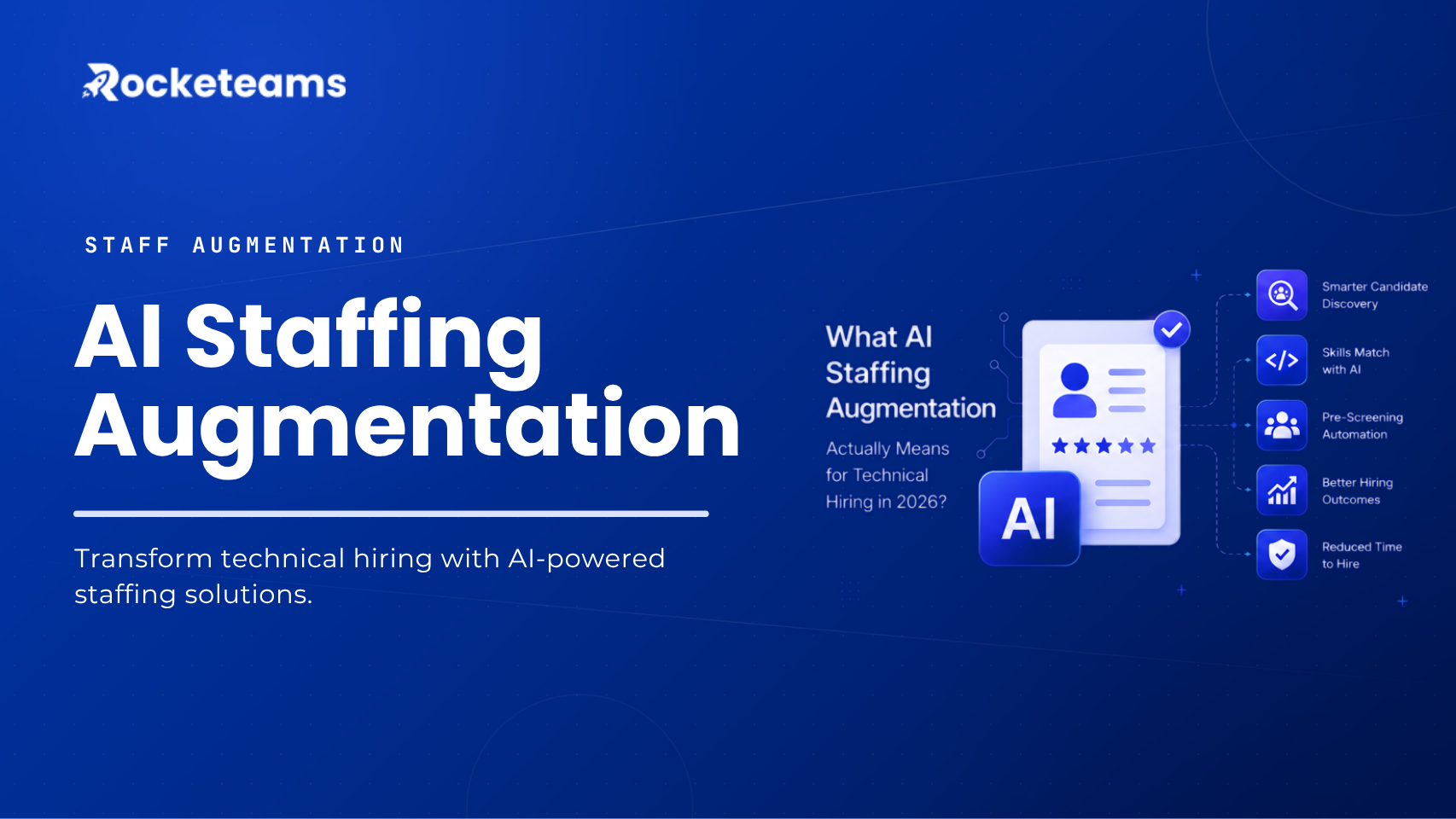
AI staffing augmentation layers AI-assisted candidate matching, AI-powered skill assessment, and predictive analytics on top of that model. The result is a faster, more accurate vetting pipeline, with candidates arriving pre-qualified at a level of consistency that manual screening processes rarely achieve at scale.
Where AI Enters the Talent Acquisition Pipeline
The traditional staffing pipeline involves a recruiter reading resumes, scheduling calls, running first-round screens, and triaging candidates by feel as much as by data. Each of those steps takes time, introduces subjective variance, and creates bottlenecks that delay delivery to the client.
In an AI-augmented staffing model, the pipeline looks different. AI systems screen resumes for skills alignment at a scale and speed no recruiter team can match, flag candidates based on past placement outcomes, schedule assessments automatically, score technical performance, and surface ranked shortlists to human reviewers.
Recruiters spend their time on the things that actually require human judgment: evaluating communication quality, assessing cultural fit, and making the final placement recommendation.
The Accuracy Shift AI Brings to Candidate Selection
AI screening tools now achieve 89 to 94% accuracy in resume parsing and skill matching, according to SHRM research cited in Second Talent’s 2025 benchmarking data. Organizations using AI-powered recruitment tools report 31% faster hiring times and a 50% improvement in quality-of-hire metrics. That accuracy improvement is not just an operational convenience. It directly reduces the downstream cost of poor placements, which remains one of the highest hidden costs in augmented staffing.
Core Benefits of Staff Augmentation for SMEs
For small and medium-sized enterprises (SMEs), building a strong technical team can be challenging. Limited hiring budgets, talent shortages, and rapidly changing technology demands often make traditional recruitment slow and expensive. Nearshore staff augmentation allows businesses to hire skilled talent from nearby regions, offering better time zone alignment
Staff augmentation offers a flexible alternative, allowing SMEs to quickly access skilled professionals without the long-term commitments of permanent hiring.
-
Access to Specialized Skills
Staff augmentation allows SMEs to quickly access highly specialized professionals without long recruitment cycles. Businesses can bring in experts in areas such as cybersecurity, cloud computing, artificial intelligence, and data science as soon as projects require them.
For many organizations, this solves a major hiring challenge, as more than half of SMEs report difficulty finding qualified candidates. Augmentation helps companies stay competitive by accessing the expertise needed to adopt new technologies and deliver complex projects.
2. Cost Efficiency
One of the strongest advantages of IT staff augmentation is cost control. Companies avoid the overhead costs associated with full-time hiring, including benefits, training, office space, and long-term salary commitments.
Instead, businesses pay only for the skills required during a specific project or timeframe. This flexible cost structure allows SMEs to manage budgets more efficiently while still accessing high-quality talent when needed.
3. Scalability and Flexibility
Market conditions and project requirements can change quickly, especially for growing SMEs. Staff augmentation allows companies to scale their teams up or down depending on current needs.
This flexibility makes it easier to respond to new opportunities, adjust resources during slower periods, and maintain operational efficiency without restructuring the entire workforce.
4. Faster Time-to-Market
Pre-vetted augmented professionals can integrate into teams quickly, reducing the time needed for recruitment and onboarding. With experienced specialists joining projects sooner, companies can accelerate development cycles and deliver products faster.
What Problems is AI Staffing Augmentation Actually Solving?
AI hasn’t introduced new hiring challenges. It’s solving long-standing ones that traditional recruiting processes struggle with overwhelming candidate volume, inconsistent vetting, slow hiring cycles, and limited visibility into talent pipelines.
For companies using AI staffing augmentation, the real advantage is combining automation with human expertise to make hiring faster, more consistent, and more scalable. Explore the key differences to determine which model best fits your business strategy and growth plans.
Below are the most common problems AI-driven staffing models are designed to solve.
1. The Volume Problem in Technical Talent Sourcing
Modern tech roles attract thousands of applications, making manual screening slow and inefficient. AI-powered sourcing tools can analyze resumes, portfolios, and profiles at scale, quickly filtering candidates who meet specific technical requirements.
This allows AI staffing augmentation firms to maintain large, active talent pipelines and present qualified candidates faster. Instead of weeks of manual review, organizations can identify high-potential engineers, developers, or data specialists in days.
2. Inconsistent Candidate Vetting
Traditional hiring depends heavily on individual recruiters, which often leads to inconsistent evaluations. Two recruiters may interpret the same resume or interview performance differently. AI-driven assessment tools apply standardized criteria across all candidates, creating a more consistent screening process. This improves placement accuracy and reduces variability in hiring decisions, allowing staffing teams to deliver candidates whose technical skills and experience are validated through repeatable evaluation frameworks.
3. Slow Hiring Cycles
Hiring specialized engineers through traditional recruitment can take weeks or even months. AI helps accelerate the process by automating resume screening, skill matching, and candidate ranking. Recruiters can quickly identify top candidates instead of manually sorting through applications. This reduces time-to-shortlist significantly and enables companies using AI staffing augmentation to fill technical roles faster while still maintaining strong evaluation standards.
4. The Speed vs. Quality Trade-Off
Historically, companies had to choose between hiring quickly or vetting thoroughly. Fast hiring often meant taking risks on candidate quality, while thorough vetting slowed hiring timelines.
AI reduces this trade-off by analyzing large datasets quickly while maintaining structured evaluation criteria. As a result, recruiters can move faster without sacrificing screening depth, allowing teams to maintain both hiring speed and technical quality.
5. Limited Visibility Into Talent Pipelines
Many organizations lack real-time insight into available talent across different markets and skill sets. AI-powered staffing platforms track candidate data, skill trends, and hiring activity across multiple channels.
This visibility helps recruiters identify emerging talent pools, predict hiring availability, and match candidates to open roles more effectively. For augmentation providers, this means faster access to specialists across multiple technical domains.
6. Talent Matching Accuracy
Matching candidates to the right role is one of the hardest parts of recruiting. AI improves this by analyzing not just resumes but also skills, project history, tools used, and career progression patterns.
These insights help staffing teams identify professionals whose experience aligns closely with the technical and operational needs of a project, increasing the likelihood of successful placements and reducing costly hiring mismatches and the detailed cost breakdown to understand where your budget goes and how to plan your app investment effectively.
7. Bias and Fairness in Hiring
Human decision-making can unintentionally introduce bias during candidate screening. When properly designed and monitored, AI systems can evaluate candidates using consistent criteria, helping reduce bias related to background, location, or educational history.
This expands access to global talent pools and improves diversity in hiring pipelines. However, responsible providers continuously monitor AI systems to ensure training data does not unintentionally reinforce historical bias.
8. Recruiter Productivity Bottlenecks
Recruiters often spend a significant portion of their time on repetitive tasks such as resume screening, candidate outreach, and scheduling interviews. AI automation reduces this administrative burden by handling repetitive workflows.
This allows recruiters to focus more on high-value activities like candidate engagement, technical validation, and client communication, improving both efficiency and hiring outcomes.
How to Evaluate and Work With an AI Staff Augmentation Service
As AI becomes a buzzword in hiring, many providers claim to offer AI-powered staffing without actually changing how recruitment works. Gartner even identified a growing trend of “AI washing,” where traditional tools are simply rebranded as AI solutions.
To choose the right AI staff augmentation service, it’s important to evaluate how AI is truly integrated into the hiring process, not just how it’s marketed.
-
Understand Where AI Is Used in the Hiring Pipeline
A credible provider should clearly explain where AI supports their process. This may include talent sourcing, resume screening, technical skill analysis, candidate ranking, interview scheduling, or predictive fit modeling.
If AI is only used for basic resume parsing, the impact is limited. However, when AI supports deeper functions such as skill scoring, candidate matching, and talent pipeline analytics, it creates a more efficient and accurate hiring process.
2. Strong Vetting Still Requires Human Expertise
AI improves efficiency, but it doesn’t replace human judgment. The best AI staffing augmentation providers combine AI-driven screening with structured human evaluation.
AI can handle large candidate volumes and initial filtering, while recruiters assess communication skills, problem-solving ability, and cultural fit. This hybrid approach ensures both speed and placement accuracy.
3. Pre-Vetted Talent Pools Enable Faster Hiring
One of the biggest advantages of AI staffing augmentation is speed. Leading providers maintain continuously updated talent pools sourced through AI-powered systems.
Because candidates are already screened and assessed before client requests arrive, companies can receive qualified profiles within days instead of weeks. This pre-vetting model allows teams to hire quickly without compromising evaluation quality.
4. Governance and Delivery Support Matter
Technology alone doesn’t guarantee successful placements. Effective staff augmentation services also include operational support such as performance tracking, sprint alignment, communication standards, and escalation protocols.
Without this governance layer, companies may end up managing all coordination themselves. The best providers combine AI-powered hiring with structured engagement management to ensure augmented professionals deliver consistent results.
5. Trial Periods Show Confidence in Talent Quality
A risk-free trial period is one of the strongest indicators of provider confidence. Firms that offer short trial engagements allow clients to evaluate technical performance, communication, and team fit before committing long-term.
Providers unwilling to offer trials often signal uncertainty about placement consistency. A transparent trial structure reduces hiring risk and builds trust in the augmentation process.
Common Challenges in AI Staff Augmentation
While AI staffing augmentation offers faster hiring, access to specialized expertise, and operational flexibility, it also introduces challenges that organizations must manage carefully.
Successfully integrating augmented professionals requires structured processes, strong communication, and clear governance. Below are the most common challenges businesses face when implementing AI staff augmentation and how they can address them effectively.

-
Skill Mismatch and Hiring Risks
One of the biggest risks in AI staff augmentation is hiring talent that does not fully match the technical or cultural requirements of a project. When organizations rush the selection process, they may onboard professionals whose skills or working style do not align with team expectations.
Working with a reliable AI staff augmentation service that conducts rigorous technical assessments, AI-powered screening, and cultural fit evaluations helps minimize this risk. Trial engagements or probationary periods can further validate whether the candidate fits the role.
2. Communication and Time Zone Differences
Distributed teams often operate across different time zones and collaboration styles, which can slow decision-making and delay project progress. Without clear communication protocols, misunderstandings can arise between internal teams and augmented professionals.
Companies should establish defined communication channels, overlapping work hours where possible, and structured workflows using collaboration tools like Slack, Microsoft Teams, Jira, or Asana. Regular stand-ups and sprint reviews also help maintain transparency and alignment.
3. Onboarding and Team Integration
Traditional onboarding approaches may not work effectively for augmented staff. External professionals need quick access to systems, project context, documentation, and team workflows to become productive quickly.
Companies should implement structured onboarding programs that introduce new staff to internal processes, project goals, and organizational culture. Treating augmented professionals as integrated team members rather than temporary contractors significantly improves collaboration, trust, and productivity.
4. Data Security and Privacy Risks
Augmented professionals may work with sensitive business data, intellectual property, or customer information. Without strong security practices, organizations risk exposing critical assets. Companies must enforce NDAs, intellectual property protection clauses, role-based access controls, and secure authentication systems such as multi-factor authentication. Compliance with data protection regulations like GDPR should also be integrated into contracts and operational practices to ensure legal and operational security.
5. Managing Project Expectations
Misaligned expectations around timelines, deliverables, and quality standards can create friction between internal teams and augmented professionals. Organizations should define clear project scopes, performance metrics, and escalation processes from the beginning.
Establishing standard operating procedures (SOPs), clear reporting structures, and regular progress reviews helps maintain accountability and ensures everyone is aligned on project outcomes.
6. Maintaining Consistent Performance Standards
When external professionals join existing teams, maintaining consistent performance and quality standards can be challenging. Differences in coding practices, documentation habits, or development methodologies may create inconsistencies.
Companies should establish clear development guidelines, code review processes, and performance benchmarks. Continuous feedback and regular evaluations ensure augmented professionals meet the same standards expected from internal team members.
The Future of Staff Augmentation
Staff augmentation is evolving from a simple hiring solution into a strategic workforce model. In 2026, the focus is no longer just on adding extra developers or filling temporary roles. It’s about building scalable teams that combine human expertise with automation, AI tools, and modern platforms.
Organizations adopting AI-driven and platform-led workforce strategies can scale projects faster, adapt to changing market demands, and reduce operational friction. Companies that rely only on traditional hiring models risk slower growth and limited access to global talent. The future of augmentation lies in intelligent, flexible teams designed to deliver outcomes rather than simply expand headcount.
FAQs
What is AI staffing augmentation?
AI staffing augmentation uses artificial intelligence to improve how companies source, screen, and match technical talent. While the staffing model remains the same, AI speeds up candidate discovery, improves vetting accuracy, and helps deliver qualified professionals faster to your team.
What is AI staff augmentation?
AI staff augmentation combines traditional staff augmentation with AI-powered hiring tools. AI analyzes candidate data, skills, and experience to help recruiters identify the best professionals who can integrate quickly into your projects.
What is an example of AI staffing augmentation?
An AI system scans thousands of candidate profiles, ranks engineers based on skill requirements, and schedules technical assessments automatically. Recruiters then review the top candidates for communication skills and team fit before final selection.
How is AI used in staffing?
AI helps automate tasks such as resume screening, skill matching, interview scheduling, and predictive hiring analytics. Many AI staff augmentation services also use AI to monitor candidate performance and engagement during active projects.
What is AI agent augmentation?
AI agent augmentation uses autonomous AI systems that can perform multi-step tasks such as sourcing candidates, building talent pipelines, and scheduling interviews automatically based on predefined hiring criteria.
What are the four types of AI agents?
The four main AI agents are simple reflex agents, model-based reflex agents, goal-based agents, and utility-based agents. In staffing systems, goal-based and utility-based agents are commonly used to optimize candidate selection.
What does augmentation mean in AI?
In AI, augmentation means enhancing human capabilities rather than replacing them. In staffing, AI supports recruiters by handling data-heavy tasks while humans make final hiring decisions and manage candidate relationships.