A few years ago, most enterprise AI conversations stayed in a narrow lane: better predictions, smarter recommendations, faster fraud detection. The tools were powerful but quiet, running in the background of operations that most users never saw.
Then generative AI arrived, and the conversation shifted entirely. Suddenly, AI wasn’t just running the pipes; it was writing the memo, drafting the pitch deck, and explaining its own output. The two types of AI can look like rivals, but that framing misses something important. They solve fundamentally different problems, and the best enterprise strategies use both.
What Is Traditional AI, and Where Does It Fit?
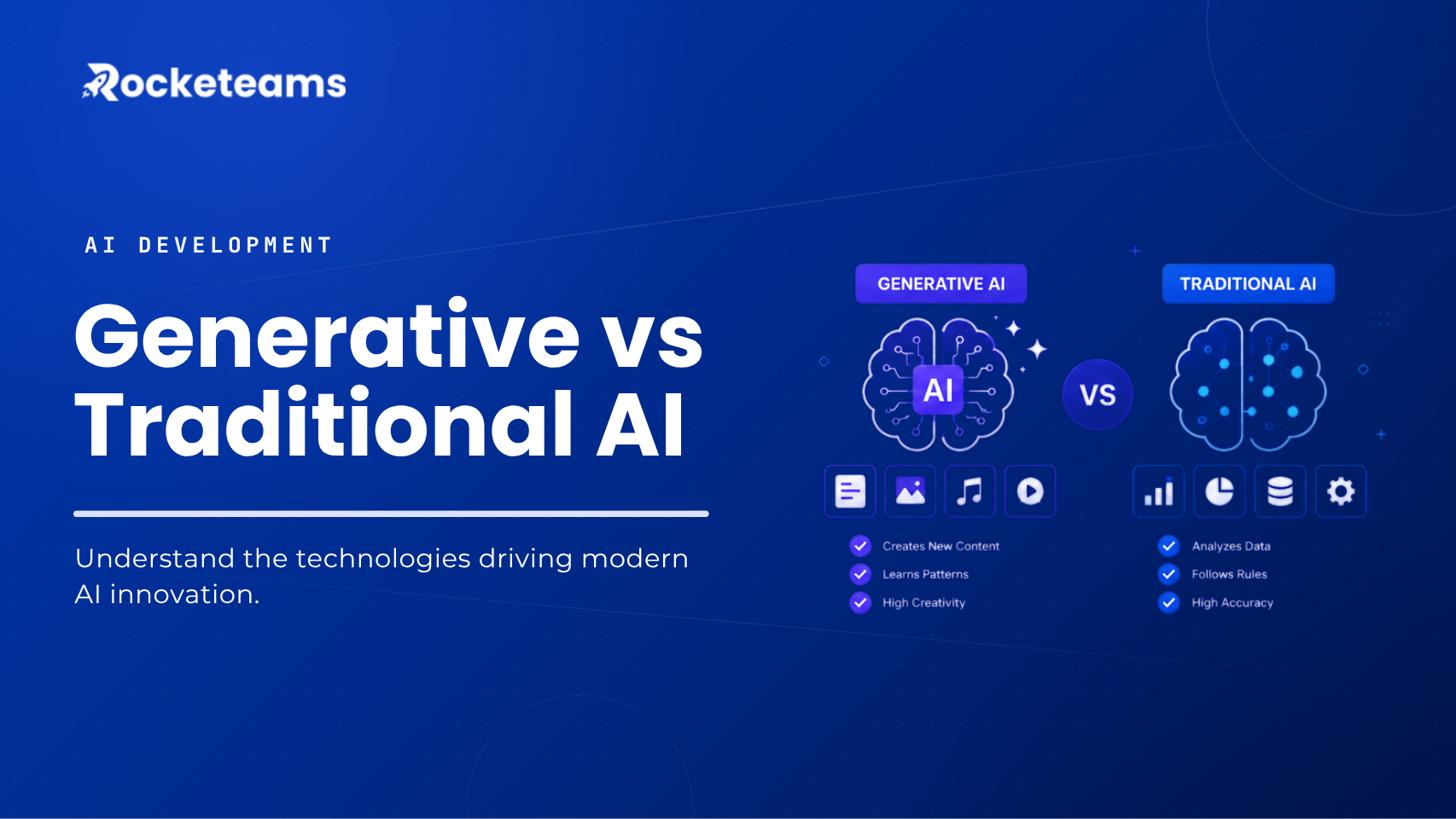
Traditional AI, often called narrow or classical AI, refers to systems trained to perform a specific, well-defined task. Given labeled data, a traditional AI model learns patterns and uses them to make predictions or classifications. It doesn’t create anything; it analyzes, ranks, or decides based on what it was trained to recognize.
The practical applications are everywhere. Credit scoring models that assess loan default risk. Demand forecasting systems that predict inventory needs six weeks out. Recommendation engines that surface the right product at the right time. Anomaly detection tools that flag unusual transactions in milliseconds.
These systems are extraordinarily good at what they do, precisely because they’re narrow. A fraud detection model isn’t trying to understand context; it’s pattern-matching against billions of prior transactions to score a new one.
Traditional AI thrives when the problem is well-structured, the data is labeled, the outcome is measurable, and consistency matters more than creativity. It’s the engine behind most of the operational efficiency gains enterprises have already realized from AI investment.
The Core Strengths of Traditional AI for Business Operations
Traditional AI models tend to be computationally lean, interpretable, and auditable by design. In regulated industries like banking and healthcare, the ability to explain why a model made a decision isn’t optional. A logistic regression model that scores credit applications can be interrogated at the feature level. A random forest predicting equipment failure can surface which sensor readings drove the alert.
That explainability is a genuine competitive advantage in contexts where regulators, auditors, or customers need a reason, not just a result. It’s also why NIST’s AI Risk Management Framework treats transparency as a foundational requirement for high-stakes AI deployment.
What Is Generative AI, and How Does It Differ?
Generative AI refers to models trained not to classify existing data but to produce new content: text, images, code, audio, video, and increasingly, structured data. Large language models like GPT-4, Claude, and Gemini are the most prominent examples, but the category extends to image generation models, code generation tools, and multimodal systems that handle several content types at once.
The underlying architecture is different at a fundamental level. Traditional AI models are typically discriminative: they learn to draw a boundary between classes based on training data. Generative models learn the underlying distribution of the data itself, which is what allows them to produce new outputs that fit the same distribution. A model trained on legal documents doesn’t just classify them; it can write new ones.
This shift in what the model does changes everything about how it’s used, where it adds value, and where it creates risk.
How Generative AI Opens New Business Possibilities?
The highest-impact generative AI use cases in enterprise settings tend to cluster around tasks that were previously bottlenecked by human writing time, synthesis, or translation between formats.
Content at scale is the clearest example. Marketing teams that previously took weeks to produce a campaign’s worth of localized content can now compress that timeline dramatically, with human editors reviewing and refining rather than starting from scratch. According to Menlo Ventures’ 2025 State of Generative AI in the Enterprise report, enterprise spending on generative AI reached $37 billion in 2025, a 3.2x increase from the prior year, with marketing platforms hitting $660 million alone.
Software development is another strong example. Developers using AI coding assistants report consistent velocity gains, with teams completing tasks 15% faster on average, as reported in the same Menlo research. Tools like GitHub Copilot don’t replace engineers; they accelerate the drafting, refactoring, and documentation work that consumes more time than most people realize.
Customer-facing document generation, contract summarization, RFP response drafting, internal knowledge base queries: all of these involve turning information into natural language, which is precisely what generative models were built to do.
Where Do Traditional AI and Generative AI Actually Diverge?
The clearest way to separate the two is to look at what the output is and how predictable it needs to be.
Traditional AI produces a score, a classification, or a ranked list. Given the same input, it produces the same output. That determinism is a feature, not a limitation, when you need consistency across millions of decisions.
Generative AI produces content: text, images, code, structured outputs. Given the same input, it may produce slightly different outputs each time. That variability is what makes it creative and context-aware, but it’s also what makes it unsuitable for tasks where the answer is objectively right or wrong.
Data Requirements and Computational Demands
The resource profiles of the two approaches are also quite different, and this matters for any organization building a business case.
Traditional AI models can often be trained on relatively modest datasets, provided the data is well-labeled and representative. A churn prediction model might need hundreds of thousands of historical customer records, but that’s data most enterprises already have. Training and inference are computationally inexpensive by current standards. A traditional model running in production might cost a few dollars an hour in cloud computing.
Generative AI is fundamentally different in its resource requirements. Foundation models like GPT-4 or Claude were trained on computers that cost hundreds of millions of dollars. For most enterprises, that means working with pre-trained models through an API or fine-tuning a smaller open-source model on proprietary data.
Neither approach requires training from scratch, but the inference costs are still meaningfully higher than traditional AI, and the infrastructure requirements for low-latency deployment at scale are non-trivial.
Google’s documentation on ML model deployment and AWS’s AI services overview both offer useful reference points for understanding the compute and latency tradeoffs between classical ML and LLM-based systems in production environments.
Accuracy, Reliability, and the Hallucination Problem
Traditional AI models have a well-understood failure mode: they’re accurate within the distribution of their training data and degrade predictably when the input drifts away from what they’ve seen before. The failure is detectable and often correctable with retraining.
Generative AI has a more challenging failure mode: hallucination. Models can produce fluent, confident-sounding content that is factually wrong. Research cited in enterprise AI adoption surveys found that 77% of businesses express concern about AI hallucinations, and 47% of enterprise AI users admitted to making at least one major business decision based on hallucinated content in 2024. That’s a significant operational risk for any business function where factual accuracy matters.
The mitigation strategies are known: retrieval-augmented generation, which grounds the model’s outputs in verified documents; structured output formats that reduce surface area for fabrication; and human review workflows for high-stakes outputs. But these mitigations add complexity and cost to deployment, which is worth factoring into any honest comparison with traditional AI.
How Should You Choose Between Them for a Specific Business Problem?
The decision framework is more straightforward than the vendor landscape suggests. The key questions are:
Does the task require producing new content, or evaluating existing content? If producing, generative AI is likely the right starting point. If evaluating or classifying, traditional AI is typically more accurate and cheaper.
Is the answer to the problem objectively correct or wrong? If yes, traditional AI with its deterministic outputs is almost always preferable. If the task involves synthesis, explanation, or communication, generative AI’s natural language strengths become relevant.
Does the output need to be explainable to a regulator, auditor, or customer? If yes, traditional AI’s inherent interpretability is a significant advantage that generative AI currently struggles to match consistently.
What’s the tolerance for error? Traditional AI errors are predictable. Generative AI errors can be surprising and hard to detect without human review. Higher-stakes decisions warrant lower error tolerance, which generally favors traditional approaches or robust human-in-the-loop generative workflows.
Where Combining Both Delivers More Than Either Alone
The most productive enterprise AI architectures in 2025 tend to use traditional and generative AI together rather than choosing between them. A customer support system might use a traditional classifier to route incoming tickets by type and urgency, then use a generative model to draft the response, with the human agent reviewing before sending. The classifier is fast, deterministic, and cheap. The generative layer handles the nuanced communication that a template can’t cover.
Supply chain management offers another example. A traditional forecasting model predicts demand and flags anomalies. A generative AI layer translates those predictions into plain-language summaries for non-technical stakeholders, or drafts supplier communications when an exception occurs. Neither layer does the other’s job better.
Together, they reduce the total human effort required while keeping the high-accuracy decisions in the domain of the more reliable model. This hybrid design also makes iteration easier: when the generative layer underperforms, you update the prompts without touching the forecasting logic. Each component stays cleanly separated and auditable.
Deloitte’s 2026 State of AI in the Enterprise report found that 66% of organizations report productivity and efficiency gains from AI adoption, but only 20% are already seeing revenue growth, with 74% still treating revenue impact as a future aspiration.
That gap reflects a pattern: organizations that use AI to optimize existing workflows see efficiency gains, while those that redesign workflows around AI’s strengths, including combining traditional and generative capabilities, tend to see the deeper impact.
What Are the Ethical and Risk Considerations Worth Taking Seriously?
Both AI types carry risks, but they manifest differently.
Traditional AI carries well-documented risks around bias embedded in training data. A hiring model trained on historical data from a workforce that was historically homogeneous will replicate that homogeneity unless the training process is explicitly designed to prevent it.
The EU AI Act, which began phasing into enforcement in 2024 and 2025, imposes specific obligations on high-risk AI systems, which include many traditional AI applications in hiring, credit, healthcare, and law enforcement.
Generative AI raises distinct concerns: intellectual property questions around training data, misinformation risk from realistic synthetic content, privacy risks when models are fine-tuned on proprietary or personal data, and the hallucination problem already described.
A 2025 survey found that 72% of executives are concerned about ethical issues like privacy loss when deploying generative AI, and 49% worry about the erosion of the human touch in customer-facing applications.
The practical takeaway for enterprise teams is that both types require explicit governance. What data was the model trained on? How are outputs monitored for drift or quality? Who is accountable when the model makes a consequential error? These questions don’t go away with better technology; they have to be answered in policy before deployment.
Conclusion
Generative AI and traditional AI aren’t competing for the same use cases. One produces outputs, the other evaluates them. One thrives on ambiguity and synthesis, the other on precision and scale. The question worth asking isn’t which is better, but which one fits the problem in front of you, and in many enterprise applications, the answer is both.
The organizations seeing the clearest returns from AI investment right now aren’t the ones that picked a side in the generative-versus-traditional debate. They’re the ones that understood what each approach is actually good at, deployed accordingly, and built the governance structures to keep both reliable and trustworthy over time. That clarity, specificity, and oversight is what separates a working AI strategy from a stalled one.
FAQs
1. What are the fundamental differences between Generative AI and Traditional AI, and how do these differences impact their application in business?
Traditional AI classifies, predicts, or scores based on patterns in existing data. Generative AI creates new content. In practice, this means traditional AI suits decisions that need consistent, auditable outputs, while generative AI suits tasks that involve producing language, code, or synthesized information.
2. How can Generative AI create new opportunities for content creation, product design, or personalized customer experiences that Traditional AI cannot?
Generative AI can produce context-aware, natural-language outputs at scale, handling tasks like drafting personalized communications, generating product descriptions across thousands of SKUs, or explaining complex data to non-technical audiences- work that traditional AI cannot do because it doesn’t generate new content.
3. What are the data requirements and computational resources needed for implementing Generative AI solutions compared to Traditional AI models?
Traditional AI models can often be trained on enterprise-owned datasets with modest compute. Generative AI typically requires working with large pre-trained models via API or fine-tuning open-source models, both of which carry higher inference costs and more complex infrastructure requirements than classical ML in production.
4. How do you determine whether a business problem is best solved with Generative AI or Traditional AI, and what is your decision-making process?
The core questions are: Does the task require creating new content or classifying existing content? Does the answer need to be deterministic and auditable? What’s the tolerance for error? Problems needing precision and consistency point to traditional AI; problems needing synthesis, communication, or content generation point to generative AI.
5. What are the ethical considerations and potential risks associated with deploying Generative AI, and how do you address them in your development process?
The main risks are hallucination, intellectual property ambiguity, and privacy exposure when fine-tuning on sensitive data. Mitigations include retrieval-augmented generation to ground outputs, human review workflows for high-stakes content, and explicit data governance policies covering what the model can and cannot access.
6. Can you provide examples of successful business applications where Generative AI has delivered significant value compared to Traditional AI approaches?
Marketing content localization, software development acceleration, RFP drafting, and customer support response generation are among the strongest enterprise examples. In each case, the value comes from replacing or augmenting tasks that require human writing time, not from replacing the predictive functions where traditional AI already excels.
7. What is the typical development timeline and cost for implementing solutions based on Generative AI versus Traditional AI?
A traditional AI model project with clean data can often reach production in two to four months. Generative AI implementation using existing foundation models via API can be faster in early stages but requires more iteration on prompt design, safety testing, and output quality validation before production. Full workflow integration for either approach typically adds two to six months regardless of the underlying model type.