Most businesses have already experimented with AI in some capacity. A chatbot here, a recommendation widget there. But the conversation has shifted. The question is no longer whether AI belongs in business operations. It’s whether the AI you’ve deployed is actually making decisions, or just answering questions.
That distinction is exactly what separates AI agents from everything that came before them. And it’s why operations leaders, product teams, and CFOs are paying close attention right now.
What Makes AI Agents Different From Traditional Automation?
It’s easy to lump AI agents in with broader automation tools, but the two operate fundamentally differently.
Traditional automation, whether it’s RPA bots or rule-based workflow software, follows fixed instructions. It executes step A, then step B, then step C. It’s reliable for predictable, high-volume tasks, but it breaks the moment something unexpected happens. Change the invoice format, and the bot fails. Add a new compliance field, and someone has to record the rule.
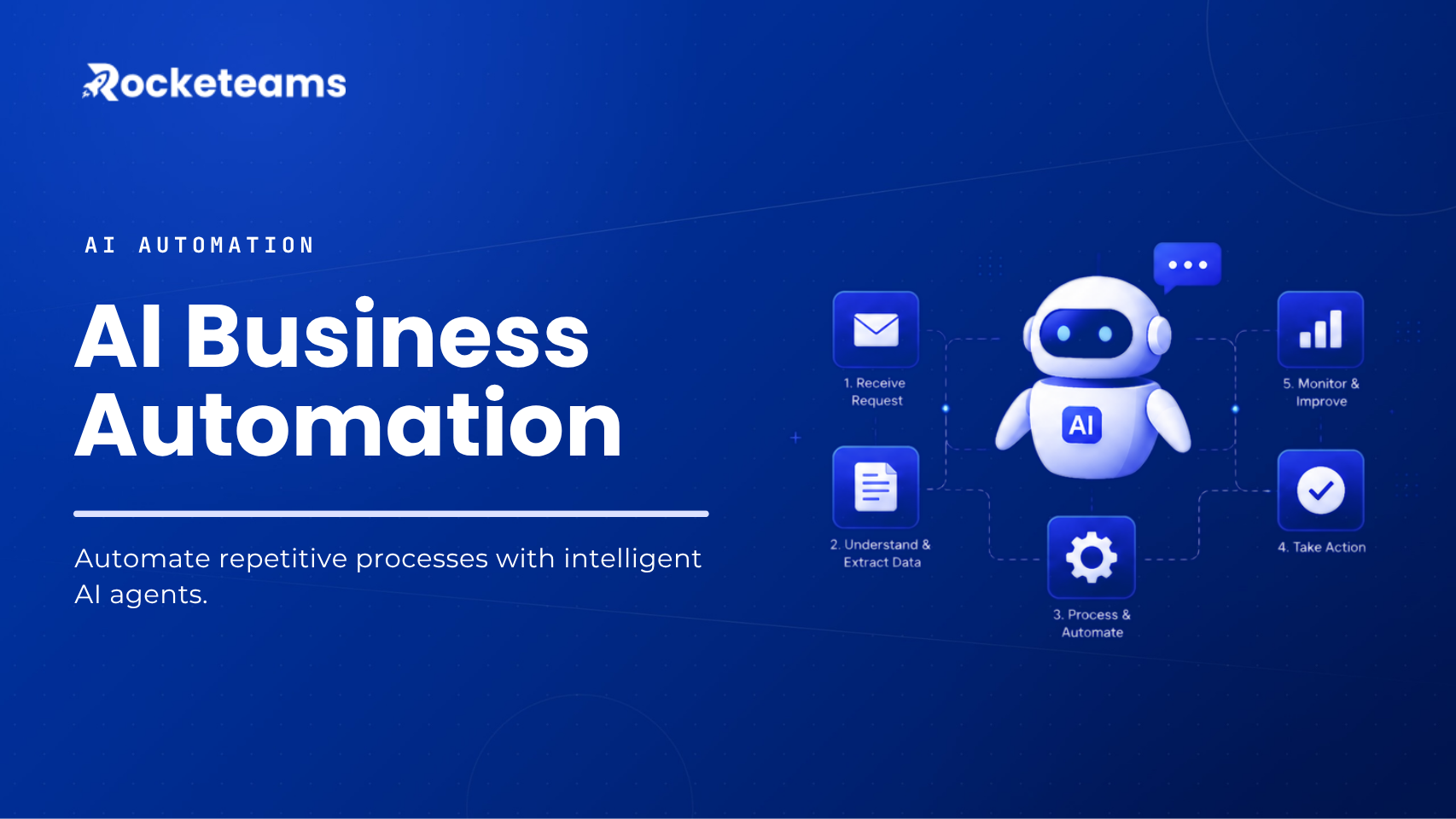
AI agents work differently. They reason through a goal, plan a sequence of steps to reach it, interact with multiple systems along the way, and adjust when conditions change. They can handle unstructured data, interpret natural language, and make judgment calls within defined boundaries, all without needing a human to review every step.
How Agentic AI Differs From Generative AI in a Business Context?
Generative AI creates content. Give it a prompt, and it produces text, code, summaries, or images. It’s useful, but it’s reactive by design. The loop starts and ends with the prompt.
Agentic AI takes things further. An agent can receive a high-level goal, break it into sub-tasks, call on different tools and APIs to complete each one, handle errors as they arise, and deliver a completed outcome rather than a draft for someone to review. A generative model writes a contract summary. An agentic system reads the contract, flags the clauses that need legal review, routes it to the right person, and logs the status, all in a single automated workflow.
This distinction matters practically because it changes what you’re buying when you invest in AI agents for business automation. You’re not just getting smarter content. You’re getting a system that can own a workflow.
Which Business Processes Are Actually Suited for AI Agents?
Not everything benefits from an autonomous agent, and one of the more useful questions a business leader can ask is: where does the cost of waiting for human input outweigh the risk of an AI acting on its own?
The answer tends to cluster around a few categories.
High-Volume, Rule-Adjacent Processes
These are tasks that have too many variables for simple automation but follow a pattern that an AI can handle reliably in most cases. Invoice processing is a good example. Most invoices arrive in different formats, require matching to a PO, and need a routing decision based on amount and vendor type. A traditional rule engine struggles with format variation. A well-trained AI agent handles it, flags edge cases for human review, and learns from corrections over time.
Customer support is another strong candidate. Research from McKinsey’s 2025 State of AI report shows that contact-center automation is one of the most widely deployed AI use cases, and organizations that have moved from basic chatbots to agentic support systems report meaningful reductions in handling time without sacrificing resolution quality.
Cross-System Workflows That Currently Require Human Coordination
Many business processes stall not because they’re cognitively difficult but because they require a person to move information between systems: pull data from CRM, update a spreadsheet, send a summary email, log an entry in a project management tool. These are exactly the workflows where multi-agent systems add disproportionate value. One agent can handle data retrieval, another formats and routes it, and a third handles notification and logging, all without a coordinator in the middle.
Decision-Light Monitoring and Escalation
Predictive maintenance is a clear example here. An AI agent continuously monitors equipment sensor data, identifies patterns that precede failures, and schedules maintenance before a breakdown occurs. The agent doesn’t decide whether to repair a machine; it flags the right conditions and initiates the right workflow. A similar model applies to fraud monitoring in financial services, supply chain exception management, and IT incident triage.
The common thread across all three categories is that the task has clear success criteria, errors are recoverable, and the value of speed outweighs the value of human sign-off on every individual case.
How Do AI Agents Actually Improve Business Operations?
The operational improvements from AI agent deployment fall into a few distinct buckets, and it’s worth separating them because they affect different parts of the business case.
Speed and Throughput
Agents don’t have business hours, queue anxiety, or cognitive fatigue. A workflow that takes a team three days to process manually because it has to pass through multiple people can run in hours when an agent handles the coordination. This is where most of the initial ROI case gets built.
According to McKinsey’s 2025 AI research, organizations classified as AI high performers are scaling agents across multiple functions and are significantly more likely than peers to report meaningful productivity gains. The gap isn’t primarily about model quality. It’s about whether the AI has been integrated deeply enough into a workflow to actually own tasks rather than assist with them.
Accuracy and Consistency
Human performance on repetitive tasks degrades over time. Agents don’t. For processes like data entry, document extraction, or compliance checks, the accuracy benefit compounds quickly, especially in regulated industries where errors carry direct financial consequences.
Freeing Up Human Capacity for Higher-Value Work
This is the ROI argument that tends to land best with operations leaders. It’s not that AI agents replace people; it’s that they handle the work that currently prevents skilled employees from doing what they were actually hired to do. A support team that spends 60% of its time on routine order status queries can redirect that capacity to complex cases, customer retention conversations, and process improvement once agents handle the routine tier.
What Does an Effective AI Agent Deployment Strategy Look Like?
Teams usually determine the gap between a successful deployment and a stalled pilot by how they scope and sequence the project, not by the underlying technology.
Start With a Well-Bounded Problem
The teams that see the fastest results from AI agent deployment tend to start with workflows that have clear inputs, defined success metrics, and contain failure modes. An agent that handles initial customer inquiry triage is a better first project than one that manages end-to-end contract negotiation. The former has a narrow scope, clear quality signals, and easy human override. The latter has too many variables and too much downside risk to run unsupervised in early stages.
IBM’s guidance on AI agent implementation recommends establishing what they call “trust architecture” before scaling: defining which actions an agent can take autonomously, which require human confirmation, and which should never be agent-handled regardless of confidence level. Building this framework early saves significant rework later.
Prioritize Integration Quality Over Feature Set
An AI agent is only as useful as its ability to actually interact with the systems it needs. An agent that can reason beautifully but can’t write to your CRM or pull from your ERP isn’t solving a real business problem. Integration architecture deserves more attention in planning than most teams give it.
Salesforce’s Agentforce documentation offers a useful reference point here. Their agent framework is built explicitly around the idea that an agent’s capability is bounded by its tool integrations, not its underlying model, which is a useful framing for any enterprise deployment decision.
Build for Auditability From Day One
One of the consistent mistakes in early agentic AI deployments is treating auditability as a compliance requirement to add later rather than a design principle to bake in from the start. Every action an agent takes should be logged in a way that lets you understand what it observed, what it decided, and why. This matters for debugging, for regulatory compliance in industries like financial services and healthcare, and for building internal trust with the teams who work alongside the agent.
NIST’s AI Risk Management Framework provides a solid baseline for how to think about accountability and transparency in AI system design, particularly for enterprise contexts where agent decisions affect customers or financial outcomes.
What Are the Real Risks, and How Do You Manage Them?
Agentic AI carries risks that are qualitatively different from traditional software bugs. When a rule-based system makes an error, it usually fails in the same predictable way every time. When an AI agent makes an error, it can make novel ones, acting on a combination of inputs that the development team never anticipated.
This doesn’t mean agents are unsafe. It means they require a different approach to risk management.
Define the Boundaries Before You Deploy
The clearest risk mitigation strategy is scope control. An agent should have a precise, documented list of what it can and cannot do. Permissions for financial transactions should be capped. Actions that affect customer accounts should have confirmation requirements above certain thresholds. Systems that an agent can write to should be explicitly listed, not implied.
Gartner has noted that organizations pursuing agentic AI should focus on deployments with clear business value and robust governance built in from the start, recommending against broad autonomous authority without explicit risk controls.
Handle Sensitive Data With Extra Rigor
AI agents for business automation often need access to sensitive information: customer records, financial data, employee information, health records. The privacy architecture for these systems needs to be as deliberate as the agent logic itself. Data minimization (giving agents access only to what they actually need), encryption at rest and in transit, and clear data retention policies are not optional in enterprise contexts.
Anthropic’s published guidance on responsible AI deployment provides a useful framework for thinking about how to build oversight mechanisms into agentic systems, particularly as their scope and authority expands.
Keep Humans Meaningful in the Loop
The goal is not to remove humans from all decisions. It’s to remove them from decisions where their involvement slows things down without improving outcomes. Knowing the difference requires ongoing monitoring, not just an upfront design decision. As agents handle more volume, the edge cases they escalate become the signal about where human judgment is still genuinely needed.
How Should You Measure ROI From AI Agent Deployments?
Teams can measure ROI for AI agents more easily than it is often portrayed, because they already understand the key variables; the real discipline lies in capturing baselines before deployment so they have something concrete to compare against.
McKinsey’s research on AI high performers shows that organizations achieving the strongest outcomes from AI agent deployments share a consistent pattern: they set specific outcome-based objectives rather than generic deploy AI mandates, and they align every agent initiative with a measurable business KPI.
That framing is worth adopting directly. An agent deployed to reduce invoice processing time by 40% within six months is a project you can evaluate. An agent deployed to “improve accounts payable” is a project that will produce an ambiguous result and a stalled expansion conversation.
Conclusion
AI agents represent a meaningful shift in what business automation can do. The leap from rule-based systems to agents that can reason, plan, and act across systems is real, and the early evidence from enterprise deployments confirms that the productivity gains are genuine for teams that deploy thoughtfully.
The businesses that pull ahead in the next few years won’t necessarily be the ones that moved first. They’ll be the ones that scoped well, integrated deeply, built in oversight from the start, and measured outcomes honestly. That’s a discipline problem as much as a technology one, and it’s one that most organizations already have the capacity to solve.
FAQs
How can AI agents specifically automate complex business processes and drive operational efficiency within our organization?
AI agents automate complex workflows by breaking goals into steps, coordinating across multiple systems, and making scoped decisions without human input at each stage. The efficiency gain comes from removing the wait time and coordination overhead that manual handoffs introduce.
What types of tasks and workflows are best suited for automation by AI agents, and how do you identify these opportunities?
The strongest candidates are high-volume tasks with variable inputs but consistent success criteria, cross-system workflows that currently require human coordination to move data, and monitoring or triage processes where speed of detection matters more than human judgment on each case.
What is the typical implementation process for integrating AI agents into existing business systems and workflows?
A well-run deployment starts with teams running a narrowly scoped pilot on a measurable workflow, building system integrations before going live, operating with human review in parallel to validate agent decisions, and gradually reducing oversight as tracked performance data builds confidence.
How do you ensure the reliability, accuracy, and security of AI agents when handling sensitive business data and critical operations?
Reliability comes from bounded agent permissions, comprehensive action logging, and defined escalation paths. Security requires data minimization, role-based access controls, and encryption. Teams maintain accuracy through ongoing performance monitoring and a feedback loop that routes agent errors back into training and rule refinement.
What are the measurable benefits and ROI we can expect from implementing AI agents for business automation?
Organizations typically see a 30-50% reduction in process cycle times within the first year, alongside meaningful drops in error rates for document-heavy or data-entry workflows. ROI timeline depends on scope and integration complexity, but narrow deployments on high-volume processes often recover implementation costs within six to twelve months.
Can AI agents be customized to adapt to evolving business rules and integrate with various third-party applications?
Yes. Modern agent frameworks are designed around tool integrations and can be extended as business rules change or new systems are added. Designers should build agent logic modularly so that when a rule changes, teams can update the relevant behavior without rebuilding the entire system.
Do you have case studies demonstrating successful AI agent deployments in business automation, particularly in our industry?
Deployment patterns vary by industry, but strong examples exist in financial services (automated invoice processing and fraud triage), healthcare (patient intake and document extraction), logistics (route optimization and exception management), and enterprise customer support. The underlying architecture, scoped permissions, deep system integration, and continuous monitoring apply across all of them.