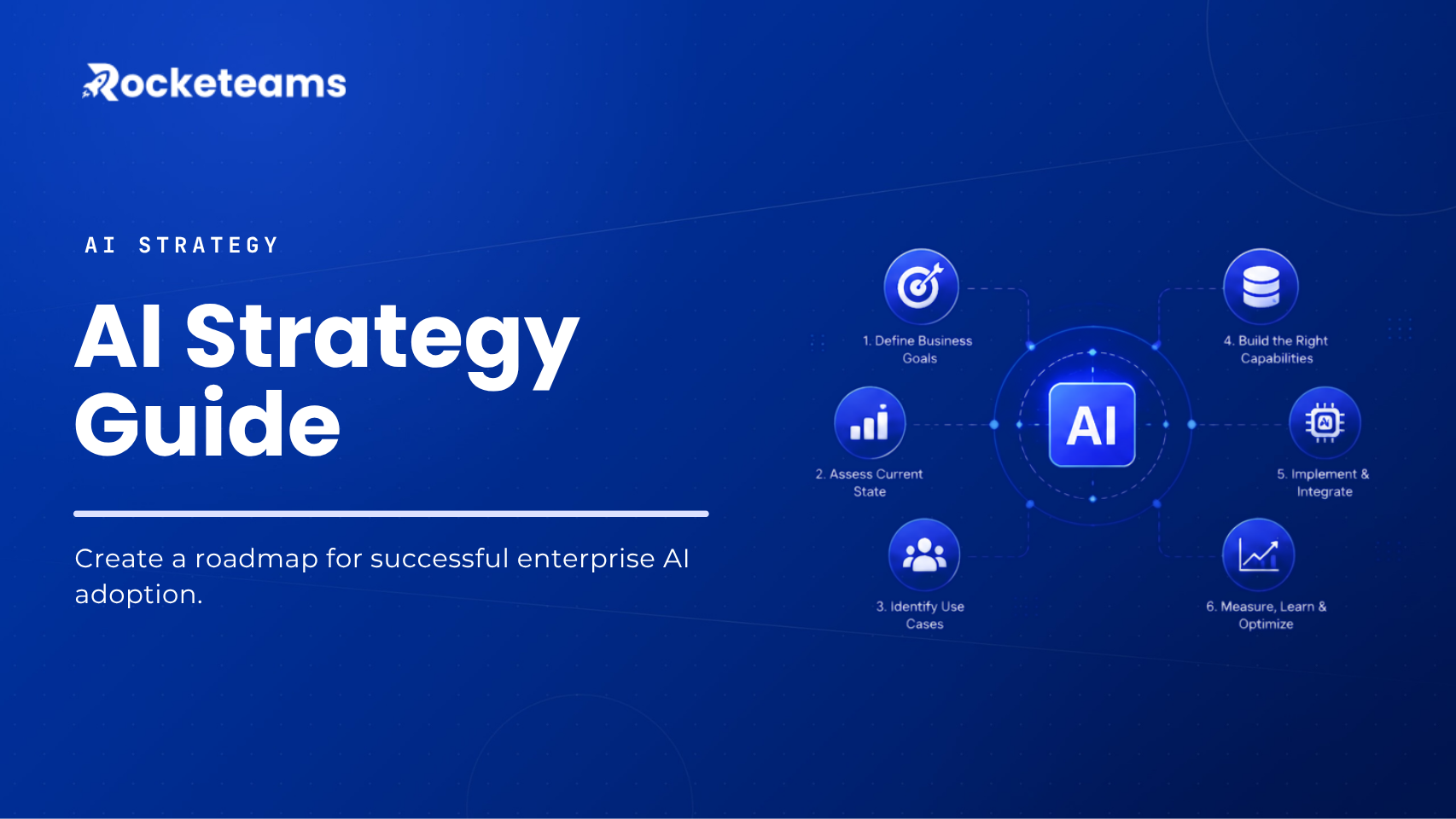
Artificial intelligence is no longer a future consideration for enterprise leaders. It is an active competitive variable in the present. Companies that have moved from AI experimentation to disciplined AI strategy development are already pulling ahead: reducing operational costs, shortening decision cycles, and building product capabilities that slower-moving competitors cannot match.
Companies still treating AI as a series of disconnected pilots are accumulating a gap that gets harder to close with each passing quarter. But having access to AI tools is not the same as having an AI strategy. Deploying a chatbot is not an AI transformation. Running a single machine learning model in one business unit is not an enterprise AI roadmap.
Real AI strategy development means making deliberate choices about where AI creates the most value in your specific business, building the infrastructure and talent to sustain it, governing it responsibly, and sequencing implementation in a way that generates momentum rather than cost overruns.
This guide walks through exactly how to do that from the initial opportunity assessment through to scaling AI across the enterprise with the engineering and product depth that most strategy frameworks skip.
What an AI Strategy Actually Is (and What It Is Not)?
An AI strategy is a structured plan that aligns artificial intelligence initiatives with specific business outcomes. It defines where AI will be applied, why those applications were chosen over others, what capabilities are needed to execute them, how success will be measured, and how risk will be managed across the full lifecycle of deployment.
What an AI strategy is not: a list of tools your team wants to evaluate, a mandate from leadership to do more with AI, or a technology roadmap that treats AI as an upgrade to existing software. AI strategic planning requires a fundamentally different approach from conventional IT planning because AI systems behave differently from traditional software. They learn from data, produce probabilistic outputs, require continuous monitoring, and can fail in ways that are subtle and difficult to detect.
The distinction matters because organizations that approach AI adoption strategy as a technology procurement exercise consistently underestimate what implementation actually requires in data infrastructure, engineering capacity, change management, and governance. The ones that approach it as a business transformation exercise, grounding every AI initiative in a specific business problem and a measurable outcome, are the ones that reach production reliably and generate returns.
Step 1: Conduct an Honest AI Opportunity Assessment
Every effective AI strategy starts with a rigorous AI opportunity assessment: an honest audit of where your business currently operates, where it has high-value problems that AI has a track record of solving, and what your current capabilities are relative to what those solutions require. This assessment has four components.
4 Components of Assessment
- Business problem mapping. Work with leaders across every major function operations, product, sales, finance, customer success to document decisions and workflows that are most costly, most error-prone, or most dependent on expertise that is hard to scale. The objective is to identify where the cost of the problem is high enough and the data rich enough that AI can deliver a return worth the investment.
- Data infrastructure audit. AI systems are only as good as the data they run on. Before committing to any initiative, you need a clear picture of what data you have, where it lives, how clean it is, and whether it is sufficient for the application you are considering. Organizations consistently overestimate their data readiness. A real audit surfaces gaps early, when fixing them is a planning problem rather than a delivery crisis.
- Talent and capability gap analysis. Production AI requires ML engineers, data engineers, backend engineers who can integrate model outputs into live systems, and DevOps engineers who maintain the underlying infrastructure. Identifying these gaps at the assessment stage determines whether you hire, train, partner, or augment and how quickly you can realistically begin.
- Competitive and market context. Understand where AI is already deployed in your industry, what capabilities competitors are building, and where AI-driven business models are creating new expectations among your customers. This context shapes prioritization: some AI investments are about gaining advantage, others are about not falling behind.
Step 2: Define Clear Strategic Objectives and Prioritize Use Cases
Once the opportunity assessment is complete, the next step in AI strategic planning is translating the problem inventory into a prioritized set of AI use cases with clear business objectives attached to each.
Good AI use cases have three properties: a well-defined problem with measurable current cost, sufficient data to train and operate an effective model, and an organizational capability to act on the AI’s outputs. Teams should deprioritize use cases that fail on any of these three dimensions until they resolve the gaps, rather than launch them in hopes that delivery will close those gaps.
Prioritization should balance two dimensions: business impact and implementation feasibility. High-impact, high-feasibility use cases belong in the first phase of your enterprise AI roadmap. High-impact, lower-feasibility cases belong in later phases, with explicit work in early phases to build the capabilities they require. Low-impact cases, regardless of feasibility, should be deferred or removed. They consume engineering capacity without advancing the strategic agenda.
Common high-value AI use cases that consistently meet the prioritization threshold across industries include: demand forecasting and inventory optimization, intelligent document processing and data extraction, customer churn prediction and intervention, automated quality assurance and anomaly detection, AI-assisted customer support and triage, and predictive maintenance for operational assets. The specific use cases that belong in your roadmap depend entirely on your business model, your data assets, and your competitive context, which is why the opportunity assessment must precede the roadmap, not follow it.
Step 3: Build Your Enterprise AI Roadmap
The enterprise AI roadmap is the operational translation of your strategic priorities into a sequenced implementation plan. It defines what will be built, by whom, on what timeline, with what resources, and measured against what outcomes.
A well-structured roadmap has three phases.
- Foundation and early wins. The first phase should focus on two things simultaneously: building the data and infrastructure foundations that all subsequent AI work depends on, and delivering a small number of high-confidence AI applications that demonstrate real business value quickly. The early wins generate organizational buy-in, validate the approach, and create the data feedback loops that make later, more complex AI systems more effective. Foundation work includes data pipeline standardization, cloud infrastructure configuration, model monitoring and observability tooling, and the establishment of data governance practices.
- Scale and integration. Once foundation work is established and early applications are in production, the second phase expands AI across the business, applying it to more use cases, integrating AI outputs more deeply into operational workflows, and building the cross-functional collaboration structures that sustained AI-driven business transformation requires. This phase also typically involves investment in internal AI capability: training existing engineering teams, embedding ML specialists into product squads, and developing the organizational muscle to evaluate, deploy, and iterate on AI systems continuously.
- Differentiation and innovation. The third phase is where AI strategy shifts from operational improvement to competitive differentiation building AI capabilities that are difficult for competitors to replicate because they are grounded in proprietary data, deeply embedded workflows, or compounding model improvements that accrue only over time. This is the phase where AI-driven business models emerge: new products, new revenue streams, new ways of delivering value that were not possible before the foundation phases were complete.
Step 4: Establish an AI Governance Framework
Scaling AI in the enterprise without a governance framework is how organizations end up with bias, compliance violations, and reputational damage that erases the value of everything they built. An AI governance framework is not an obstacle to AI adoption strategy, it is what makes AI adoption sustainable.
A governance framework addresses four areas:
Model risk management
Every AI model deployed in a production environment should have documented risk assessments covering the potential failure modes, the impact of those failures on the business and on the people affected by the system’s outputs, and the monitoring and remediation processes in place to detect and address problems. High-risk applications, particularly those that affect credit, employment, healthcare outcomes, or any other consequential individual decision require more rigorous oversight and explicit human review processes.
Data governance
AI systems process large volumes of data, often including sensitive personal information. Data governance for AI includes clear policies on data collection and retention, access controls, consent management, and compliance with applicable regulations such as GDPR, HIPAA, and sector-specific data protection requirements. It also includes data lineage documentation so that when a model’s behavior is questioned, you can trace exactly what data it was trained and evaluated on.
Transparency and explainability
Enterprise AI systems increasingly need to be explainable, not just accurate. Customers, regulators, and internal stakeholders are asking not just what the AI decided but why. Building explainability into AI systems from the design stage is substantially easier than retrofitting it after deployment.
Accountability structures
Governance requires people to own it. Assign clear accountability for AI risk across engineering, legal, compliance, and business leadership. Establish review processes for new AI deployments and a clear escalation path when governance questions arise. This is not bureaucracy, it is the organizational infrastructure that lets you move fast because the risk management is built in, not bolted on.
Step 5: Hire and Embed the Right Engineering Talent
Strategy without execution capability is a document. The single most common reason enterprise AI roadmaps fail to deliver is not a strategy problem, it is an engineering capacity problem. Organizations underestimate how specialized the talent required for production AI actually is, and they underestimate how different it is from conventional software development.
Building AI in production requires ML engineers who understand model development, evaluation, and deployment. It requires data engineers who can build and maintain the pipelines that feed those models. It requires backend engineers who can integrate model outputs into existing systems reliably and at scale. DevOps are required engineers who understand the specific observability and infrastructure requirements of AI workloads. And it requires product managers who can translate between business objectives and technical constraints well enough to keep AI initiatives grounded in real value rather than technical novelty.
This is precisely what Rocketeams delivers. We place ML engineers, data engineers, full-stack engineers, and DevOps specialists with direct experience building production AI systems into enterprise product teams matched to your stack, your architecture, and your specific AI roadmap in under 100 hours. Whether you need a single ML engineer to accelerate a specific initiative or a full product squad to execute an entire phase of your AI roadmap, we deploy the right talent at the right stage without the six-week hiring delay that makes every AI timeline slip.
Step 6: Measure, Iterate, and Sustain
AI strategy development is not a one-time project it is an ongoing practice. The enterprise AI roadmap you build today should be a living document, updated as models are deployed, as performance data accumulates, as new AI capabilities emerge, and as your business context evolves.
Measurement should operate at two levels. At the model level, track performance metrics specific to each AI application: accuracy, precision, recall, latency, data drift, and model degradation over time. At the business level, track the outcomes each AI application was deployed to improve: cost reduction, throughput increase, error rate reduction, revenue impact, or customer satisfaction improvement depending on the use case. The connection between these two levels of how model performance translates into business outcomes is what tells you whether your AI investment is working and where to iterate.
Iteration is not failure. The organizations that get the most from AI are not the ones whose first deployment is perfect, they are the ones that have built the organizational infrastructure to learn quickly from what is not working and improve it. That means monitoring systems, reviewing cadences, clear ownership, and an engineering culture that treats AI deployment as the beginning of the work, not the end.
Conclusion
Every company has AI ambition. What separates the companies generating real returns from those still running pilots is execution infrastructure: the right engineering talent, deployed against the right use cases, with the right governance in place to sustain it.
Rocketeams delivers the engineering capacity that AI strategy execution requires. ML engineers, data engineers, full-stack specialists, and DevOps engineers with production AI experience, matched to your roadmap and contributed from day one. From a single embedded specialist to a full AI product squad, we deploy top 2% engineering talent in under 100 hours, with a 2-week risk-free trial before any financial commitment.
FAQs
How can a well-defined AI strategy directly contribute to our business’s competitive advantage and long-term growth?
A well-defined AI strategy helps businesses improve efficiency, make smarter decisions, and create scalable AI-powered products. Over time, it builds competitive advantages through better data, stronger models, and continuous innovation.
What are the key components of a comprehensive AI strategy?
A comprehensive AI strategy includes opportunity assessment, prioritized use cases, data infrastructure, skilled talent, governance, and performance measurement. Together, these elements ensure AI initiatives deliver sustainable business value.
How do you assess organizational readiness for AI adoption?
AI readiness is evaluated by assessing data quality, technical capabilities, leadership alignment, and governance. Identifying gaps early helps organizations plan successful AI implementation with minimal risk.
What is the typical timeline and investment required to implement an AI strategy?
Initial AI foundations and pilot deployments typically take 3–6 months, while full implementation may span 12–36 months. Timelines vary based on project scope, infrastructure, and available engineering resources.
How do you identify and prioritize high-impact AI use cases?
AI use cases are prioritized based on business value and implementation feasibility. Organizations should focus first on initiatives with measurable impact, reliable data, and strong execution potential.
What are the risks and ethical considerations in AI strategy development?
Common risks include biased models, poor data governance, compliance issues, and overreliance on AI decisions. Strong governance, transparency, and human oversight help ensure responsible AI deployment.
Can you provide examples of measurable AI strategy outcomes?
Successful AI strategies can reduce manual work, improve forecasting accuracy, lower customer churn, and accelerate product development. Actual results depend on the organization’s goals and the AI use cases implemented.