Budgeting for a custom mobile app is genuinely difficult when you’re working off ranges that span from $10,000 to $500,000. That gap isn’t arbitrary it reflects real differences in scope, team structure, compliance requirements, and what it actually means to build something that scales. This guide breaks down where the money goes, what drives costs up or down, and what most budget estimates quietly leave out.
What is the Average Cost of Mobile App Development in the USA?
Before getting into specifics, it helps to understand what the market actually looks like right now. According to Netguru’s 2025 analysis of app development projects, businesses are now paying an average of $171,450 for custom mobile applications in the US. That number is a useful anchor, but the spread underneath it is wide.
Here’s a practical framework for thinking about cost tiers:
- Simple apps (basic UI, minimal backend, a handful of screens): $40,000–$80,000
- Medium-complexity apps (user authentication, payment processing, real-time features): $80,000–$180,000
- Complex or enterprise-grade apps (AI features, multi-role systems, ERP/EHR integrations): $180,000–$500,000+
Anything below $40,000 for a US-built product should raise questions. At that price point, you’re typically looking at a template-heavy build, a very limited feature set, or a team working in a much lower-cost region not a durable product you can grow.
Why US Development Costs More Than Other Regions?
The gap between US and offshore rates is significant and worth understanding clearly, not to discourage US-based development, but to make the trade-offs transparent.
According to Salary.com data from April 2026, the average annual salary for a mobile applications developer in the United States is $105,988, or roughly $51 per hour. Senior developers and contract talent charge considerably more freelance senior developers in the US typically run $100–$160 per hour to cover taxes, benefits, and overhead. Development agencies in the US generally bill between $100–$200 per hour, with specialized practices in healthcare or fintech reaching $200–$400+.
By contrast, developers in Eastern Europe or Latin America typically bill $30–$80 per hour for comparable experience levels. That can translate to 30–50% cost savings on total project budgets. Many US firms now run hybrid models keeping lead architects and product managers stateside while supplementing with offshore execution teams.
What Are the Real Cost Drivers in Custom App Development?
Cost estimates that don’t explain the underlying variables aren’t particularly useful. The actual cost of your app comes down to a specific set of decisions, most of which happen before a single line of code gets written.
How Does App Complexity Affect the Total Budget?
Complexity is the single biggest cost driver in mobile development, and it’s not just about features. It’s about how those features interact, what they depend on, and how much backend infrastructure they require.
A simple app think a utility tool, basic content viewer, or event-based app needs relatively little backend logic. A few screens, straightforward navigation, no real-time data. That’s a fundamentally different project from a multi-role platform with payment processing, push notifications, analytics dashboards, and integrations into third-party systems like Salesforce or an EHR.
Each added integration layer multiplies both development time and QA complexity. Payment gateways, GPS, live chat, biometric authentication, and AI-driven recommendation engines don’t just add features they add dependencies that need to be tested across device types, OS versions, and edge cases.
Platform Choice: Native, Cross-Platform, or Both?
Whether you’re building for iOS only, Android only, or both platforms is a foundational cost decision. Building two separate native apps roughly doubles the development effort. Cross-platform frameworks like Flutter and React Native allow a single shared codebase to deploy to both, typically at 25–40% lower cost than dual native development.
The catch is that cross-platform apps achieve 80–95% code reuse, not 100%. Platform-specific behaviors, UI conventions, and hardware integrations often require separate implementations. For most business applications, that trade-off is well worth it. For performance-intensive or hardware-heavy apps, it may not be.
How Much Do Design and Discovery Phases Cost?
These two phases are frequently underestimated in initial budget conversations, and skipping or compressing them tends to cost more downstream.
Discovery
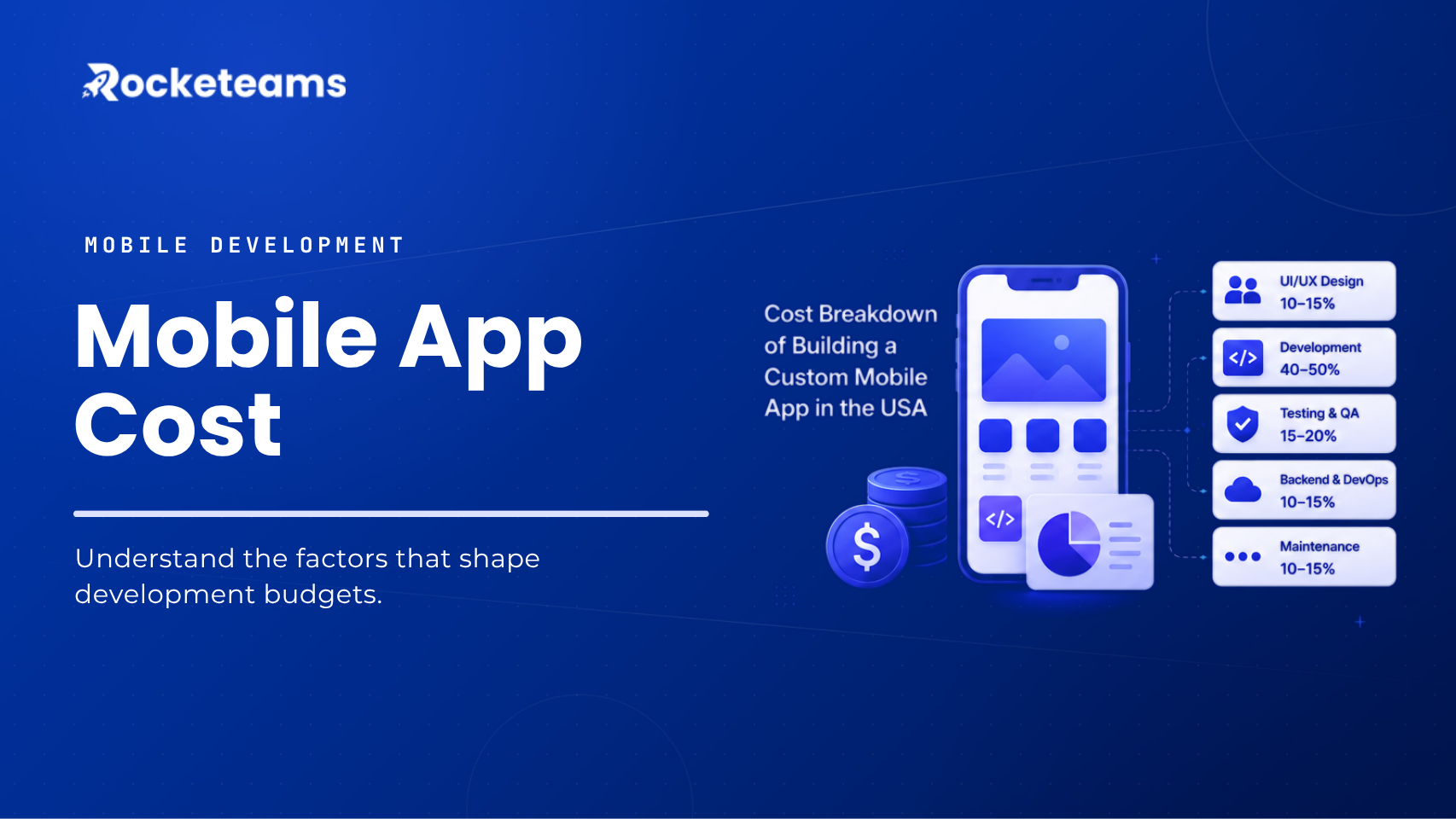
Discovery including requirements gathering, technical scoping, and project road mapping typically accounts for 10–15% of total project cost. For a $150,000 project, that’s $15,000–$22,500 that goes toward defining exactly what you’re building before any design or code work begins. Teams that skip this phase tend to encounter expensive scope changes mid-project.
Design
Design (wireframes, UI/UX prototyping, visual systems) accounts for another 20–25% of the budget. For a mid-sized app, design work alone can run $20,000–$50,000. This isn’t decorative design directly affects user retention and conversion. Apps with poor UX don’t get second chances; users delete them within the first session and rarely return.
What Does the Development Phase Actually Cost?
Development is the largest single line item, consuming roughly 40–55% of total project budget. This is where engineering hours accumulate frontend UI, backend APIs, database architecture, third-party integrations, and quality assurance testing.
For context, a medium-complexity app typically requires 800–1,600 hours of development work. At US market rates of $100–$150/hour for a blended agency team (developers, QA, project management), that puts development alone at $80,000–$240,000 depending on scope and timeline. Many organizations struggle to scale generative AI beyond initial pilots due to challenges in integration, governance, and ROI measurement.
AI-assisted development tools are compressing these timelines. One agency, Chop Dawg, reported that projects that ran $75,000–$150,000 pre-AI are now being delivered for $35,000–$70,000 in roughly half the time, due to AI-powered coding tools reducing repetitive engineering work. This efficiency improvement is real, but it hasn’t collapsed prices teams are simultaneously adding AI features, multi-platform support, and more complex integrations to their scope, which keeps budgets from falling as fast as hourly rates.
What Are the Hidden Costs of App Development That Catch Businesses Off Guard?
The development quote is usually only part of what you’ll spend. Several cost categories show up after the initial contract and if you haven’t planned for them, they can seriously disrupt post-launch momentum.
Post-Launch Maintenance and Updates
Ongoing maintenance is one of the most commonly underestimated expenses in app development planning. Once your app is live, it requires regular updates for new OS versions from Apple and Google, security patches, bug fixes, and performance improvements.
Industry standard: budget 15–20% of your original development cost annually for maintenance. A $150,000 app will likely require $22,500–$30,000 per year just to stay current. In the first year specifically, maintenance costs can run as high as 50% of initial development cost, as bugs surface in production and early user behavior reveals UX issues that weren’t visible in testing.
App Store Fees and Platform Revenue Sharing
Apple charges a $99 annual developer fee. Google charges a one-time $25 fee. Beyond those baseline costs, both platforms take a 15–30% cut of in-app purchases and subscription revenue. For apps with meaningful in-app monetization, that commission has a real impact on unit economics and it’s baked into your business model from day one, not an afterthought.
Hosting, Infrastructure, and Third-Party API Costs
Apps that depend on cloud infrastructure for storage, authentication, or real-time data incur ongoing hosting costs. Basic setups can run $10–$100/month; high-traffic or data-heavy apps can reach $500+ per month in AWS, Google Cloud, or Azure costs, and that number scales with usage.
Third-party tools and APIs add to this. Payment processors like Stripe charge per transaction. Mapping APIs, video SDKs, chat infrastructure, and analytics platforms often bill based on active users or API calls. These costs are small at launch but can become significant at scale and teams that don’t model them out early are often surprised by the invoice at 10,000 users.
Compliance and Regulatory Requirements
This one applies specifically to certain verticals but deserves explicit attention. Healthcare apps must meet HIPAA requirements. Consumer apps serving California residents must address CCPA. Apps handling children’s data must comply with COPPA. Financial apps face their own regulatory frameworks. Resource augmentation is becoming a go-to strategy for businesses seeking flexibility, scalability, and faster hiring in 2026.
Compliance isn’t just a legal checkbox it’s an engineering requirement. HIPAA-compliant apps need encrypted data storage, audit logging, access controls, and BAA agreements with any third-party vendors who touch patient data. All of that adds development time and ongoing maintenance complexity. For healthcare and fintech projects, compliance-related work can add $20,000–$100,000+ to the total budget depending on scope.
How Do You Build a Mobile App Budget That Actually Holds?
Most project overruns don’t happen because of unexpected technical problems. They happen because of scope creep, unclear requirements, and cost categories that weren’t included in the original estimate. A few practices significantly reduce that risk. As AI adoption accelerates, enterprises need a clear, structured roadmap to align technology with business goals and drive measurable outcomes.
Start With an MVP, Not a Full Product
The most common budgeting mistake is treating the first version of an app as the finished product. A more useful framing: define the minimum feature set that lets you test your core hypothesis with real users, and build that first.
An MVP-first approach keeps initial investment manageable often in the $40,000–$80,000 range even for moderately complex apps and lets user behavior inform what to build next. Features that seem important during planning frequently turn out to be non-essential once real users interact with the product. Building everything upfront locks budget into assumptions that may not survive first contact with the market.
Define Scope Before You Sign Anything
Discovery the phase where requirements, technical architecture, and project scope are formally defined is worth paying for separately before committing to a full development contract. A $5,000–$15,000 discovery engagement with a development partner gives you a detailed scope document, technical requirements, and a realistic timeline estimate.
Without it, fixed-price quotes are essentially educated guesses. Scope changes after development begins are the most expensive changes you can make.
Budget Explicitly for Post-Launch
A realistic app budget should include at least the first 12 months of post-launch maintenance from the start. If your development cost is $120,000, plan for an additional $18,000–$24,000 in year one for maintenance, plus a separate allocation for marketing and user acquisition which, depending on category, can easily match or exceed the development budget itself.
Teams that allocate every dollar to development and nothing to the post-launch lifecycle often find themselves with a working app that can’t attract or retain users because there’s no budget left to iterate or promote.
Choose Your Team Structure Carefully
The decision between an in-house team, a US-based agency, or an offshore/nearshore partner isn’t just about hourly rates it’s about risk, control, and long-term maintenance capacity.
In-house teams give maximum control but require full-time salaries, benefits (adding 20–30% to base compensation), equipment, and management overhead. For ongoing, multi-year product development, this often makes sense. For a first app with an uncertain roadmap, it’s a significant fixed cost commitment.
US agencies charge a premium but bring project management infrastructure, end-to-end accountability, and post-launch support. Offshore teams offer cost savings of 30–50%, but require more active project management from your side and can introduce communication friction on complex integrations.
What Should Businesses Know Before Committing to an App Development Budget?
The number that matters most isn’t the development quote it’s the total cost of ownership over the first three years. That includes development, maintenance, app store fees, hosting, compliance, and iteration based on user feedback.
Apps that succeed commercially are treated as ongoing products, not one-time projects. The companies that get the best return on their app investments are the ones who plan for the full lifecycle from the start: adequate scope definition upfront, an MVP-first launch strategy, and a realistic maintenance and iteration budget in years two and three. The mobile landscape is evolving fast, with trends like AI integration, 5G, and cross-platform development transforming user experiences and app performance.
The market context supports the investment. Mobile app revenue globally is projected to reach $613 billion by 2025 according to Statista, and the in-app purchase market is valued at $225 billion with a 19% annual growth rate. The opportunity is real but so is the cost of under-investing in quality and post-launch support.
Conclusion
Mobile app development in the USA is a major investment, ranging from $40,000 to over $200,000 depending on scope, team structure, and post-launch planning. Successful businesses don’t just spend more, they define scope clearly, launch focused MVPs, and plan beyond development. Prioritizing a solid discovery phase and a long-term cost model is critical.
To execute efficiently, consider Rocketeams, which provides skilled, pre-vetted professionals who integrate quickly and help turn well-planned ideas into scalable, high-performing apps.
FAQs
How much does it cost to develop a mobile app?
The average cost of mobile app development in the USA is approximately $171,450 for a custom application, though simple apps can start around $40,000 and complex enterprise platforms can exceed $500,000 depending on features, integrations, and team structure.
How to create mobile apps that make $3,000 a day?
Apps generating that level of revenue typically combine strong monetization models (subscriptions, in-app purchases, or transaction fees), a well-defined niche audience, and sustained investment in growth and user retention not just a well-built product. Sustainable revenue comes from product-market fit and ongoing iteration, not launch alone.
How much does it cost to build a simple mobile app?
A simple app with basic screens, minimal backend logic, and no complex integrations typically costs $40,000–$80,000 in the US market. Quotes below $10,000–$15,000 almost always reflect a template-based build or an offshore team, not a scalable custom product.
Do I need an LLC to start an app?
You don’t legally need an LLC to launch an app, but forming one provides liability protection and makes it easier to open business bank accounts, sign vendor contracts, and accept investment. Most founders form an LLC or C-Corp before taking on outside capital or publishing commercially.
How much does a 1 million downloads app make a day?
It depends heavily on the monetization model. A free app with no in-app purchases generates little directly from downloads; an app with even modest $1/month subscriptions and a 5% conversion rate on 1 million downloads could generate $1,600+/day. Revenue varies widely based on category, geography, and retention.
Why does 90% of startups fail?
The most commonly cited reasons are building a product no one needs (cited in roughly 42% of failure post-mortems), running out of cash, and team problems in that order. For app-based businesses specifically, launching without validating demand through an MVP and underestimating ongoing maintenance and marketing costs are consistent contributors.