Enterprise leaders rarely greenlight technology investments without a clear line to returns. Mobile apps are no exception. But while the general case for mobile has been made many times over, the question most decision-makers are actually asking is more specific: does custom mobile app development justify the investment compared to off-the-shelf alternatives?
The answer depends on what you’re building for, and that’s exactly what this article unpacks.
What Does Custom Mobile App Development Actually Mean for Enterprises?
Before evaluating ROI, it’s worth being precise about what “custom” means in an enterprise context because it gets used loosely.
Custom mobile app development refers to building a mobile application from the ground up, or significantly tailoring an existing codebase, to address the specific operational, customer-facing, or workflow needs of a business. This is different from configuring a SaaS platform or licensing a white-label product.
The Difference Between Bespoke App Solutions and Off-the-Shelf Software
Generic apps are built for the widest possible user base. That’s their strength and their limitation. They solve common problems adequately but rarely address the nuanced workflows, data structures, or user journeys that define enterprise operations.
Bespoke app solutions, by contrast, are architected around your processes. The user interface reflects how your customers or employees actually behave. The backend integrates with your existing systems. The logic matches your business rules, not a vendor’s interpretation of what those rules might generically look like.
Native App Development vs. Cross-Platform: What Enterprises Need to Know
One decision that significantly shapes both cost and capability is the platform approach. Native app development, building separately for iOS and Android, delivers the highest performance and access to device-level features. It’s the right call when the app demands speed, precision, or deep hardware integration, such as in field service, logistics, or augmented reality.
Cross-platform frameworks like React Native or Flutter have matured considerably and now handle the majority of enterprise use cases effectively. Most teams handling complex enterprise builds find that around 70% of projects suit cross-platform development, with native reserved for performance-critical applications.
The platform decision should follow the use case, not the budget alone.
Why Are Enterprises Still Struggling With Generic Mobile Solutions?
The problems with off-the-shelf mobile tools tend to reveal themselves gradually and usually at the worst possible time, when adoption has already happened, and switching costs are high.
The Core Problems With Generic Enterprise Mobile Tools
Enterprise mobile solutions that aren’t purpose-built create friction at almost every level of the organization.
On the employee side, generic apps rarely match internal workflows. Teams end up working around the tool rather than within it, entering data in one system, then re-entering it elsewhere, or maintaining spreadsheets alongside an app that was supposed to replace them. This erodes trust in the technology and keeps productivity gains hypothetical.
On the customer side, the stakes are equally high. A mobile experience that feels borrowed or generic communicates something about the brand, intentionally or not. Users are sophisticated they notice when an app behaves like a template.
Then there’s the integration challenge. Most enterprises run a mix of legacy systems, cloud platforms, and custom databases. Off-the-shelf apps rarely integrate cleanly with all of them. Workarounds accumulate, and data integrity suffers.
Scalable Mobile Architecture and Why It Can’t Be an Afterthought
One of the most consistent pain points for enterprises that started with generic solutions is scalability. A mobile app that works for 500 users may perform poorly at 50,000. A feature set that covered business needs in 2022 may be inadequate for 2025 requirements.
Scalable mobile architecture isn’t just a technical specification — it’s a business continuity question. Custom development allows architects to design for anticipated growth, integrate modular components that can be updated independently, and plan for API dependencies that will evolve over time.
By contrast, scaling a generic platform often means renegotiating contracts, waiting on vendor roadmaps, or accepting functional compromises.
The Customized Mobile UX Problem That Generic Apps Can’t Solve
User experience is where the gap between generic and custom becomes most visible. Tailored mobile UX goes beyond visual customization. It’s about understanding how different user segments interact with an application, what information they need first, how they move through tasks, and where friction causes them to abandon a flow entirely.
Enterprises using app-based solutions have seen a 21% improvement in workforce productivity, but that figure assumes the app was actually designed around how those employees work. Generic tools often carry the implicit assumption that users will adapt to the software, rather than the other way around.
How Does Custom Mobile App Development Actually Drive ROI?
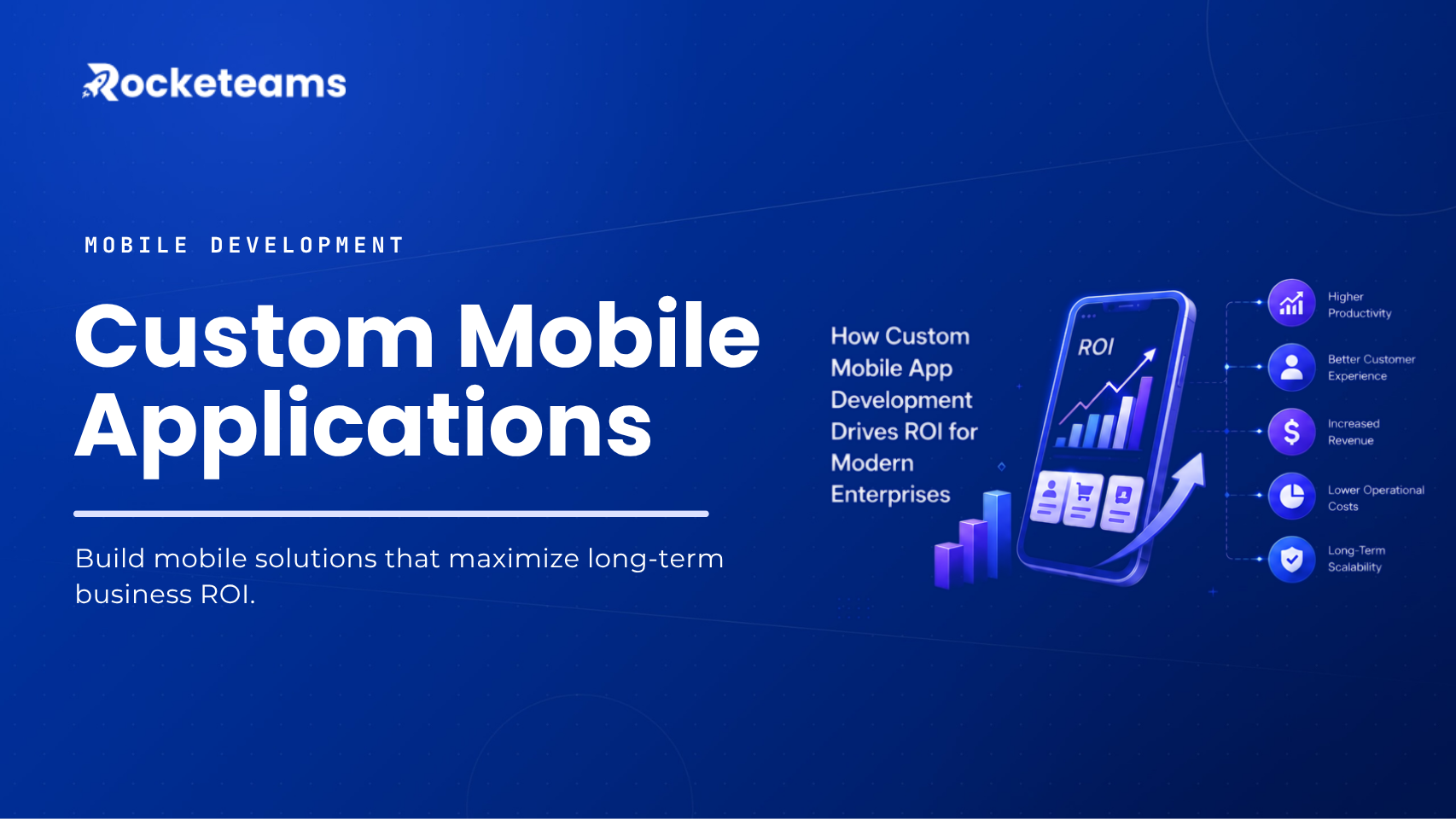
ROI in mobile development isn’t a single number it’s a composite of revenue impact, cost reduction, and efficiency gains. Understanding where those returns come from helps build a more credible business case.
Measuring ROI Through Revenue Impact
The most direct ROI signal from a custom mobile app is its effect on revenue. For consumer-facing businesses, this connection is well-documented.
Starbucks’ Mobile Order & Pay platform now accounts for nearly 20% of the company’s revenue across 30 million users. Forrester called it “the most successful mobile ordering app of all time.” What made it work wasn’t just the technology. It was the deliberate design of a personalized experience loyalty integration, AI-driven recommendations, and location-aware features built specifically for how Starbucks customers behave.
That’s not replicable with a generic ordering platform. It required a tailored mobile UX built around specific customer data, specific store operations, and a specific loyalty model.
For B2B enterprises, the revenue connection is less direct but equally real. Custom apps that improve sales team workflows, reduce order processing time, or give field agents real-time inventory access all compress the sales cycle and faster cycles mean more revenue.
Custom App Features That Reduce Operational Costs
Cost reduction is often where enterprise apps generate their clearest ROI in the first 12 to 24 months. Custom app features designed to automate manual processes, surface real-time data, or replace paper-based workflows deliver measurable savings relatively quickly.
Common examples include:
- Field service apps that eliminate paper job sheets and reduce re-keying errors
- Approval workflow apps that replace email chains and reduce processing lag
- Inventory management tools that give warehouse teams live stock data without calling central systems
These aren’t glamorous use cases, but they tend to generate returns that are easy to quantify and present to finance teams.
Workforce Productivity and the Enterprise Mobile Solutions Argument
Over 78% of enterprises globally had adopted mobile-first strategies by 2024, with 63% investing in custom mobile apps specifically for internal operations, logistics, and client engagement. The competitive implication is notable: organizations not investing in custom internal tools are increasingly outliers, not the norm.
Productivity gains from well-designed enterprise apps compound over time. When employees can complete tasks on mobile that previously required desktop access or physical presence, they recover time across hundreds of touchpoints per week. At scale, those marginal gains are significant.
Customer Retention and Lifetime Value
Personalized mobile apps have a measurable effect on customer retention. Customer lifetime value is 2.8 to 5 times higher for app users compared to web-only customers, and app users purchase approximately 33% more often. Those numbers apply most forcefully when the app experience is genuinely tailored to the customer not a generic interface with a logo swapped in.
Custom iOS and Android apps that reflect the specific preferences, purchase history, and behavior patterns of a user create a stickiness that off-the-shelf tools simply can’t replicate at the same depth.
What Strategies Make Custom Mobile App Development Work at the Enterprise Level?
Knowing that custom apps drive ROI is one thing. Getting there without overruns, scope creep, or post-launch abandonment is another. The following approaches reflect what actually works in enterprise-scale mobile development.
Define Business Objectives Before Writing a Single Line of Code
This sounds obvious, but it’s where many enterprise mobile projects go sideways. The app requirements are driven by technical specifications or feature requests rather than anchored to measurable business outcomes.
Before development begins, decision-makers should be able to answer three questions clearly:
- What specific metric will this app move, and by how much?
- Who are the primary users, and what does their current workflow look like?
- What does success look like at 6, 12, and 24 months post-launch?
When those answers are vague, the development process inherits that vagueness — and it shows up in the final product.
Choose the Right Custom App Design and Dev Partner
Not all development partners operate the same way. Enterprises need partners who bring domain experience in enterprise integration, not just strong frontend design skills.
Key criteria for evaluating a custom app design and dev partner include:
- Experience integrating with enterprise systems (ERP, CRM, HRIS, legacy databases)
- A portfolio that includes apps in comparable industry verticals
- Clear methodology for discovery, prototyping, and iterative testing
- Post-launch support capacity, including SLAs for critical issues
References from similar-scale projects matter more than awards or case study branding.
Build for Scalable Mobile Architecture From Day One
Retrofitting an app for scale after the fact is expensive and disruptive. Enterprises should insist on architecture decisions that accommodate projected growth — in users, in data volume, and in feature complexity.
This includes decisions about cloud deployment, API design, authentication frameworks, and data security architecture. Cloud deployments captured 68.3% of global revenue share in enterprise mobile in 2024 and are advancing at a 14.5% CAGR, reflecting a clear shift toward flexible, scalable infrastructure models.
Hybrid architectures combining cloud processing with local or edge capabilities are increasingly relevant for enterprises in regulated sectors or those with latency-sensitive operations.
Plan for Post-Launch Evolution, Not Just Launch
Enterprise apps that succeed long-term are treated as products, not projects. The launch is not the finish line, it’s the starting point for a feedback loop.
Post-launch priorities should include:
- Usage analytics to identify where users drop off or complete tasks slowly
- A roadmap for phased feature additions based on actual behavior, not initial assumptions
- Regular performance reviews tied to the business objectives defined at the outset
Apps that don’t evolve after launch see engagement decline. The enterprises that get the most from their mobile investment treat it as a sustained operational capability, not a one-time capital expenditure.

Prioritize Security and Compliance Architecture for Custom iOS and Android Apps
Security is non-negotiable in enterprise mobile development, and it requires deliberate architectural choices, particularly for apps handling sensitive customer data, financial records, or proprietary operational data.
Custom iOS and Android apps allow security controls to be embedded at the architecture level: encryption standards, authentication protocols, session management, and audit trails. This is harder to achieve with generic platforms where security configurations are constrained by vendor decisions.
For enterprises in regulated industries, such as financial services, healthcare, and legal, this isn’t optional. It’s often a compliance requirement that effectively rules out off-the-shelf tools.
Is Custom Mobile App Development Worth the Investment?
The question of cost always enters the conversation, and it should. Custom mobile app development is a meaningful investment. But evaluating it against the sticker price alone misses the more relevant comparison: what does it cost to not build something purpose-designed for your business?
Generic tools come with ongoing licensing costs, integration overhead, and a ceiling on what they can deliver. They also create a dependency on vendor roadmaps and pricing decisions that enterprises don’t control. Custom development has higher upfront costs but typically delivers stronger ROI over a three-to-five year horizon, particularly when productivity, retention, and operational efficiency gains are factored in.
The organizations seeing the strongest returns are those that approach custom mobile app development as a strategic capability investment tied to specific business outcomes, built to last, and evolved continuously based on real user behavior.
That’s not a technology decision. It’s a business decision.
FAQs
What is your process for custom mobile app development, from concept to launch and post-launch support?
The process typically spans discovery, wireframing and prototyping, iterative development sprints, QA, and launch, followed by ongoing support cycles. Post-launch SLAs and roadmap planning should be agreed upon before development begins.
How do you ensure the custom mobile app aligns perfectly with our business objectives and target audience needs?
Alignment starts with a structured discovery phase that maps user journeys, defines success metrics, and ties every feature decision to a stated business outcome before development begins.
What is the estimated cost range for developing a custom mobile app with specific features and functionalities?
Costs vary significantly based on platform, feature complexity, integrations, and team structure. Most enterprise-grade custom apps range from $100,000 to $500,000 or more, with ongoing maintenance factored separately.
Can you provide examples of successful custom mobile apps you have developed for enterprise clients?
Enterprise case studies should be reviewed directly with your development partner look for examples in your industry vertical with measurable outcomes like productivity improvement, reduced processing time, or revenue attribution.
What technologies and platforms do you specialize in for custom mobile app development to ensure scalability and performance?
Leading enterprise partners typically work across React Native, Flutter, Swift, and Kotlin, with cloud deployment on AWS, Azure, or Google Cloud chosen based on your existing infrastructure and performance requirements.
Custom mobile app development is a long-term capability investment. The enterprises that benefit most from it are those that enter the process with clear objectives, the right partners, and a commitment to treating their app as an evolving product rather than a one-time build.