Most software decisions feel deceptively simple until you’re two years into a platform that can’t scale, won’t integrate, and forces your team to work around it daily. The build-vs-buy debate has been a fixture in IT planning for decades, but the calculus in 2026 has shifted.
Custom web application development has become more accessible, off-the-shelf solutions have become more capable, and the cost of making the wrong choice has grown considerably alongside both.
This guide lays out the decision framework honestly, where each model wins, where each fails, and what separates a well-executed custom build from a costly one.
What is Custom Web Application Development?
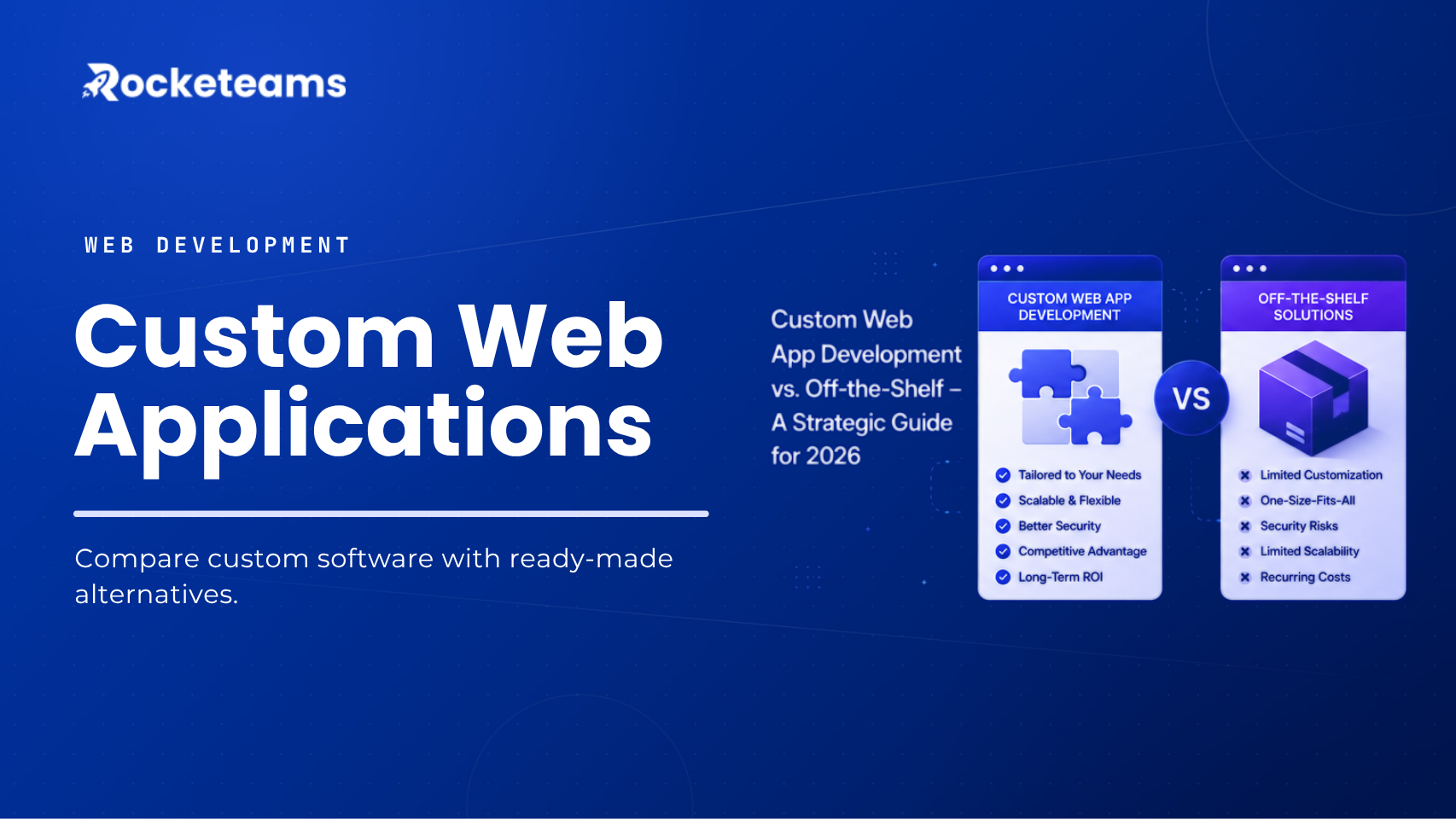
At its core, custom web application development is about building software that fits your business, not forcing your business to fit software. A custom web application is designed and developed from the ground up around your specific workflows, data structures, user roles, and business logic.
Every decision from architecture to integrations to user experience is intentional and aligned with how your organization actually operates. Nothing is inherited from a generic template, and nothing exists unless it serves a defined purpose.
This is what separates it from off-the-shelf software.
Off-the-shelf (or commercial off-the-shelf, COTS) solutions are built for scale across thousands of users and industries. They’re optimized for speed to deploy and ease of access. You can get started quickly, often within days or weeks, and the cost is spread across a large customer base.
But that convenience comes with a trade-off: standardization. These tools are designed around common denominators, which means your processes often have to adapt to the system. Customization exists, but it’s typically limited, and bigger changes either aren’t possible or come with added complexity through plugins, workarounds, or expensive upgrades. Custom development takes the opposite approach. The software adapts to you.
When Does It Actually Make Sense?
Where it actually makes sense is when your business requirements move beyond what standardized tools can reasonably support. Custom web application development becomes the right investment when:
- Your workflows are unique enough that forcing them into a pre-built system creates inefficiencies
- You rely on multiple systems that need tight, reliable integration rather than loose third-party connectors
- Your application is central to how you deliver value not just a support function
- You need full control over data handling, security, or compliance requirements
- Long-term scalability matters, and you want to avoid compounding licensing costs or platform limitations
In these situations, custom software doesn’t just “fit better” it removes operational friction, reduces dependency on multiple tools, and creates a system that can evolve alongside your business.
What is Off-The-Shelf Development?
Off-the-shelf development refers to using pre-built software products that are designed for a wide audience rather than a single organization. These solutions, often called commercial off-the-shelf (COTS), are created to solve common business needs like accounting, CRM, HR management, or project tracking.
Instead of building software from scratch, you purchase or subscribe to an existing platform and configure it to fit your operations as closely as possible. The core advantage is speed and accessibility: implementation can happen in days or weeks, not months, and the upfront cost is significantly lower because development expenses are distributed across many customers.
However, that efficiency comes with a structural limitation. Off-the-shelf software is built around generalized workflows, which means your business often has to adapt to how the software works, not the other way around. Customization is usually limited to surface-level changes, and deeper modifications either aren’t possible or become expensive through add-ons, plugins, or workarounds.
When Does It Actually Make Sense?
Where off-the-shelf development actually makes sense is in scenarios where differentiation is not tied to the software itself. In these cases, off-the-shelf tools provide immediate value without the overhead of building and maintaining software internally.
It’s the right choice when:
- The function you’re solving is standardized across your industry (like payroll, invoicing, or basic HR systems)
- Speed matters more than precision. You need something live quickly, and “good enough” is acceptable
- You’re operating with a small team or limited budget and can’t justify a large upfront investment
- The use case is temporary, experimental, or part of early-stage validation, where requirements are still evolving
- Your processes are flexible enough to align with how widely used tools are already designed
The 2026 Context – Why Custom Web Application Development Carries More Weight Now?
The build-vs-buy decision isn’t new, but the stakes have changed.
Custom development is no longer as inaccessible as it once was. Modern frameworks, cloud infrastructure, and global talent pools have reduced both the time and cost barriers. At the same time, off-the-shelf platforms have become more powerful but also more complex, often locking businesses into ecosystems that are difficult to extend or migrate away from.
The result is a sharper inflection point.
Organizations today are not choosing between “build” and “buy” in isolation they’re choosing between flexibility and constraint over the long term.
This is reflected in broader industry direction. Spending on custom software continues to grow as companies prioritize systems that align with their operations rather than reshaping operations around rigid tools. At the same time, a significant portion of technology leaders are focused on modernizing and integrating their existing applications, often because earlier off-the-shelf decisions no longer scale.
These aren’t theoretical concerns. They’re patterns that emerge after teams hit the limits of what packaged software can handle.
Which brings the decision back to a single, practical question:
Not “Is custom development better?”
But “At what point does your business outgrow standard solutions?”
Because that’s where custom development stops being an expense and starts becoming infrastructure.
Pros and Cons of Custom Web Application Development vs. Off-the-Shelf Software
Once the definitions are clear, the real decision comes down to trade-offs. Both models solve problems, but they do so in very different ways, with very different long-term implications.
Custom Web Application Development Pros
- The biggest advantage of custom web application development is alignment. The software is built specifically for your business, which means it reflects how your team actually works instead of forcing process changes.
- This is where bespoke web solutions stand out. You’re not constrained by predefined features or rigid workflows. Every function is intentional. Whether it’s custom web portal development for internal teams or customer-facing platforms, the result is software that directly supports your operations.
- Scalability is another major strength. With a properly designed scalable web architecture, your application can grow alongside your business, handling increased users, data, and complexity without requiring a platform switch. This is especially critical in enterprise web app development, where performance and reliability are non-negotiable.
- Custom builds also excel in integration. Through full-stack web development, your application can connect seamlessly with legacy systems, third-party APIs, and internal tools, eliminating data silos and reducing manual work. This becomes even more valuable in legacy web app modernization, where older systems need to be upgraded or replaced without disrupting operations.
- From a user perspective, tailored web UX/UI ensures that the interface is designed around your users’ behavior, not generic assumptions. This improves adoption, efficiency, and overall experience.
- Finally, there’s ownership and control. With custom business software, you control the roadmap, data, security, and feature set. You’re not dependent on a vendor’s update cycle or pricing changes.
Custom Web Application Development Cons
- The most obvious drawback is cost. Custom solutions require a higher upfront investment compared to off-the-shelf tools, especially if you hire custom web developers or work with an experienced development partner.
- Time is another factor. Unlike ready-made tools, custom applications take months to design, build, and deploy. This makes them less suitable for urgent or short-term needs.
- There’s also execution risk. A poorly scoped or poorly managed project can lead to budget overruns, delays, or a product that doesn’t fully meet expectations. The quality of the outcome depends heavily on the team behind the custom web application development process.
- Ongoing maintenance is another consideration. Updates, security patches, and feature enhancements require continuous investment, typically structured as a percentage of the original build cost.
Off-the-Shelf Software Pros
- The primary strength of off-the-shelf software is speed. You can deploy quickly and start seeing value almost immediately. For businesses that need fast solutions, this is often the deciding factor.
- Cost efficiency is another advantage, at least initially. Subscription-based pricing makes these tools accessible without a large upfront investment, which is ideal for startups or small teams.
- Ease of use also plays a role. Most off-the-shelf platforms are designed for mass adoption, with standardized interfaces and onboarding flows that require minimal training.
- Additionally, maintenance and updates are handled by the vendor. You don’t need an internal development team or to worry about infrastructure, security patches, or performance optimization.
Off-the-Shelf Software Cons
- The same standardization that makes off-the-shelf tools accessible also limits them. These platforms are built for general use cases, which means they rarely align perfectly with your workflows.
- As your business grows, these limitations become more visible. You may find yourself relying on multiple tools, workarounds, or plugins to fill gaps, creating inefficiencies rather than eliminating them.
- Integration is another common challenge. While many platforms offer connectors, they’re often not as reliable or flexible as purpose-built integrations in custom business software.
- Scalability can also become an issue, not always technically, but economically. Per-user or per-feature pricing models can become expensive at scale, especially compared to a one-time investment in a scalable web architecture.
- Finally, there’s a lack of control. You’re dependent on the vendor for updates, feature releases, and pricing changes. If the product roadmap doesn’t align with your needs, your options are limited, so adapt or migrate.
Types of Custom Web Application Development and Off-the-Shelf Solutions
Not all software in either category is created equal. Both custom web application development and off-the-shelf solutions exist in different forms, each suited to specific business needs, scales, and levels of complexity. Understanding these variations helps you make a more precise decision, not just build vs. buy, but what exactly to build or buy.

Types of Custom Web Application Development
Custom solutions are not one-size-fits-all. They range from focused tools to large-scale platforms, depending on business requirements.
1. Custom Web Portals
Custom web portal development focuses on creating centralized platforms for specific user groups \such as customers, employees, vendors, or partners. These portals provide role-based access, dashboards, and workflows tailored to each user type.
They’re commonly used for client dashboards, internal management systems, or vendor ecosystems where off-the-shelf tools fall short in flexibility.
2. Enterprise Web Applications
This is where enterprise web app development comes into play. These are large-scale systems designed to handle complex operations, high user volumes, and mission-critical processes.
They often include advanced features like multi-level permissions, real-time data processing, and deep integrations across departments. A strong, scalable web architecture is essential here to ensure performance and reliability at scale.
3. Bespoke Business Systems
Custom business software built as bespoke web solutions is designed to support highly specific workflows that define how a company operates.
This could include anything from supply chain systems to booking engines to internal automation tools. These applications are typically built when no existing product can support the required level of specificity without compromise.
4. SaaS Platforms (Custom-Built)
Some businesses invest in full-stack web development to create their own SaaS (Software-as-a-Service) products. These are not internal tools but revenue-generating platforms offered to customers.
In this case, custom web application development becomes part of the business model itself, requiring careful attention to scalability, security, billing systems, and tailored web UX/UI for end users.
5. Legacy Web App Modernization
Rather than building from scratch, some organizations focus on legacy web app modernization, upgrading, or rebuilding outdated systems into modern, scalable applications.
This often involves re-architecting old software, improving performance, and integrating it with newer tools, while retaining critical business logic.
Types of Off-the-Shelf Software
Off-the-shelf solutions also come in different forms, each offering varying levels of flexibility and complexity.
1. SaaS (Software-as-a-Service) Platforms
These are the most common types of off-the-shelf tools. Delivered via subscription, they include products for CRM, accounting, HR, and project management. They’re easy to deploy, regularly updated, and require minimal technical involvement, making them ideal for standardized business functions.
2. Industry-Specific Software
Some off-the-shelf tools are built for specific industries such as healthcare, real estate, or logistics. While still standardized, they offer more relevant features compared to general SaaS platforms, reducing the need for customization.
3. Modular or Plugin-Based Systems
These platforms provide a base system with the option to extend functionality through plugins or modules. They offer more flexibility than typical SaaS tools but can become complex over time as more extensions are added, often leading to integration and maintenance challenges.
4. Open-Source Solutions
Open-source software sits in the middle ground. It’s pre-built but allows access to the source code, enabling customization. While this offers more flexibility than traditional off-the-shelf tools, it still lacks the precision and alignment of fully custom web application development, and often requires technical expertise to modify and maintain.
5. On-Premise Software Packages
These are traditional licensed software solutions installed on a company’s own servers rather than accessed via the cloud. They offer more control over data and infrastructure but come with higher setup and maintenance overhead, making them less common in modern, cloud-first environments.
How to Think About These Types?
The distinction isn’t just technical, but it’s strategic.
On the custom side, you’re deciding how deeply the software should reflect your business, from simple custom web portal development to full-scale enterprise web app development or even building your own SaaS product.
On the off-the-shelf side, you’re choosing how much flexibility you’re willing to trade for speed and simplicity from basic SaaS tools to more adaptable open-source or modular systems.
The key is not to default to a category, but to match the type of solution to the nature of the problem.
Conclusion
The choice between custom web application development and off-the-shelf software ultimately comes down to fit, flexibility, and long-term value. Off-the-shelf tools work well for standardized needs and quick deployment, while bespoke web solutions offer control, scalability, and alignment with complex workflows.
As businesses grow, the limitations of generic tools become more visible. Investing in custom business software with a scalable web architecture ensures your technology evolves with you, not against you, making it a strategic asset rather than a constraint.
FAQs
How can a custom web application specifically address my unique business challenges and operational inefficiencies?
A custom application is built around your actual workflows, data structures, and business rules not a generic template. This means automation targets the specific friction points in your operations, integrations connect the systems your team actually uses, and the interface reflects how your people work, rather than asking them to adapt.
What is the typical development process for a custom web application, and how are clients involved at each stage?
Projects typically move through discovery, architecture and design, iterative development sprints, integration and QA testing, and staged deployment. Clients are most heavily involved during discovery (defining requirements) and sprint reviews (validating working features), with input collected throughout rather than only at the start.
Can your team integrate a new custom web application with our existing legacy systems and third-party software?
Yes, integration with legacy systems, internal databases, and third-party APIs is a core part of custom development, not an add-on. The architecture is designed from the start with your existing tech stack in mind, using purpose-built integrations rather than generic connectors.
What are the estimated timelines and cost factors associated with developing a custom web application tailored to our business requirements?
MVPs typically take 3–6 months and range from $50,000–$150,000. Full enterprise applications take 9–18 months and $150,000–$300,000+. Primary cost drivers are integration complexity, number of user roles, backend infrastructure requirements, and the scope of the discovery phase.
How do you ensure the scalability and future-proofing of custom web applications to support our business growth?
Scalability is designed in from the start through choices in architecture, database design, and deployment infrastructure, not added later. Modern cloud-native deployment and microservices patterns allow the application to scale with usage, and a modular architecture makes it straightforward to extend functionality without rebuilding.
What post-launch support, maintenance, and update services do you offer for custom web applications?
Post-launch support typically includes bug fixes, performance monitoring, security patching, and OS/dependency updates. Ongoing maintenance is usually structured as a retainer at 15–20% of the original development cost annually, with feature additions scoped and quoted separately.
Can you provide examples or case studies of custom web applications you’ve developed for businesses in our industry?
Yes, we can share relevant case studies based on your industry, business model, and technical requirements. Rather than generic examples, we focus on projects with similar complexity, whether that’s enterprise web app development, custom web portal development, or legacy web app modernization.